How Do You Actually Choose a Mobile App Framework in 2026?
LN Webworks
·
18 Sep, 2026
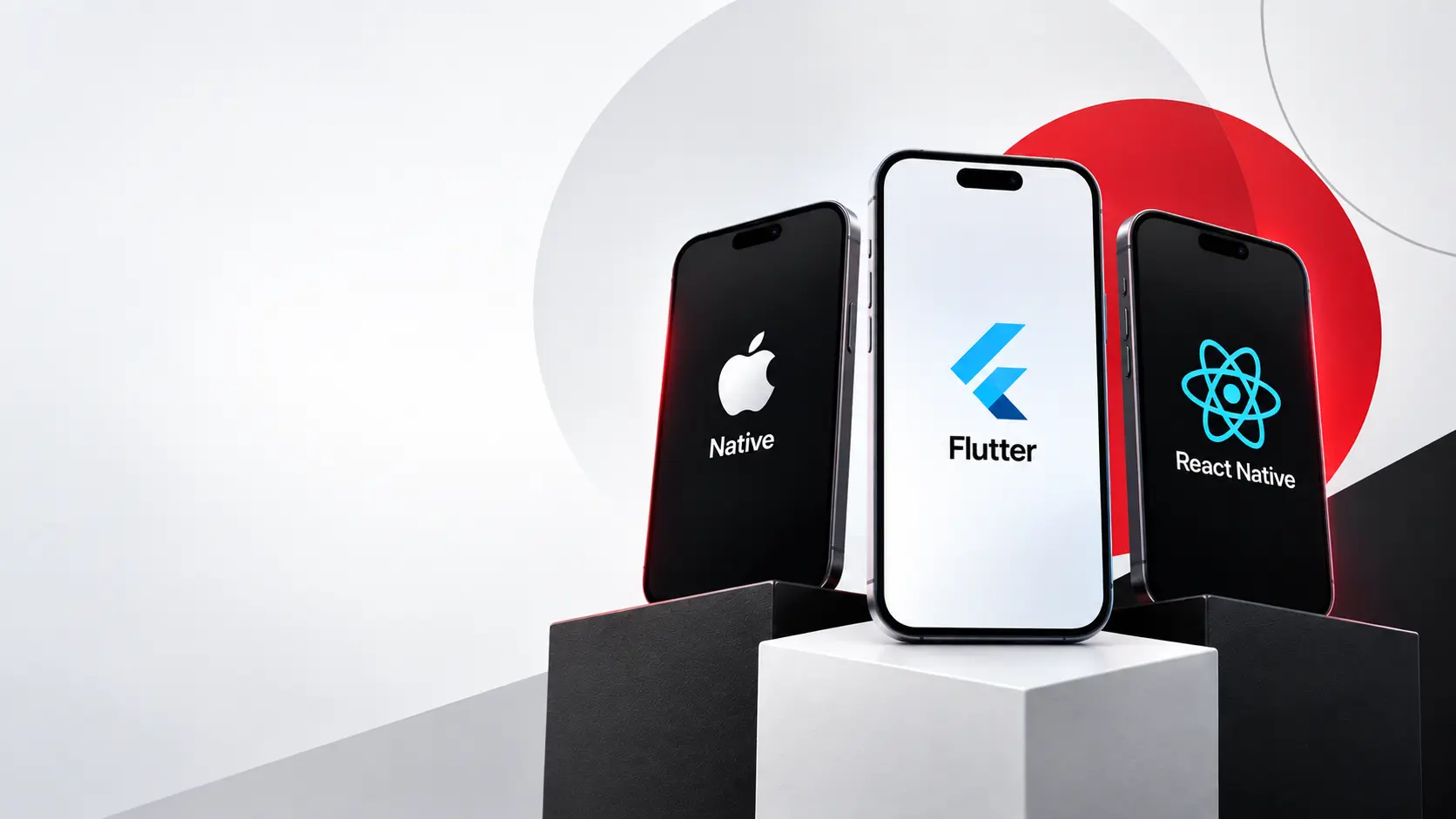
Three options exist for building a mobile app: native, Flutter, or React Native.
Only one of those three answers is stable.
Native has meant roughly the same tradeoff for a decade: full platform control, two separate codebases, two separate teams or skill sets to maintain – one point in the broader native vs. web vs. hybrid mobile app decision that comes before the framework choice even starts.
The other two changed meaningfully in 2026, closing most of the performance gap that used to be the whole argument for choosing between them, and most of what gets written about that shift stops at frame rates instead of the decision it actually changes.
React Native’s New Architecture, built around Fabric, TurboModules, and the Hermes JavaScript engine, removed most of the bridging overhead that used to make React Native visibly slower than native code.
Flutter’s Impeller rendering engine, which replaced the older Skia-based renderer, cut frame rasterization time substantially and gave Flutter more consistent animation performance across devices. Both changes were significant engineering work, and both landed specifically to close the gap that used to be the whole argument for choosing one framework over the other – see our 2023 React Native vs. Flutter comparison for how much of that argument has actually held up since
| For roughly 90% of mobile applications, performance is no longer a meaningful differentiator between the two frameworks. |
| Dimension | Flutter | React Native |
|---|---|---|
|
Complex UI frame rate |
58–60 FPS (Impeller) | ~51 FPS (Fabric) |
|
App startup time |
Baseline | ~200ms faster |
| Battery consumption | Baseline |
~12% less drain |
| Team ramp-up (JS/TS team) | 2–3 weeks to learn Dart |
Productive within days |
None of these differences are imaginary.
They are also not large enough, on their own, to justify picking a framework for a standard business application, an internal tool, or a typical customer-facing app without heavy animation or real-time graphics.
The businesses that actually feel these numbers are the ones building something genuinely performance-sensitive, not the ones building an app to manage appointments or browse a product catalog.
A useful thing to check here: describe the app you are actually building in one sentence, without naming a framework.
If that sentence includes words like gaming, AR, real-time, or hardware, the frame rate difference deserves real weight.
If it describes a fairly standard mobile experience – ordering, scheduling, account management, internal operations – the frame rate difference is very unlikely to be the thing a user notices, let alone the thing that determines whether the app succeeds.
Two native codebases, one for iOS and one for Android, mean two teams or two skill sets, two review cycles, and two places every bug fix and feature has to land.
A shared cross-platform codebase collapses that into one, which is where the commonly cited 30 to 60 percent cost savings over separate native builds actually comes from, not from the framework being inherently cheaper to write in what actually needs to be built, the essential features every mobile app needs, stays the same regardless of framework
That saving compounds over the life of the app: a feature shipped once in Flutter or React Native reaches both platforms immediately, while the same feature in native code is really two features, built and tested twice, on two different schedules with two different sets of edge cases – the same compounding logic behind most mobile app business growth arguments that focus only on launch cost and skip the maintenance math.
The place this cost logic breaks down is exactly where native still wins: once a feature depends on something platform-specific enough that the cross-platform framework needs a custom native bridge to expose it anyway, you are paying for two implementations regardless of which path you started on, just with extra abstraction in between.
Deep hardware integration sounds abstract until it is a specific feature that will not ship on schedule.
Real-time camera frame processing for a custom AR filter, background Bluetooth Low Energy scanning that needs to survive OS-level power management differently on iOS and Android, or NFC payment flows that touch each platform’s secure element directly are the kind of features where a cross-platform bridge either does not expose the native API cleanly or introduces enough latency to matter. For teams building this kind of experience specifically, our guide to augmented reality in mobile app development goes deeper on the AR side
None of this is common in a typical business app. It shows up reliably in health-tech devices pairing with wearables, point-of-sale hardware, and AR-driven retail or gaming experiences – a pattern that lines up closely with which industries actually benefit most from mobile apps, which is why those categories skew native far more often than the broader market does.
Kotlin Multiplatform has been quietly picking up adoption for a narrower, specific job that Flutter and React Native were not built for: sharing business logic across an existing native iOS and Android codebase without replacing either app’s UI layer.
A team with two mature native apps that want to stop maintaining duplicate logic, data models, networking, validation, without a full rewrite, is the actual use case, not a general Flutter or React Native alternative.
It solves a different problem than the cross-platform-from-scratch decision this piece is mostly about, but it is worth knowing about before assuming the only paths forward are native, Flutter, or React Native as complete alternatives to each other.
If your team already works in JavaScript or TypeScript, React Native is productive within days and can share real code with an existing web product.
If you are starting genuinely fresh with no existing stack commitment and the product is visually demanding, brand-driven, animation-heavy, Flutter’s consistency across platforms is a real advantage worth the two to three weeks it takes a team to get comfortable in Dart.
React Native’s ecosystem is also three to five times larger by available packages and hiring pool, which matters more than people initially expect once a project needs to scale a team, not just ship a first version.
Choosing one framework for the entire company is a simplification, not a requirement, and some of the largest mobile products in the world do not do it.
Certain organizations run Flutter for customer-facing apps where visual polish carries real weight, and React Native for internal tools where reusing an existing JavaScript team matters more than a few frames per second.
Treating this as a single, permanent, company-wide decision is usually a choice made for organizational simplicity, not because the technology demands it.
None of this closes the case for native development entirely. Deep hardware integration, wearables, IoT, specialized sensors, augmented or virtual reality, and genuinely extreme performance requirements like real-time gaming still favor native code, since a cross-platform framework’s bridge layer, however narrow the gap has gotten, is still a layer.
This is exactly the split we build around directly: native iOS and Android where performance and platform control are genuinely non-negotiable, and cross-platform development where a shared codebase makes real business sense — whether that’s a mobile app architecture built for scale, modernizing an existing app, an ecommerce app, or infrastructure planned around 5G’s impact on app performance with the choice driven by actual usage and lifecycle needs rather than a default preference for one approach
If you are trying to figure out whether your next app genuinely needs native performance or whether cross-platform would serve it just as well, that is worth a direct conversation before the framework decision gets made by default.

 DevOps, Platform Strategy
Gartner says 80% of large software engineering organizations will have a dedicated platform team by the end of 2026. That stat is everywhere right now. It’s also convinced a wave of 15-person startups that they need an internal developer platform immediately. Most of them are wrong. Here’s why, and how to tell which side of […]
 Build vs. Buy, Platform Strategy, SaaS Development, Thought Leadership
We deal with the clients on a daily basis when they ask us if we should build this or buy it. And trust us this conversation feels like a new decision the first time a business has it. But it rarely is. The same underlying math shows up whether the system in question is a […]
 Higher Education, Platform Strategy, Systems Integration
Ask an IT director at a growing university what breaks when they try to unify their systems, and the answer rarely starts with the software. It starts with a department that will not adopt the new standard, a data-sharing agreement nobody wants to sign, or a budget line that funded the project but not what […]