Drupal 10 End of Life: What to Do Before 9 December 2026
Hem Kant
·
21 Oct, 2026
Key Takeaways
Drupal 10 stops receiving security fixes on 9 December 2026. Your site will not break that day, and that is the problem.
Nothing visible happens. Pages load, forms submit, and editors keep publishing. What changes is that the next serious flaw found in Drupal core will have no patch coming for your version. Sites that go quiet in December tend to resurface in an audit or an incident months later.
This guide covers what the end of life really means and how to find your starting point in ten minutes. It also explains what the upgrade to Drupal 11 involves, and what to do if the date is too close for comfort. We are a Drupal agency, so we have an interest in this work. We will say where the upgrade is small and where it is not.
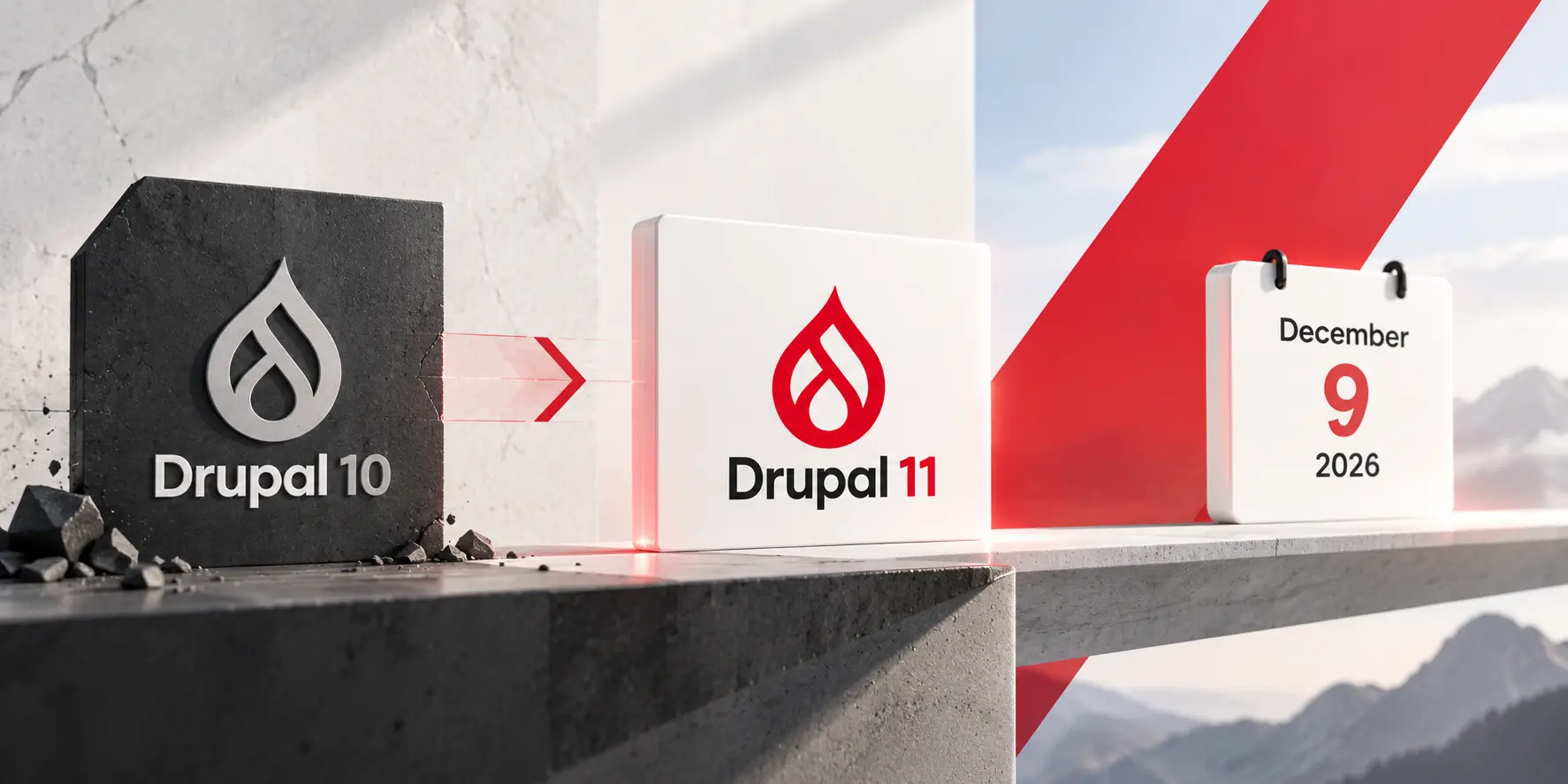
The Drupal core schedule is clear. Drupal 10 reaches end of life on 9 December 2026, and no new Drupal 10 releases follow. As The Drop Times reports from that schedule, 10.6 is the final minor release of Drupal 10, and Drupal 12 is planned for the same December window.
Two details often get missed. First, each minor version has its own, shorter security window. Security support for 10.5.x ended in June 2026, so a site on 10.5 or earlier is already outside the window. Second, you cannot jump past Drupal 11. Drupal 12 is reached through 11, which makes 11 the right target now.
After the date, the risk is practical, not dramatic. New core vulnerabilities go unpatched. Standards that expect supported software, such as PCI DSS, HIPAA, and SOC 2, become harder to defend in an audit. A web application firewall helps, but it does not replace a patch. Pantheon’s end of life explainer covers the same ground, with a hosting vendor’s view.
Open your site’s Status report in the admin area, or run Drush status. Note the exact core version, the PHP version, and the database. Then match yourself to below information.
| Your version | Where You Stand | First Move |
| Drupal 10.6.x | Covered until 9 December 2026 | Run Upgrade Status and plan the move to 11 |
| Drupal 10.4 or 10.5 | Already outside security coverage | Update to 10.6 now as a stopgap |
| Drupal 10.0 to 10.2 | Outside coverage, and below the 10.3 minimum for the upgrade | Update to 10.6 first |
| Drupal 8 or 9 | Unsupported for some time | Move to 10.6, then to 11, testing at each step |
| Drupal 7 | Long unsupported | Treat it as a migration, and aim for Drupal 11 directly |
Either way, the first move is the same. Get an accurate inventory before you promise anyone a date.
The official upgrade guide sets the prerequisites. You need Drupal 10.3 or later, PHP 8.3 or later, and hosting that meets Drupal 11 requirements. You also need Composer and Drush access. Here is the order we follow:
This is why it is not a rebuild. Your content, configuration, and structure stay in place. The work is cleaning code and verifying behavior. Th
Core is usually the easy part. When upgrades run late, the cause is almost always one of four things:
A clean site can finish in a few weeks. A heavily customized one can take months. With about seven weeks left from today, a site in the second group may not make the date, and that is fine if you plan for it.
Some sites will not make it, and that is a business decision, not a failure. Make it on purpose:
For most sites, no. The upgrade is far smaller than a rebuild, and Drupal remains a strong choice for content-heavy, multilingual, or integration-heavy sites. But the deadline is a fair prompt to ask an honest question. If your site is a small brochure that nobody on your team can maintain, a simpler platform might serve you better.
Ask that question after the audit, not before. The inventory in the steps above gives you the facts. Our Drupal migration and upgrade team does this kind of review, and we will tell you if staying is not the right call.
If this were our own site, we would do three things this week and one next. We would check the exact core version. We would ask the host about PHP 8.3 and the database. We would run Upgrade Status and read the full report.
Then we would decide, with real numbers, whether we can reach Drupal 11 by 9 December or need a dated exception. Either answer is acceptable. The only poor answer is not knowing.
Seven weeks is enough for a clean site and tight for a complicated one. The advantage goes to whoever starts with the inventory today.
Send us your status report. Share your site’s Status report page and the list of custom modules. We will tell you which group you are in, how long we think the move to Drupal 11 would take, and what could stop it. Talk to a Drupal Expert →
When does Drupal 10 reach end of life?
Drupal 10 reaches end of life on 9 December 2026. After that date there will be no new Drupal 10 releases and no security advisories for it. Drupal 10.6 is the final minor release, and earlier minor versions have already lost security coverage.
What happens to my site after Drupal 10 ends?
Your site keeps running, but new security flaws in Drupal core will go unpatched. That raises your risk and can cause trouble in audits for standards that expect supported, patched software. Plan to be on Drupal 11 before the date, or document a short, dated exception.
Can I skip Drupal 11 and go straight to Drupal 12?
No. Upgrades move through major versions in order, so Drupal 12 is reached from Drupal 11. Moving to Drupal 11 now also gets you ready for Drupal 12, which is scheduled to arrive in the same December window.
How long does a Drupal 10 to 11 upgrade take?
A clean site on current modules and hosting can take a few weeks. Sites with a lot of custom code, outdated contributed modules, or hosting that needs a PHP and database upgrade can take months. An Upgrade Status scan on day one tells you which group you are in.
What do I need before upgrading to Drupal 11?
You need to be on Drupal 10.3 or later. We suggest 10.6 as the starting point, because it is the last release that still has security coverage. You also need PHP 8.3 or later, hosting that meets Drupal 11 requirements, Composer and Drush access, and compatible versions of your contributed and custom code.
Is upgrading from Drupal 10 to 11 a full rebuild?
No. It is an in-place upgrade of core and code, not a migration to a new site. Your content, configuration, and structure stay. The work is in removing deprecated code, replacing removed modules, and testing. A migration is only needed from Drupal 7 or other platforms.

 Legacy Modernization, Platform Strategy
Key Takeaways Modernization is a set of decisions, not a rewrite. For each system you choose one of five moves: keep, wrap, move, rebuild in slices, or retire. Start with a business reason you can write in one sentence, then map what you have before you touch any code. Change small slices while old and […]
 Platform Strategy
The firm that writes your software owns it, unless your contract says otherwise. That is the starting point under US copyright law for software built by an outside firm, and the Copyright Office’s own guidance explains why. It is easy to miss, because nothing in a pitch, a proposal, or an invoice ever brings it […]
 Digital Transformation, Platform Strategy
Picture the same Tuesday morning, a few months from now. Someone closes a deal in the CRM. The billing record updates itself in the background. Nobody opens a second tab. Nobody retypes a single detail. That is not a fantasy. It is what actually happens once this problem gets fixed, and it is a smaller […]