How We Price Web, CRM, ERP, and HRMS Projects: An Honest Breakdown
LN Webworks
·
15 Sep, 2026
Ask five agencies what a custom software project costs and you will get five variations of it depends. Technically, they are all correct. Practically, it is a useless answer to give someone trying to plan a budget, get a proposal approved, or figure out whether they are even in the right conversation before spending a month on discovery calls.
So here is the actual breakdown: how we think about pricing across web, CRM, ERP, and HRMS projects, what genuinely moves a number up or down, and rough ranges for each category so you can tell early whether you are looking at a ten-thousand-dollar project or a two-hundred-thousand-dollar one.
Nobody can quote your specific project from a blog post; that part really is true. But you can walk away from this knowing which tier you are probably in, and why.
Every estimate starts from the same three questions, regardless of whether the project is a marketing website or an enterprise ERP rollout.
How much of this is genuinely new work versus configuring something that already exists?
How many other systems does it need to talk to, and how clean is the data moving between them?
And how much of the cost is the build itself versus the testing, migration, and change management around it, which on a real project is often the larger share.
From there, most projects fall into one of two pricing models. A fixed quote works when the scope is genuinely well understood before work starts, which tends to be true for smaller, well-defined builds.
Time-and-materials, usually with a not-to-exceed ceiling, fits larger or more exploratory work better, where forcing a fixed number before real discovery has happened usually means the quote is either padded to cover what nobody has scoped yet, or optimistic in a way that will not survive contact with the actual system.
This is also why a modernization readiness assessment exists as its own separate step for larger projects. It is cheaper to spend a few weeks finding out what you are actually dealing with than to find out mid-build that the data migration was three times messier than anyone assumed.
Web project pricing spreads across the widest range of any category here, because “website” covers everything from a five-page marketing site to a platform with its own login system, dashboards, and integrations.
| Tier | What It Typically Includes | Rough Range |
|---|---|---|
| Marketing site | Brand-driven design, CMS, standard pages, basic integrations | $8,000 – $25,000 |
| Custom web application | Custom UI, user accounts, database-backed features, API integrations | $40,000 – $150,000 |
| Enterprise platform | Multi-role permissions, complex integrations, compliance requirements, and high traffic architecture | $150,000 – $500,000+ |
The variable that moves a web project between tiers fastest is usually not design complexity; it is how much custom logic sits behind the pages people see.
A marketing site with a contact form is a different project from one with a portal, a booking system, or content gated behind a login, even if the visual design looks similarly simple.
We go deeper into the specific cost drivers, hosting choices, and build-vs-template tradeoffs in our full website cost breakdown.
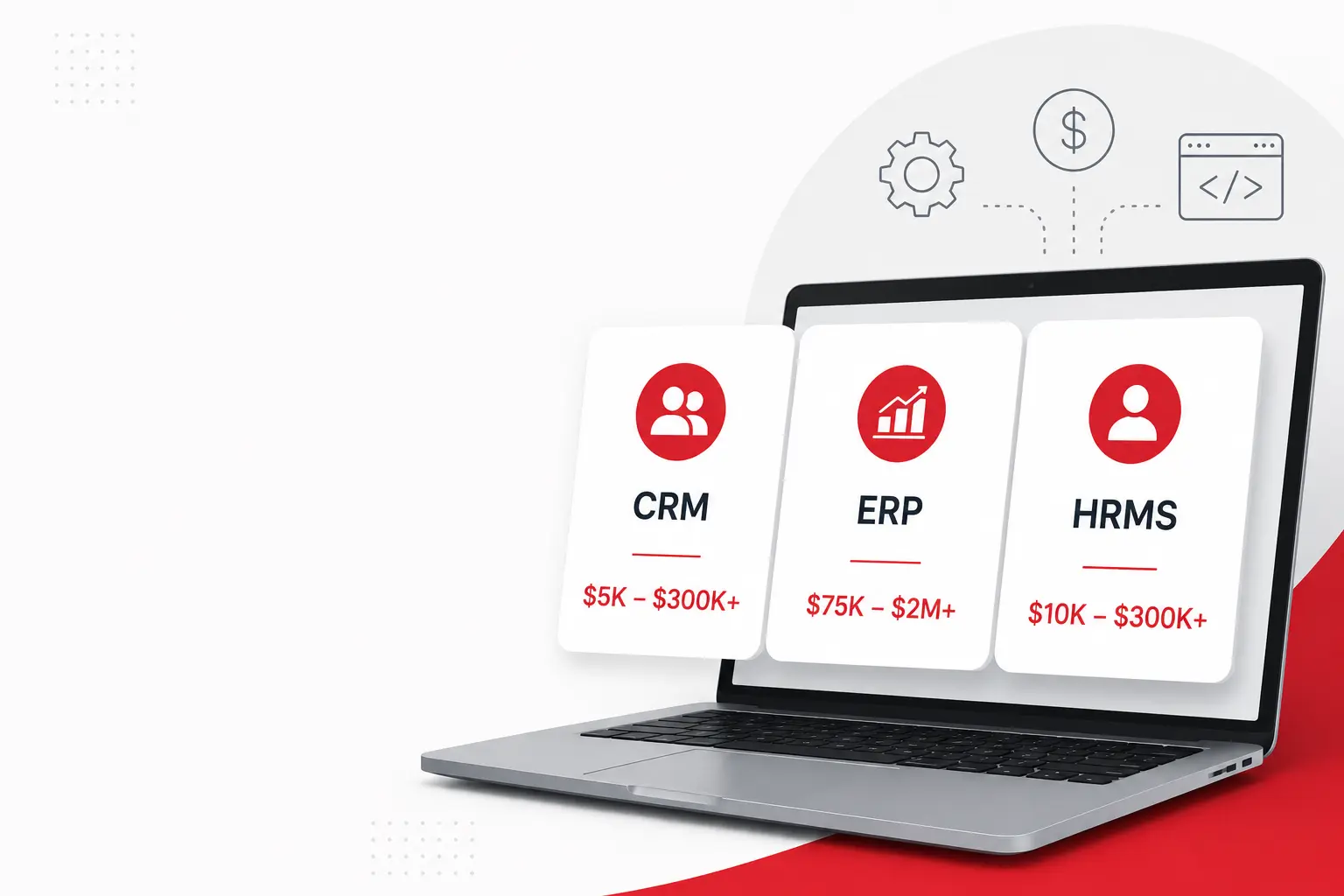
CRM pricing splits cleanly into two very different conversations: configuring an existing platform, or building something custom around a sales or service process that does not fit a generic tool.
| Tier | What It Typically Includes | Rough Range |
|---|---|---|
| Off-the-shelf configuration | Set up custom fields, workflow automation, and basic integrations on an existing CRM platform | $5,000 – $50,000 |
| Custom CRM build | Purpose-built data model, custom workflow engine, deep integration with internal systems | $60,000 – $300,000+ |
Most teams should start by assuming configuration is enough, because it usually is. Custom becomes the right call only when the sales or service process itself is genuinely unusual, not just when the off-the-shelf option feels slightly clunky.
The difference between those two situations is worth its own conversation, which is exactly why it gets a full breakdown on its own.
ERP is where budgets grow fastest, because an ERP system typically touches finance, inventory, procurement, and operations all at once, and every one of those modules has its own data and its own edge cases.
| Tier | What It Typically Includes | Rough Range |
|---|---|---|
| Mid-market implementation | Standard modules, moderate customization, single-entity data migration | $75,000 – $500,000 |
| Enterprise implementation | Multi-entity, multi-currency, heavy customization, complex legacy data migration | $500,000 – $2,000,000+ |
Data migration is almost always the part that breaks an ERP budget, not the software configuration itself. Years of inconsistent data entry, duplicate vendor records, and inventory counts that have never quite matched physical stock all surface the moment someone tries to migrate them into a system that expects clean, structured data.
This is exactly the kind of gap a readiness assessment is meant to catch before a quote gets locked in, an approach we walked through in more detail in what to actually ask a platform partner before signing anything.
Budgeting for the migration and cleanup work separately, rather than folding it into a single number, is usually what keeps an ERP project from running over.
HRMS pricing tends to follow employee count and module complexity more predictably than the other categories here, though compliance requirements can push a small deployment into a much larger scope quickly.
| Tier | What It Typically Includes | Rough Range |
|---|---|---|
| Off-the-shelf configuration | Payroll, attendance, and basic HR workflows on an existing platform | $10,000 – $40,000 |
| Custom HRMS build | Custom compliance logic, multi-region payroll, deep integration with finance and ERP systems | $80,000 – $300,000+ |
Multi-region compliance is the single biggest reason an HRMS project jumps tiers. A company operating payroll and leave policy in one country can usually get by on configuration.
The moment a second country, with a different tax structure, different statutory leave requirements, and different reporting obligations, enters the picture, a purely off-the-shelf setup starts to strain, and custom logic becomes hard to avoid.
Two variables explain most of the spread within every tier above, more than any other factor.
Integration count: Every system a project needs to connect to, whether it is a payment gateway, an existing ERP, a legacy database, or a third-party API, adds real engineering time that rarely shows up clearly in an initial scope conversation.
A project with three integrations and a project with twelve can look identical on a requirements document and cost two to three times apart once the actual work starts. This is the same underlying driver behind what actually moves an AI integration budget, and it holds just as true for CRM, ERP, and HRMS integrations.
Data condition:
Clean, well-structured data moving into a new system is a straightforward migration. Data spread across spreadsheets, duplicated across old systems, or simply undocumented after years of manual entry is a cleanup project wearing a migration’s clothes, and it is almost always underestimated in an initial quote. This is a large part of why we run a readiness assessment before quoting larger projects rather than pricing off a requirements call alone.
Neither of these shows up cleanly in a scope document written before discovery happens. That is precisely why an honest estimate almost always has a range attached to it rather than a single number, and why any quote that arrives suspiciously fast, before anyone has actually looked at your systems, is worth a second look.
None of this means pricing has to stay a mystery until the invoice arrives. It means the honest version of a pricing page is a range plus the reasoning behind it, not a single number designed to look reassuring. If a vendor cannot explain why your project sits where it does in that range, that gap in the explanation is worth asking about directly.
If you want an actual number instead of a range, the fastest way to get one is a real conversation about your specific systems. Book a Discovery Call, and we will tell you honestly which tier you are in.

 Web Development
A customer lands on your site from a search result, ready to buy. Before they can, a banner asks them to download your app. They do not want an app. They want to check out. That single moment of friction, repeated across millions of visits, is the exact problem a progressive web app was built […]
 Web Development
Most advice about Core Web Vitals treats them as a checkbox for search rankings. Fix the score, keep Google happy, move on. That framing misses what these metrics actually connect to, the same narrow lens we pushed back on in what actually changed between SEO and GEO. A handful of real companies have published what […]
 SEO and Content Strategy, Web Development
AI answer engines don’t read your website the way a person does. A person scrolls, skims, and reads things in context. An AI tool pulls out a single sentence or paragraph, often without ever showing your page at all. That difference changes what “good” actually looks like online. Most “AI-ready website” checklists repeat the same […]