How Much Does It Cost to Build a Website in 2026 -2027?
Hem Kant
·
03 Aug, 2026
Ask ten people what a website costs and you’ll get ten different answers, because they’re all technically right. Someone building a landing page in an afternoon on a drag-and-drop builder spent $12. Someone else just signed off on a six-figure platform with a custom CRM integration behind it. Both of those are “a website” in casual conversation, and neither number is useful to you until you know which one you’re actually building.
Here’s the more useful framing: the biggest driver of cost isn’t the software you build it on. It’s who does the work, and how much the site actually needs to do once it’s live.
A website that exists to look professional and list your hours is a fundamentally different project from one that processes payments, manages bookings, or feeds data into three other systems your team already relies on.
Let’s walk through what that looks like at each level, honestly, including the part most quotes leave out.
Every credible 2026 pricing breakdown we cross-checked lands in a similar shape, even with different framing. Here’s the consensus version:
|
Route |
Typical Cost |
Timeline |
Best For |
|
DIY builder |
$0–$1,600 | Days to 2 weeks | Testing an idea, a low-stakes presence, a tight budget, and tech comfort |
|
Freelancer |
$1,500–$8,000 | 2–6 weeks | A standard marketing site, blog, or simple store, custom design without agency overhead |
| Boutique agency | $6,000–$35,000+ | 1–3 months |
A site that drives real revenue needs a strategy, conversion work, or complex integrations |
| Enterprise/custom platform | $50,000–$150,000+ | 3–6+ months |
Deep CRM/ERP integration, high traffic, a platform your whole business runs on |
If you want a rougher gut check than the table above, hire a freelancer if your budget is under $5,000 and your needs are fairly standard.
Hire an agency once your budget clears roughly $7,500 and the site needs to do more than exist; it should drive conversions, integrate with other systems, or withstand real traffic.
The cheapest “agency” tier, around $5,000 to $10,000, is honestly often a one-person shop calling themselves an agency, which isn’t automatically bad, just worth knowing going in, since the pricing alone won’t tell you which one you’re actually talking to.
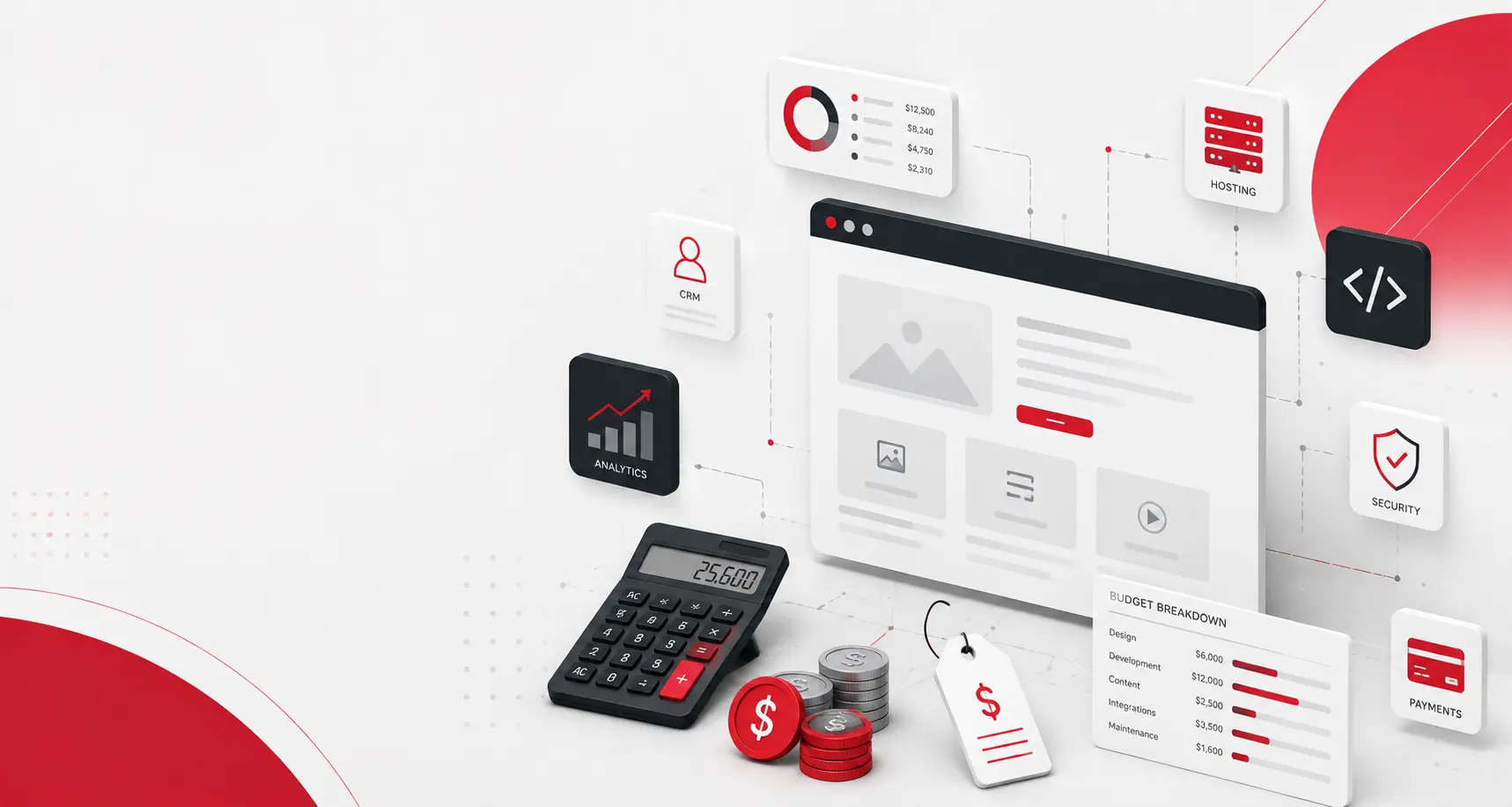
Six line items make up most of what you’re paying for, whichever tier you’re in: design and user experience, development and functionality, content and copywriting, hosting and infrastructure, security, and whatever integrations connect the site to the rest of your business.
DIY tools bundle most of these into a subscription, which is exactly why they feel deceptively cheap upfront. Freelancers and agencies price them out more explicitly, which is why a quote can look more expensive line by line while actually being more transparent about what you’re buying and where your money is going.
Content is the quiet cost most first-time buyers underestimate entirely. Someone has to write the copy, source or shoot the photography, and structure the information so a visitor can actually find what they came for.
A beautifully designed site with thin, generic copy converts worse than a plainer one that actually answers a visitor’s real questions, and that gap shows up in the results, whether or not it showed up in the original budget.
The single biggest jump in price between tiers rarely comes from a prettier design. It comes from integration complexity, connecting a site to a CRM, a payment processor, an inventory system, a booking tool, anything that needs the website and another piece of your business to actually talk to each other reliably.
That’s the same pattern we’ve seen play out in build-versus-buy decisions for CRM tooling specifically: the core product is rarely the expensive part. Making it fit precisely into how your business actually runs is.
The build price is the number everyone quotes you. It’s also, honestly, about half the real number. Budget roughly 15 to 30 percent of your initial build cost every year afterward: hosting, security patches, backups, and routine maintenance.
If you skip planning for accessibility and performance work upfront, expect that to add another 20 to 40 percent on top once it inevitably needs fixing later, which is a near-identical pattern to what we’ve documented for ecommerce platform costs: the sticker price and the real cost are rarely the same conversation.
A concrete example: a $12,000 small business site with modest ongoing support realistically costs $23,000 to $42,000 across three years, once hosting, maintenance, and iteration are counted honestly. Almost nobody budgets for that number at the start. It’s real regardless.
Enterprise and custom-platform pricing isn’t agencies padding a quote for a bigger logo. At that tier, you’re paying for uptime guarantees, security review, load testing under real traffic, and a data architecture that can actually support deep integrations without breaking every time one connected system changes.
Complexity multiplies cost faster than most people expect, not because the underlying technology gets fancier, but because each step up demands more testing, more oversight, and a wider range of real-world situations the system has to handle without falling over.
If your website is genuinely the thing your business runs on, checkout, bookings, a customer portal, not just a digital brochure, that’s the tier where the extra cost is buying real risk reduction, not vanity.
A checkout that fails silently during a traffic spike costs more in lost revenue and damaged trust than the entire premium you paid to prevent it in the first place, which is exactly the kind of tradeoff that’s easy to underweight when you’re staring at a bigger number on a quote.
It’s also worth being honest about where this tier tends to go wrong. The most common failure isn’t underbuilding, it’s overbuilding: paying enterprise prices for capacity and complexity a business doesn’t actually need yet, because “enterprise-grade” sounds safer than admitting the business is still figuring out what it needs.
The right scope matches your actual traffic, actual integration count, and actual risk tolerance today, with room to grow into, not a guess at what you might need in five years.
Most budgeting mistakes at every tier come from the same root cause: underestimating integration complexity and comparing quotes that were never scoped the same way in the first place.
A $5,000 quote and a $15,000 quote for “the same website” are rarely actually the same project once you look closely at what’s included; one might exclude content, the other might exclude a payment integration you assumed was standard.
The fix isn’t finding the cheapest number; it’s getting a scope specific enough that quotes can actually be compared honestly.
A useful test before you sign anything: ask each vendor to walk you through exactly what’s included in their number, line by line, the same six items above. The vague quote that comes back is telling you something, usually that the gaps will surface later, as change orders, after you’ve already committed.
Not sure which tier your business actually needs, or whether that integration you’re picturing is a small add-on or the reason your budget just tripled? That’s exactly the kind of question worth a real conversation before you commit to a number.
The honest answer to “how much does a website cost” was never going to be one number, because it’s really three separate questions: what does the site need to do, who’s the right person or team to build it, and what does it cost to keep running once it’s live. Get clear on those three, in that order, and the number stops being a mystery and starts being a scope decision you can actually make with confidence.
Most people overpay by guessing at the wrong tier, or underpay by ignoring the ongoing cost until it shows up as a surprise. Neither mistake is really about money. Both come from skipping the scoping conversation that would have made the real number obvious from the start.
Not sure which tier your business actually needs, or whether that integration you’re picturing is a small add-on or the reason your budget just tripled? That’s exactly the kind of question worth a real conversation before you commit to a number.
Tell us what the site needs to do, and we’ll tell you honestly what that actually costs, no inflated first quote to negotiate down from.

 SEO and Content Strategy, Web Development
AI answer engines don’t read your website the way a person does. A person scrolls, skims, and reads things in context. An AI tool pulls out a single sentence or paragraph, often without ever showing your page at all. That difference changes what “good” actually looks like online. Most “AI-ready website” checklists repeat the same […]
 AI & Enterprise Strategy, Artificial Intelligence, SaaS Development, Web Development
A year ago, “vibe coding” was a term for weekend prototypes. It is not that anymore. Prompt-to-app platforms have made it possible to describe a working application in plain language and have one generated in minutes, and that capability has moved from novelty to default across a huge share of new software, including a meaningful […]
 Build vs. Buy, Software Development, Web Development
Ask five agencies what a custom software project costs and you will get five variations of it depends. Technically, they are all correct. Practically, it is a useless answer to give someone trying to plan a budget, get a proposal approved, or figure out whether they are even in the right conversation before spending a […]