How Much Does an E-commerce Platform Really Cost?
Hem Kant
·
29 Jul, 2026
Ask most store owners what their platform costs, and they’ll quote the subscription tier. That number is real. It’s also, by most industry estimates, somewhere around 30 percent of what the platform actually costs once everything running on top of it gets counted.
The gap between those two numbers is where budgets quietly break, and it’s rarely because anyone did anything wrong. It’s because platform pricing pages are built to show the smallest true number, not the most useful one.
That gap matters more than a rounding error in a spreadsheet. It’s the difference between a budget that survives contact with reality and one that gets revised twice before the fiscal year is out, usually right after someone finally adds up every app subscription, every processing fee, and every hour of developer time nobody itemized as a platform cost.
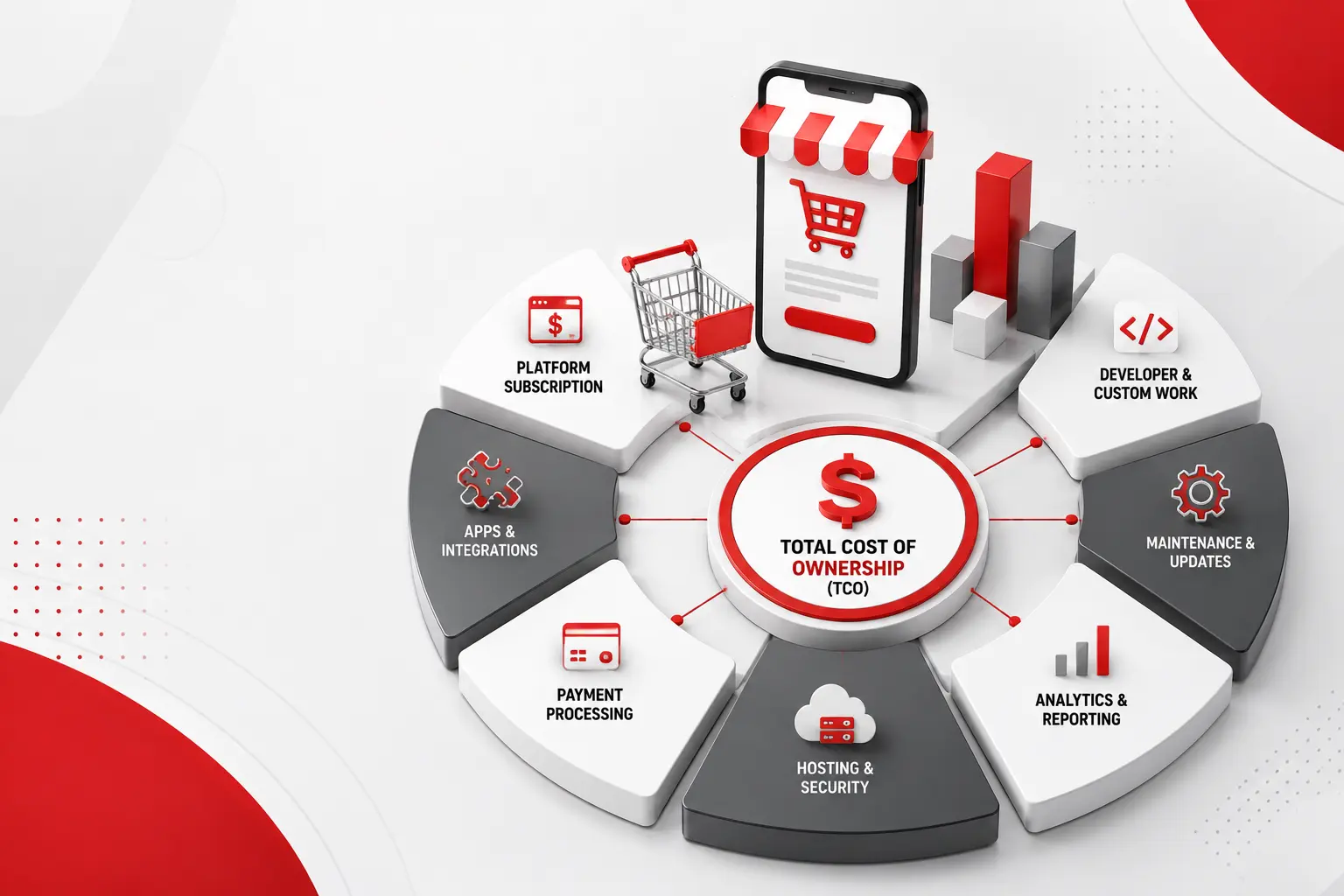
Here’s a representative build-up, not a quote for any specific platform, but the shape of what a modest store’s monthly reality tends to look like once the entry-level plan stops being the only line item:
| Cost Category | What It Covers | Typical Monthly Range |
| Platform subscription | The advertised entry-level plan | $40–$100 |
| Apps & integrations | Reviews, email marketing, upsells, subscriptions, and the features the base plan doesn’t include | $100–$400 |
| Payment processing | The percentage taken on every transaction | Scales with sales |
| Theme & design | A paid theme or ongoing design adjustments | $0–$150 |
| Hosting & security add-ons | SSL, backups, and uptime monitoring were not bundled | $0–$100 |
| Analytics & reporting tools | Reporting beyond the platform’s native dashboard | $0–$300 |
| Realistic monthly total | Before a single ad dollar is spent | $500–$1,500+ |
That’s the small end. Mid-market brands doing several million dollars a year in revenue commonly land in the tens of thousands annually once apps, agencies, and platform fees are combined, and enterprise-tier platforms scale further still, sometimes charging a percentage of revenue on top of a base license once a store crosses certain volume thresholds.
Platforms built on an app-marketplace model solve a real problem: every business is different, and a single core product can’t natively serve a supplement brand and a furniture retailer equally well. Apps let the platform stay lean while still covering the long tail of specific needs. The tradeoff is cost stacking. Each app is individually reasonable, five, twenty, or fifty dollars a month, and collectively they’re most of the real bill.
The same pattern shows up on self-hosted, technically “free” platforms in a different shape: no licensing fee, but hosting, security patching, plugin conflicts, and developer time to keep it all running instead.
Several 2026 platform comparisons put self-hosted and hosted total costs in broadly similar ranges once every category is counted, which is the opposite of what the word “free” implies on a pricing page, and it’s a close cousin of the same claim-versus-reality gap we’ve written about in vendor compliance claims generally: the label rarely matches what verification actually finds.
Worth noting: several of the most-cited our platform is cheaper comparisons are commissioned or published by the platforms themselves. That doesn’t make the underlying pattern, sticker price hides most of the real cost, untrue. It does mean the specific percentage in any single vendor’s favorable comparison deserves the same scrutiny you’d apply to any other vendor claim.
The pattern doesn’t disappear once a store grows past the mid-market range; it just changes shape.
Enterprise-tier platforms commonly shift part of the pricing model from a flat license to a percentage of revenue once a store crosses certain volume thresholds, sometimes around a quarter of a percent of gross sales on top of a base platform fee.
In a large store, that revenue-share component alone can run into six figures annually before a single app or agency invoice gets added. Layer in enterprise hosting, PCI compliance audits, dedicated DevOps support, and agency or in-house development time, and the realistic annual range for a genuinely large operation spans from the tens of thousands into the hundreds of thousands, depending on scale and how much custom work the store requires.
That’s not a criticism of enterprise platforms; at that scale, the additional spend usually buys real capability: dedicated infrastructure, better uptime guarantees, and support responsiveness that a smaller plan doesn’t include.
The point is the same one that applies at the small end: the headline number on a pricing page and the number that actually lands on next year’s budget are different questions, and the gap between them grows, not shrinks, as a store scales.
That’s exactly the kind of gap a real engagement tends to surface early, before it shows up as a budget surprise instead of a plan.
Beyond the categories above, two costs rarely make it into a TCO conversation. The first is developer and agency time spent maintaining the stack, patching plugin conflicts, troubleshooting a broken integration during a sale, and updating a theme after a platform change breaks it. That time is real; it’s usually absorbed into someone’s existing workload rather than itemized as a platform cost, which makes it invisible in budget conversations even though it’s genuinely part of what the platform costs to run.
The second is the cost of the workarounds we described in the companion piece to this one: the four signs a platform has become the actual bottleneck. A slow release cycle, integrations held together with custom middleware, and manual reporting reconciliation are all costs; they just show up as staff time and missed opportunity instead of a line item on an invoice, which is exactly why they’re easy to underestimate.
A useful Total Cost Of Ownership model covers three time horizons, not just this month’s bill.
One-time costs: migration, initial theme and setup, and developer onboarding.
Ongoing costs: the recurring stack above, platform fees, apps, payment processing, hosting, and support.
And change costs: what it costs every time you add a new sales channel, expand into a new market, or need a checkout customization that the platform doesn’t support natively.
Most budget conversations only account for the second category, which is why the number that gets planned around is so often wrong by the time a full year has passed.
The most useful exercise isn’t finding the cheapest platform on paper. It’s building an honest three-year total across all three categories for the platform you’re actually running, or actually considering, and comparing that number to what the switching cost would be to move somewhere else. Most of the value in a TCO exercise comes from that comparison, not from the sticker price on any single line.
Once a store actually models its full stack, the biggest opportunities rarely turn out to be negotiating a better platform rate. They’re in the app layer: overlapping tools bought at different points by different people, each solving a problem the platform’s native features have since caught up to, still being paid for out of habit. A reporting app nobody’s opened in months. Two different tools are handling roughly the same job because nobody consolidated after the second one was added. Auditing the app stack specifically, not the platform contract, is usually where the fastest, least disruptive savings live.
The second-biggest opportunity is the invisible cost: developer and support time spent on recurring, avoidable friction, the same workaround integrations and manual reconciliation described earlier. That cost doesn’t show up on an invoice, which is exactly why it survives budget reviews that only look at line items with a dollar sign attached. Counting it honestly, even as a rough estimate of hours times a loaded hourly rate, usually reveals it’s larger than any single app subscription on the list.
If you don’t have a clear picture of what your current platform is actually costing you across app fees, workaround maintenance, and the staff time absorbed by both, that’s exactly the kind of gap a Modernization Readiness Audit surfaces alongside the technical risk picture, in two weeks.
If you want to talk directly with our team, schedule a call today!

 DevOps, Platform Strategy
Gartner says 80% of large software engineering organizations will have a dedicated platform team by the end of 2026. That stat is everywhere right now. It’s also convinced a wave of 15-person startups that they need an internal developer platform immediately. Most of them are wrong. Here’s why, and how to tell which side of […]
 Mobile Development, Platform Strategy
Three options exist for building a mobile app: native, Flutter, or React Native. Only one of those three answers is stable. Native has meant roughly the same tradeoff for a decade: full platform control, two separate codebases, two separate teams or skill sets to maintain – one point in the broader native vs. web vs. […]
 Build vs. Buy, Platform Strategy, SaaS Development, Thought Leadership
We deal with the clients on a daily basis when they ask us if we should build this or buy it. And trust us this conversation feels like a new decision the first time a business has it. But it rarely is. The same underlying math shows up whether the system in question is a […]