Custom Software vs. Low-Code vs. SaaS: How Do You Actually Decide?
 gagan kumar
·
28 Sep, 2026
gagan kumar
·
28 Sep, 2026
gagan kumar
·
28 Sep, 2026
gagan kumar
·
28 Sep, 2026
We deal with the clients on a daily basis when they ask us if we should build this or buy it.
And trust us this conversation feels like a new decision the first time a business has it. But it rarely is.
The same underlying math shows up whether the system in question is a CRM, an ERP, a CMS, or an ecommerce platform, and once you see the pattern once, the next four times it comes up stop feeling like separate discussion and start feeling like the same question in different clothes.
This is that pattern, stated in layman, with the real numbers behind it.
|
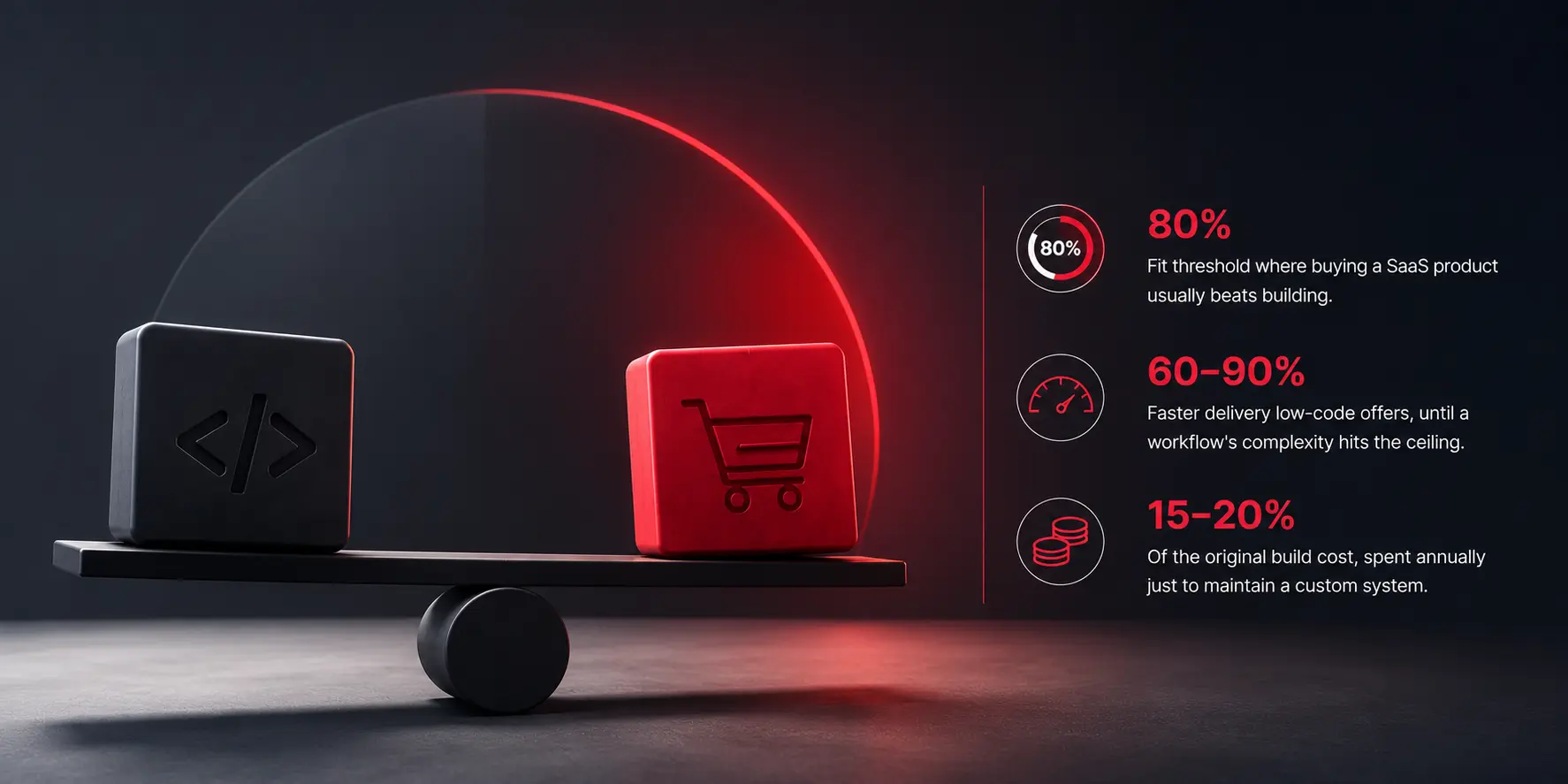
80% fit threshold where buying a SaaS product usually beats building, even after accounting for the remaining gap |
60–90% faster delivery low-code offers, until a workflow’s complexity pushes past what it was built to handle |
15–20% of the original build cost, spent annually just to maintain a custom system after launch |
If an existing SaaS product already covers roughly 80% or more of what your process actually needs, buying and configuring it beats building almost every time, even once you account for the friction of adapting to the remaining gap.
Below that threshold, the math starts to flip: the cost of customizing, working around, and eventually fighting a platform that was never built for your specific process can exceed what a purpose-built system would have cost from the start.
This is the exact logic behind custom CRM versus off-the-shelf SaaS CRM, ERP versus custom-built systems, and the same CMS vs. custom platform decision. The platform is rarely wrong in the abstract, it is wrong for a specific process it was never designed to represent.
Low-code sits in the middle, and it is frequently misunderstood as a cheaper version of custom, much like the web development myths that push teams toward the wrong option rather than what it actually is: a different tool for a different shape of problem. If you’re comparing options, our breakdown of low-code platforms for application building and the best low-code/no-code platforms covers where each one fits best.
For workflows that fit its model, forms, approvals, standard business logic, low-code genuinely delivers sixty to ninety percent faster than traditional development.
That advantage narrows quickly once a workflow’s logic gets complex enough to strain the platform’s built-in constraints, at which point teams sometimes find themselves fighting the low-code platform’s limitations for longer than a custom build would have taken in the first place.
Low-code is the right tool when the process is genuinely standard and speed matters most. It is the wrong tool when the process is the thing that makes the business different.
The same buy-vs-build logic shows up in content platforms too. Whether you’re comparing the 15 best CMS platforms, choosing between a headless CMS and a traditional CMS, or deciding what type of CMS is right for your business, and even WordPress vs. a custom CMS for a growing publisher, all come down to the same 80% fit question.
And once a CMS is chosen, the follow-up decision is usually a page builder vs. a layout builder, or which of the best WordPress page builders actually fits the team’s workflow.
Custom software wins when the workflow is genuinely unusual, but it wins at a real, ongoing price that rarely gets budgeted honestly upfront.
A reasonable planning figure is fifteen to twenty percent of the original build cost every year just to keep the system maintained, and that figure often excludes the less visible costs: security patching, the institutional knowledge that walks out the door when a key engineer leaves (one reason some teams turn to IT outsourcing services), and the technical debt that accumulates quietly until someone finally has to address it all at once.
Organizations that skip this accounting frequently find the real three-year cost of a custom system running two to three times the original estimate, the same pattern we described in how we price web, CRM, ERP, and HRMS projects.
The most common failure is not choosing the wrong option. It is skipping the comparison entirely, without first understanding the types of software development available, and defaulting straight to custom because it promises control and flexibility, without first checking whether a SaaS platform or a low-code build would have covered the actual requirement.
A well-documented pattern shows up repeatedly: a team discovers mid-project that a significant share of the budget, sometimes as much as forty percent, went toward building basic infrastructure, such as subscription and paywall infrastructure, that a platform would have provided from day one. The same trap we unpack in proprietary vs. open-source platforms, where the “control” of proprietary tools often costs more than it delivers.
| ASK THESE THREE QUESTIONS, IN ORDER
1. Does an existing platform already cover roughly 80% of the actual requirement? If yes, buy and configure. The remaining 20% is almost always cheaper to work around than to justify a full build. 2. Is the gap a standard workflow, or something genuinely unique to how this business operates? Standard gaps point toward low-code. A genuinely unique core process points toward custom. 3. Does the business have the capacity to own a custom system for years, not just build it once? If not, the platform’s community and documentation are worth more than the control a custom build offers. |
Run this filter honestly, and most systems land somewhere other than a full custom build, which is exactly why most of the pieces referenced above ended in a hybrid: buy or configure the commodity layer, build only the piece that is genuinely different.
|
Path |
Best Fit |
Real Cost Driver |
|---|---|---|
| SaaS | Process matches ~80%+ of the platform’s default model | Subscription cost, scales with usage |
| Low-code | Standard workflow, speed matters most | Development speed, until complexity hits a ceiling |
| Custom | Genuinely unique core process | 15–20% of build cost annually, ongoing |
None of this is a one-time decision, either.
The right answer for a ten-person team is frequently the wrong answer for two hundred people, and the reverse holds just as often when a business needs to move from generic to genuinely differentiated.
Treating this as something decided once and never revisited is how a platform that was the right call five years ago quietly becomes the thing holding the business back today.
If you are running this comparison right now for a specific system, we are glad to help you run the filter honestly rather than defaulting to whichever option sounds more impressive.
Book a Discovery Call and we will guide you accordingly.
 Platform Strategy, Web Development
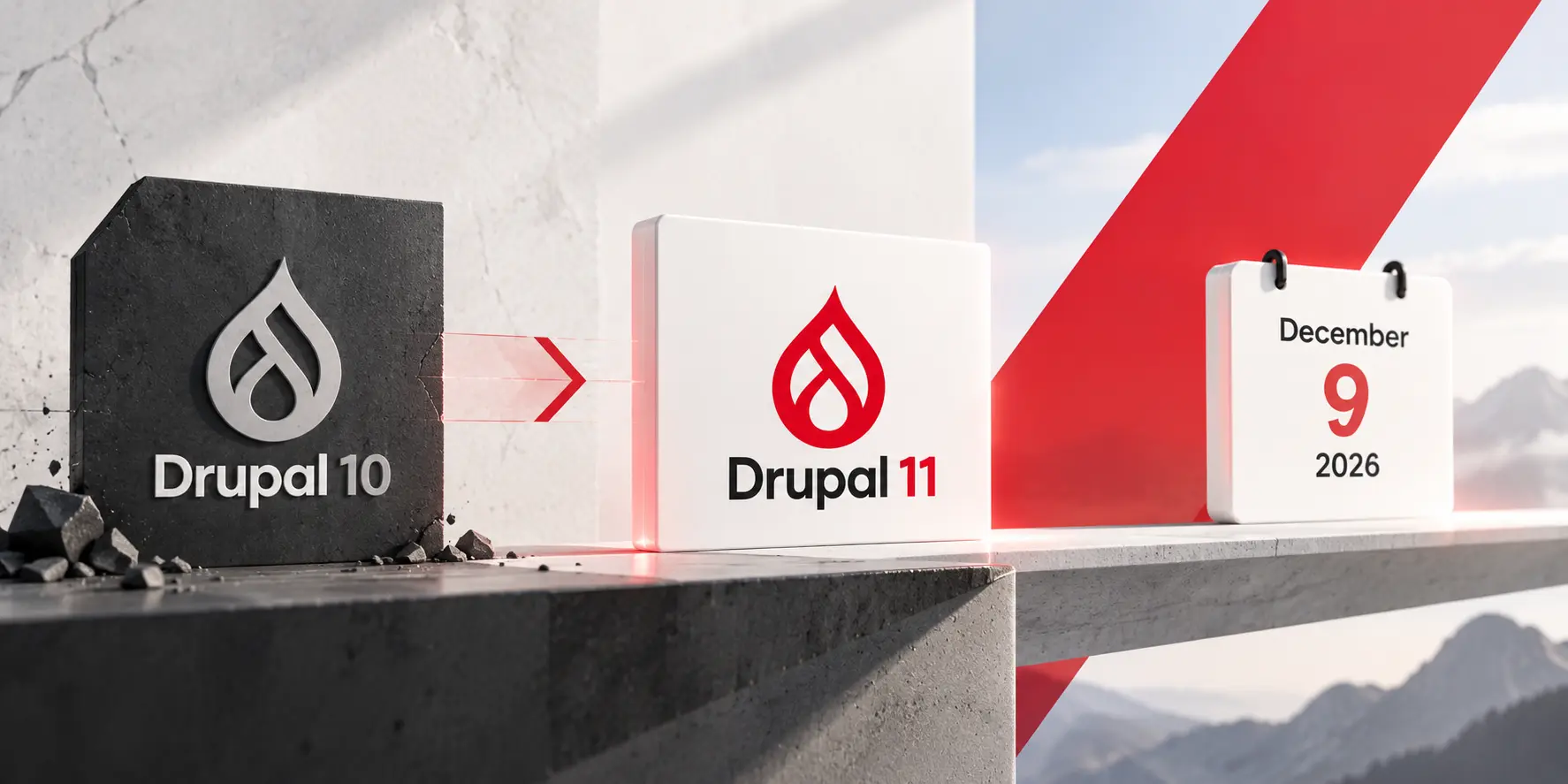
Key Takeaways Drupal 10 reaches end of life on 9 December 2026. After that, core gets no new releases and no security advisories. Check your minor version today. Drupal 10.6 is the last release, and earlier minor versions have already lost security coverage. The move from 10 to 11 is an in-place upgrade, not a […]
 Legacy Modernization, Platform Strategy
Key Takeaways Modernization is a set of decisions, not a rewrite. For each system you choose one of five moves: keep, wrap, move, rebuild in slices, or retire. Start with a business reason you can write in one sentence, then map what you have before you touch any code. Change small slices while old and […]
 Platform Strategy
The firm that writes your software owns it, unless your contract says otherwise. That is the starting point under US copyright law for software built by an outside firm, and the Copyright Office’s own guidance explains why. It is easy to miss, because nothing in a pitch, a proposal, or an invoice ever brings it […]