What Are the Signs Your E-commerce Platform Has Become the Bottleneck?

Hem Kant
·
24 Jul, 2026
Growth is supposed to make things easier: more revenue, more data, more leverage to negotiate better terms with vendors.
For many e-commerce teams, growth has the opposite effect on the platform underneath it. The same system that handled year one without complaint starts fighting back at year three, not because anything has broken, but because everything has become heavier.
The hard part is that this shift rarely calls itself. It shows up as four separate, individually excusable annoyances until the day someone adds them up and realizes the platform, not the business, is setting the pace now.
None of these four signs looks alarming in isolation, which is exactly why they usually go unaddressed for so long. Each one has a reasonable-sounding excuse attached to it: the team is short-staffed this quarter, that integration was always going to be a little messy, and checkout is complicated by nature.
Individually, those excuses are often true. Collectively, they’re a pattern worth naming honestly instead of explaining away one at a time.
Every platform slows down a little as it matures; that’s normal. The bottleneck version is different: a genuinely simple change, a new discount rule, a product page tweak, a shipping calculation update, now requires touching four different places in the codebase to avoid breaking something unrelated.
Nobody planned for that. It accumulated one workaround at a time, the same way unsequenced changes compound into a platform nobody wants to touch, and now it’s the default cost of doing anything.
A healthy platform treats a new tool, a loyalty app, a new payment method, a marketplace channel, as a connection: define the data that needs to move, build the link, and done.
A bottlenecked one treats it as a project: custom middleware, a sync job someone has to babysit, a spreadsheet bridging two systems that should talk to each other directly.
If your last three integrations each needed their own workaround instead of following the same clean pattern, that’s not bad luck. That’s the platform telling you it wasn’t built to be extended this way.
This is the sign teams notice last, because it shows up as caution, which looks responsible, not as a red flag. But there’s a real difference between “we’re careful with checkout because it’s important” and “we’re afraid of checkout because we don’t fully understand what a change will break.”
The second one means institutional knowledge has outpaced documentation, and every change now comes with informal, unspoken testing rituals that exist because someone got burned once and nobody wants to repeat it, the same instinct we described in why teams get burned by partners who never diagnosed the real problem in the first place.
Revenue in the platform doesn’t match revenue in the finance system. Inventory counts drift between the storefront and the warehouse tool. Someone on the team has become the unofficial translator who knows which number to trust and why, and that knowledge lives in their head, not in the systems.
When getting a straight answer to “how did we do this month” requires a person instead of a report, the platform has stopped being a reliable source of truth, exactly the kind of gap a real technical audit is built to catalogue and rank, not just a general everything feels slow complaint.
A quick gut check: if you recognized one of these, it’s worth a look. If you recognized three or four, they’re very likely connected, symptoms of the same underlying architecture problem showing up in different departments, not four unrelated issues to fix separately.
They map to the four things a commerce platform actually has to do well: ship changes, connect to other systems, handle the transactions that make money, and tell you the truth about what happened.
When all four degrade at once, it’s rarely because four different things broke. It’s usually one thing: the platform’s underlying architecture was built for a smaller, simpler version of the business than the one running on it today.
There’s a temptation to treat each of these as manageable in isolation. A slow release cycle is annoying but survivable. One more workaround integration is fine; you’ll clean it up later.
That temptation is exactly how platforms end up carrying all four signs at once instead of catching the pattern at two. Each instance is genuinely tolerable. The compounding effect across a year of them isn’t.
The actual cost isn’t abstract. Slower releases mean competitors ship features first. Workaround integrations mean more things that can silently break during a peak sales period. A team afraid of checkout means slower incident response when something does go wrong. And numbers that require manual reconciliation mean decisions get made on stale or wrong data.
None of that shows up as a single dramatic failure. It shows up as a business that’s persistently a step slower than it should be, for reasons that are hard to point to individually, which is exactly why they’re worth naming explicitly instead of accepting as background noise.
These four signs are tolerable most of the year precisely because most of the year doesn’t test them. Peak season does. Traffic spikes expose the workaround integrations that were never load-tested under real pressure. Promotional pricing changes hit the same slow-release process that everyone else’s roadmap is already competing for.
The team that’s cautious about touching checkout is now under pressure to touch it anyway, fast, with less time to be careful. And the reporting gap that’s a minor annoyance in March becomes a serious problem in November, when leadership needs accurate, real-time numbers to make inventory and marketing decisions, not a reconciled report that arrives two days later.
This is why the signs are worth addressing on a schedule you control, months before peak season, rather than discovering the full extent of them during the highest-stakes weeks of the year.
A platform that’s merely inconvenient in June can become genuinely costly in November, at the exact moment recovering from a mistake is most expensive. And that’s why replatform ecommerce site is a way forward, but only considering what’s breaking in the existing one.
Recognizing the signs is the easy part. The harder, more useful step is figuring out whether they trace back to one architectural root cause or several unrelated ones, and which of the four is actually costing the business the most before you commit budget to fixing any of them. That’s a scoping question, and it’s not one a checklist can answer on its own; it requires actually looking at the platform.
It also requires resisting the instinct to fix the loudest symptom first. The sign that generates the most internal complaints, usually the slow release cycle, isn’t always the one costing the business the most money.
A reporting gap that quietly leads to a few thousand dollars in overstocked or understocked inventory every month can easily outweigh the frustration of a development team that’s merely annoyed. Sequencing the fix correctly depends on evidence, not on whichever problem is currently the squeakiest wheel internally.
A Modernization Readiness Audit is built for exactly this moment: mapping which of these four patterns you’re actually carrying, how they connect, and what sequence of fixes addresses the root cause instead of patching each symptom separately. If you want to understand what that audit actually delivers before booking one, we’ve written the full breakdown here.

 DevOps, Platform Strategy
Gartner says 80% of large software engineering organizations will have a dedicated platform team by the end of 2026. That stat is everywhere right now. It’s also convinced a wave of 15-person startups that they need an internal developer platform immediately. Most of them are wrong. Here’s why, and how to tell which side of […]
 Mobile Development, Platform Strategy
Three options exist for building a mobile app: native, Flutter, or React Native. Only one of those three answers is stable. Native has meant roughly the same tradeoff for a decade: full platform control, two separate codebases, two separate teams or skill sets to maintain – one point in the broader native vs. web vs. […]
 Build vs. Buy, Platform Strategy, SaaS Development, Thought Leadership
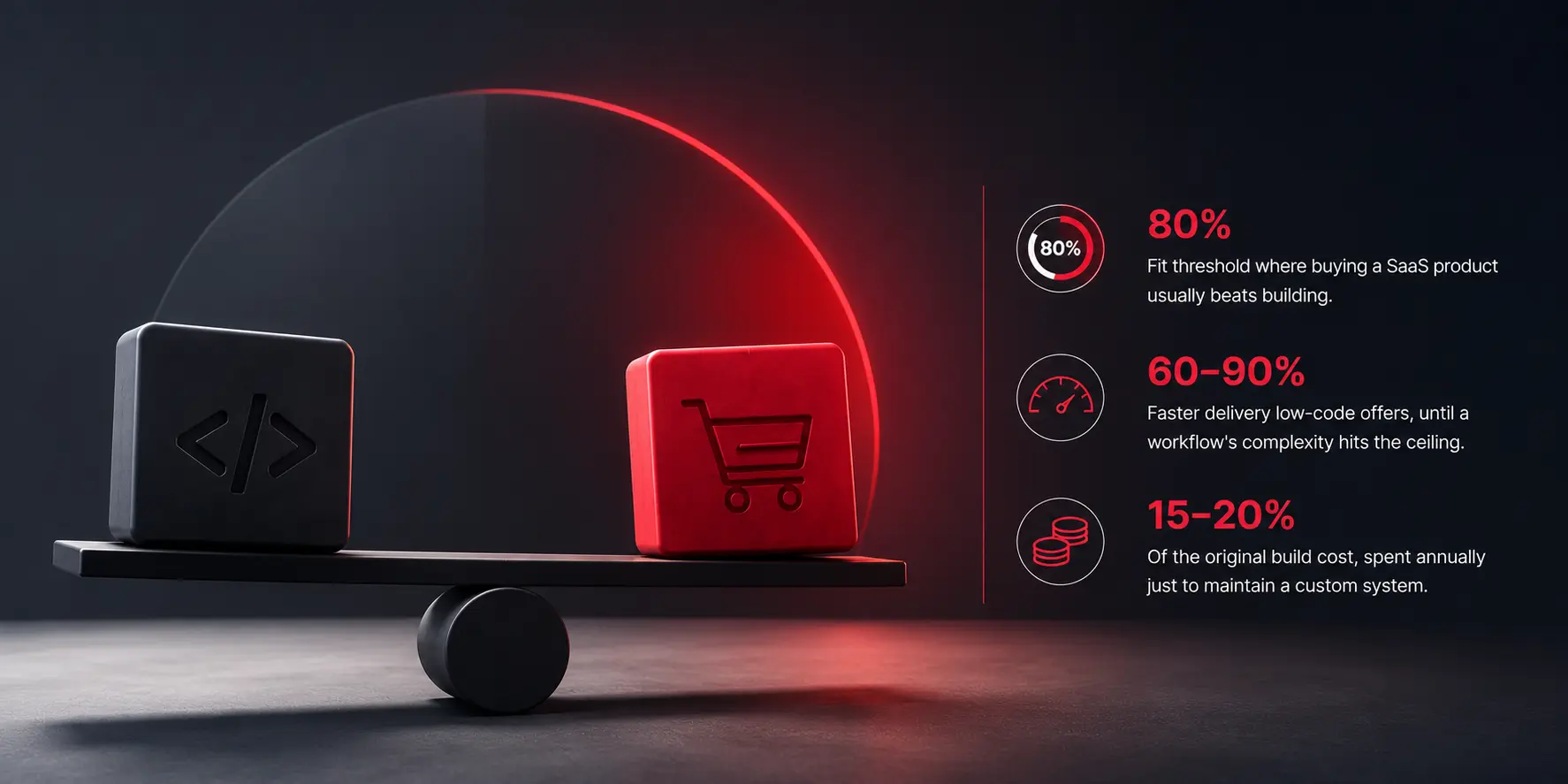
We deal with the clients on a daily basis when they ask us if we should build this or buy it. And trust us this conversation feels like a new decision the first time a business has it. But it rarely is. The same underlying math shows up whether the system in question is a […]