Do Core Web Vitals Actually Affect Revenue?
Hem Kant
·
24 Sep, 2026
Most advice about Core Web Vitals treats them as a checkbox for search rankings.
Fix the score, keep Google happy, move on.
That framing misses what these metrics actually connect to, the same narrow lens we pushed back on in what actually changed between SEO and GEO. A handful of real companies have published what happened to their actual revenue after fixing them. The numbers are specific enough to change how seriously this deserves to be taken.
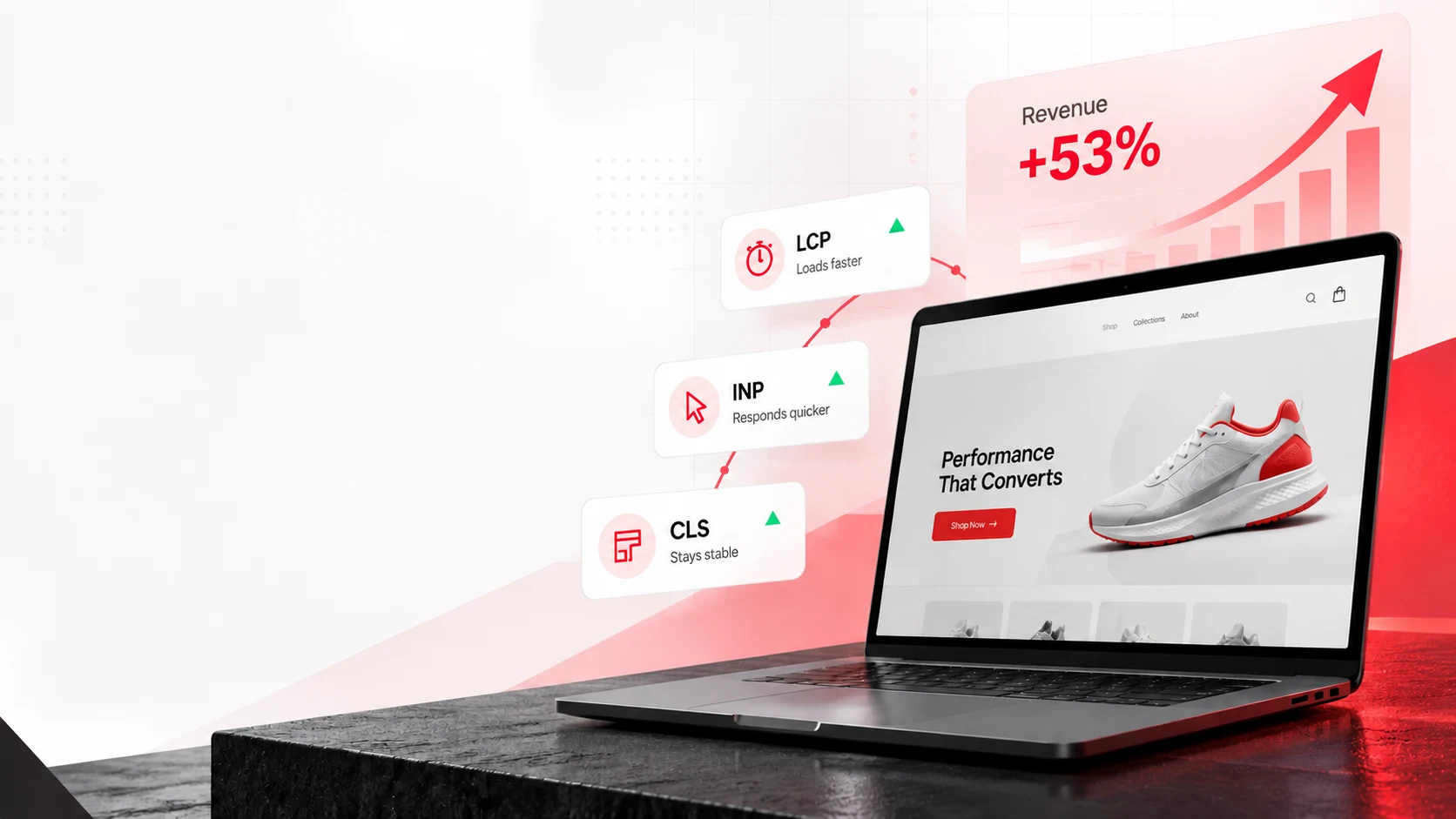
Largest Contentful Paint, or LCP, measures how quickly the main visible content on a page loads. Usually that means a hero image or the main heading. It reflects whether a visitor feels like the page has actually shown up.
Interaction to Next Paint, or INP, measures how quickly a page responds once someone clicks or taps something. A page that looks loaded but freezes when tapped fails this one. It can fail even if it scores well on LCP.
Cumulative Layout Shift, or CLS, measures whether things on the page jump around while it loads. A button that shifts right as a visitor tries to tap it is a CLS failure. Anyone who has tried to close an ad on a news site, only to have the page jump and tap something else instead, has felt exactly what this metric is trying to catch.
|
Company |
What They Fixed | Measured Result |
| Improved LCP | 53% increase in revenue per visitor, 33% increase in conversion rate | |
| Improved LCP by 31% |
8% increase in sales |
|
| RedBus | Improved INP |
7% increase in sales |
| Ray-Ban | Prerendered key pages |
101% increase in mobile product page conversions |
These are not projections or industry averages. They are individual, published results from Google’s own case study archive. Each one is tied to one specific technical change, not a full website overhaul. That specificity matters. Each result can be traced back to a single, identifiable fix, not a vague bundle of “we redesigned everything.”
Search for page speed statistics and you will find a wide spread. Some sources say every second of delay costs 7% in conversions. Others say every 100 milliseconds costs 1%. Others cite entirely different figures for mobile versus desktop, or retail versus travel.
That honesty matters more than picking the single most dramatic number to repeat. The direction is consistent across every credible source. Speed and conversion move together. The exact size of the effect depends heavily on your specific site, audience, and starting point. That is exactly why the four company case studies above are more useful than any single industry-wide average. They show a real, specific before and after, not an aggregate guess.
Only about a third of websites currently pass all three Core Web Vitals at once. That is up from roughly a fifth just a few years ago.
Progress is real, but slow. Broken down individually, the pass rates are uneven. CLS and INP are passed by a comfortable majority of sites. LCP is the weak point. Barely more than half of sites clear that bar on its own.
That pattern shows up consistently across the web. Whatever is slowing a page down enough to fail LCP tends to be the harder problem to fix. Usually it is an unoptimized hero image, a script blocking the page from responding, or a slow server response. These are exactly the problems most sites have not gotten around to yet.
Desktop pass rates for all three metrics together sit noticeably higher than mobile pass rates. That gap matters more than it might first appear. Mobile now accounts for the clear majority of ecommerce traffic in most industries. A site optimized well for desktop and poorly for mobile is optimized for the smaller half of its actual audience.
One nuance gets lost in most performance advice. Excellent Core Web Vitals will not rescue thin, unhelpful content. Poor Core Web Vitals will hold back genuinely strong content. Neither one substitutes for the other.
This is the same relationship we described from the content side in 10 things every website needs in the AI era. Technical performance and content quality are not competing priorities. A fast page with nothing useful on it converts poorly. A genuinely useful page that takes eight seconds to load loses most of its audience before they ever see it.
Before assuming any of this applies, or does not apply, to a specific site, it is worth actually checking.
Google’s own PageSpeed Insights tool is free and shows real, field-collected data from actual visitors, not just a lab simulation.
It breaks results down by mobile and desktop separately, which matters given how differently the two often perform.
A site with no historical data yet will only see lab results at first, an estimate rather than real visitor behavior. That is still useful as a starting point. Real field data builds up over time as enough visitors load the page for Google to report a reliable average.
If a site is already failing Core Web Vitals, the fix rarely requires a full rebuild. It usually means a focused pass on the specific bottleneck, an oversized hero image, a script blocking the main thread, or layout elements that load in the wrong order.
This is the same kind of underlying technical debt we discussed from a different angle in why new websites often convert worse than the ones they replaced, where visual polish and actual performance quietly pull in opposite directions if nobody is watching both.
Treating this as a one-time cleanup rather than an ongoing discipline is the most common mistake. A site that passes today can slip back within months as new images, scripts, and features get added without anyone checking the impact.
If your site’s Core Web Vitals have never actually been audited against real user data, that is a fast, concrete thing to check before investing in anything bigger.
We run this exact audit as part of our web development work, and it often surfaces a smaller, cheaper fix than people expect.

 SEO and Content Strategy, Web Development
AI answer engines don’t read your website the way a person does. A person scrolls, skims, and reads things in context. An AI tool pulls out a single sentence or paragraph, often without ever showing your page at all. That difference changes what “good” actually looks like online. Most “AI-ready website” checklists repeat the same […]
 AI & Enterprise Strategy, Artificial Intelligence, SaaS Development, Web Development
A year ago, “vibe coding” was a term for weekend prototypes. It is not that anymore. Prompt-to-app platforms have made it possible to describe a working application in plain language and have one generated in minutes, and that capability has moved from novelty to default across a huge share of new software, including a meaningful […]
 Build vs. Buy, Software Development, Web Development
Ask five agencies what a custom software project costs and you will get five variations of it depends. Technically, they are all correct. Practically, it is a useless answer to give someone trying to plan a budget, get a proposal approved, or figure out whether they are even in the right conversation before spending a […]