Key Takeaways
Every agency says it uses AI now. That makes the phrase useless as a filter, because it covers everything from a team that rebuilt its workflow around AI to a team that pasted a chatbot into its proposal template.
If you are choosing an AI-enabled digital marketing agency, your job is to find out which one you are talking to before you sign.
This guide shows you how to choose an AI marketing agency that earns the label: what the term should mean, what should change compared with a traditional agency, six checks to run, the questions to ask in the pitch, and a pilot that lets the work prove itself.
There is no standard for it. No certification exists, and no test. So the label tells you what an agency wants to be called, not what it does.
A practical definition works better. An AI-enabled agency uses AI inside its everyday work: reading performance data, drafting variants, running tests, and building reports. People still own the strategy, the brand voice, and every decision that reaches the public.
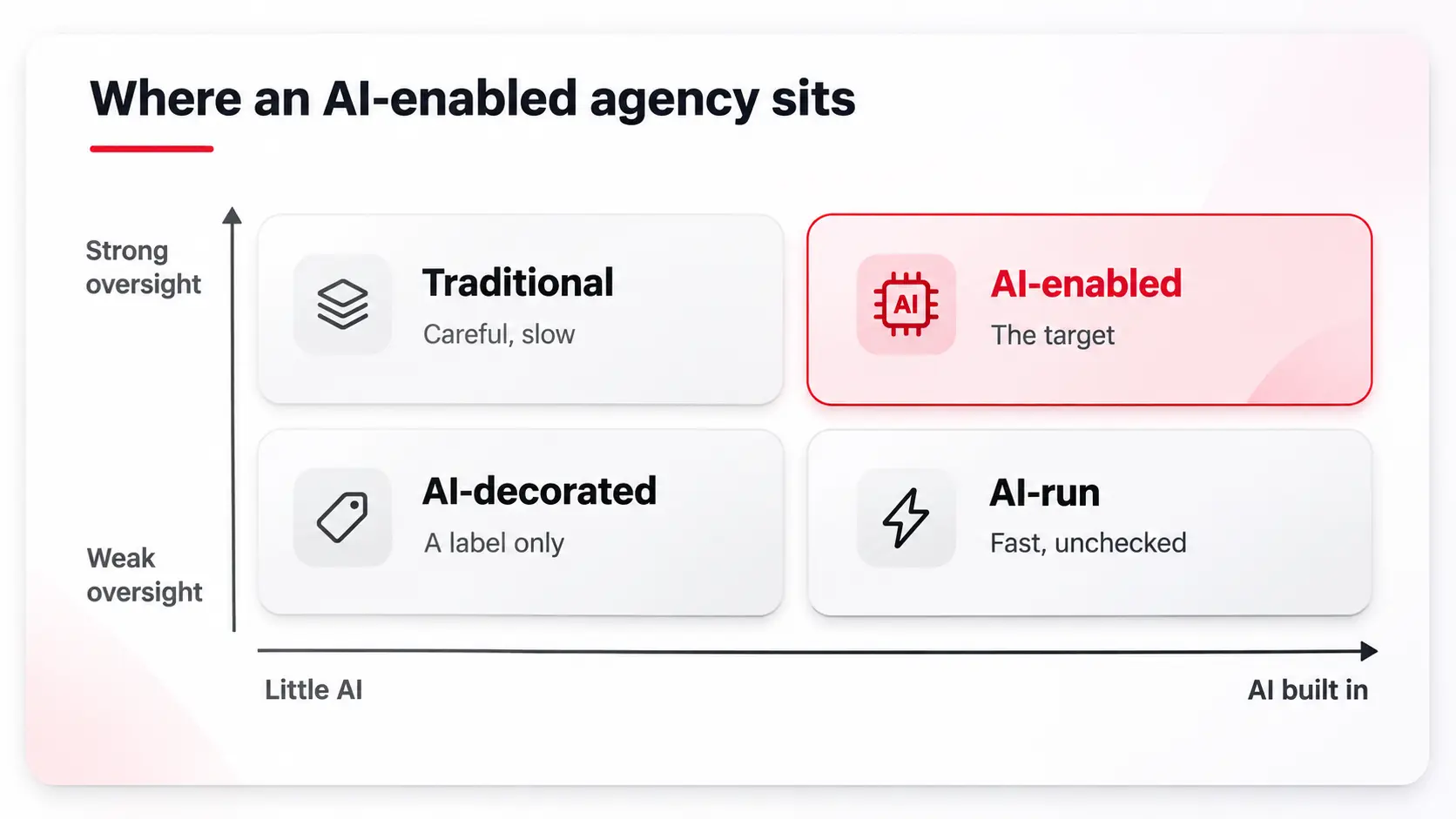
Most agencies land in one of four places. Traditional agencies are careful but slow to test. AI-decorated agencies put AI in the deck and not in the work. AI-run agencies move fast, with nobody checking the brand or the goal. The one you want sits in the top right, where AI does the volume work and people make the calls.
A long tool list does not settle it either. Plenty of agencies name tools they barely use.
If an agency is truly AI-driven, you should notice differences within the first quarter. Four are worth looking for:
Some things should not change. Someone senior still owns your strategy. Someone is accountable for results. You can still call a person and get a straight answer.
Search is where the gap shows fastest. AI is rewiring how buyers research and search, so a capable agency should be able to explain what changed for your category and what was simply relabeled. If the answer is a pile of new acronyms, keep looking.
Run these in order. Each one can be answered from a call, a demo, or a contract. The four filters below remove most agencies from a shortlist.
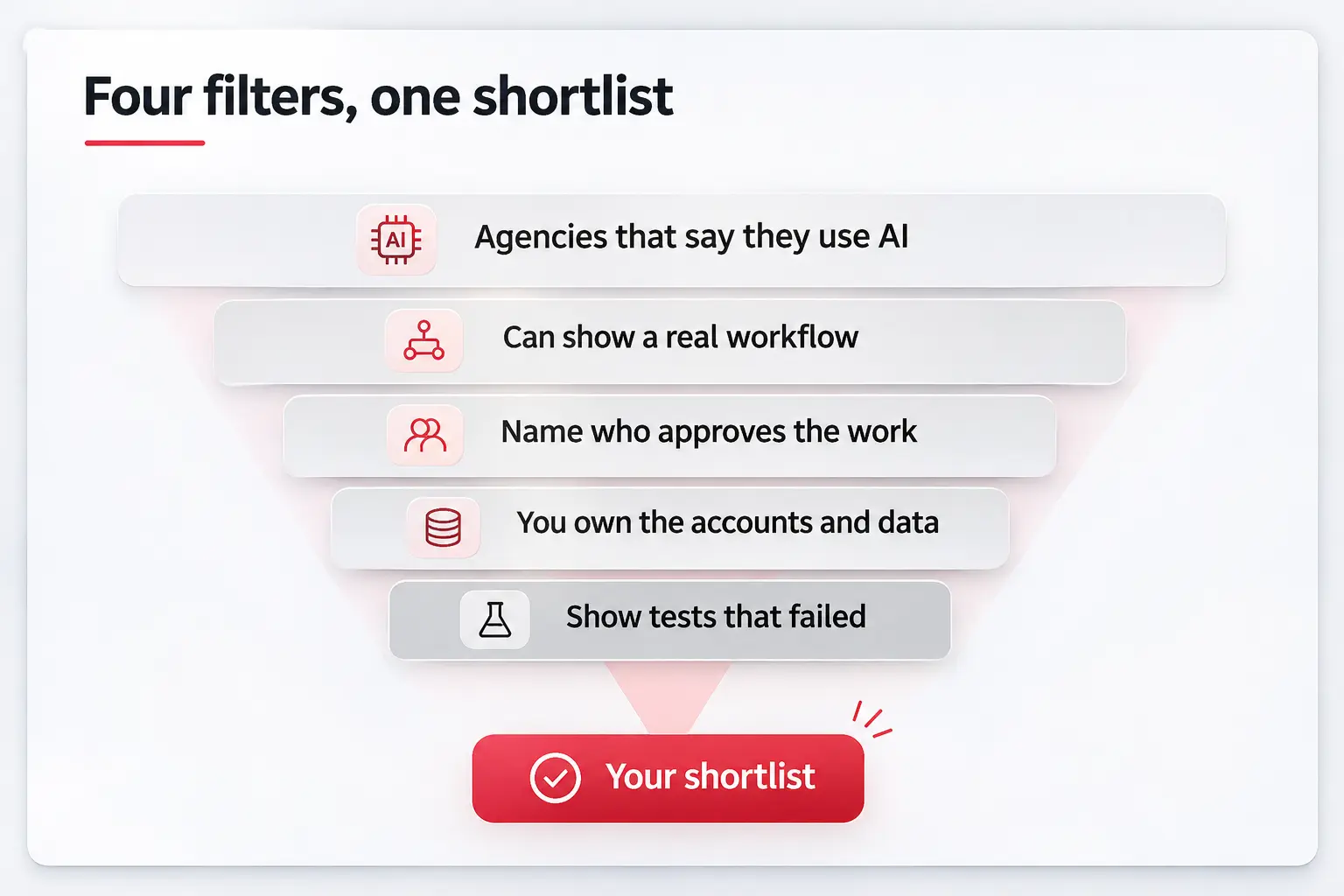
Ask the agency to walk through one real client task from start to finish. Where does the data come from? Which steps does AI do? Where does a person step in? A real agency answers quickly and in detail. A decorated one answers with product names.
It also helps to know how much sits behind a working system. What it actually takes to build an AI marketing platform from scratch shows why a thin layer over someone else’s tool rarely holds up.
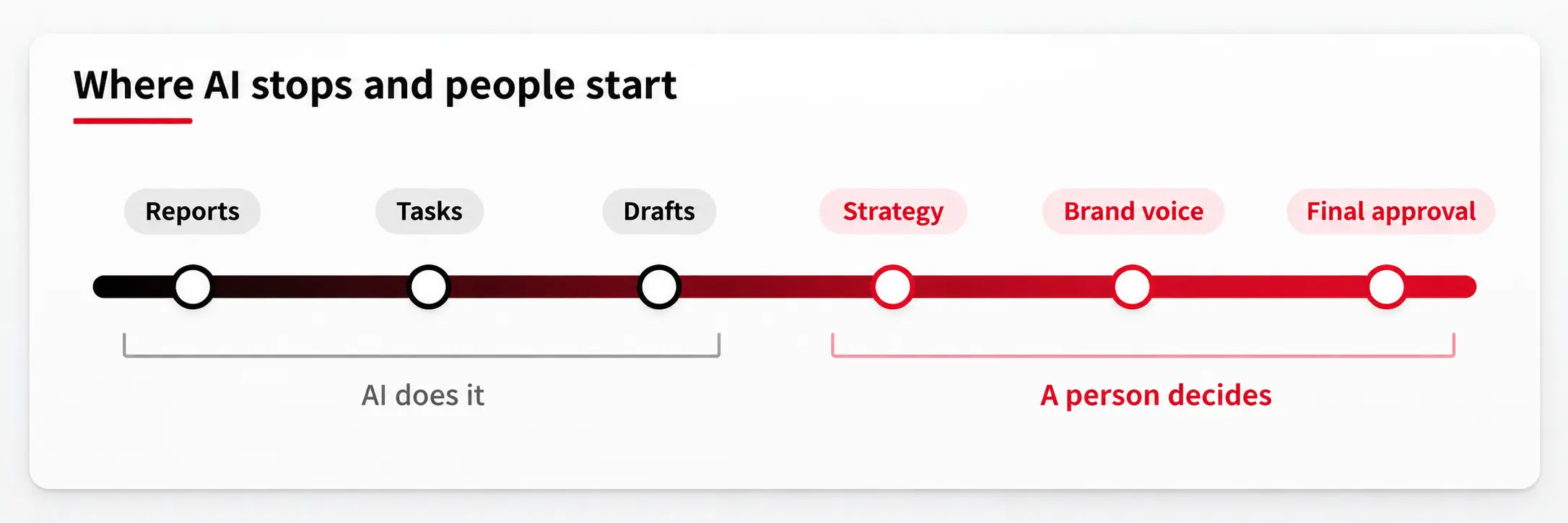
Human oversight in AI marketing is the deciding factor, because AI optimizes whatever number you give it, even after that number stops matching your goal. A model told to lower cost per click will happily buy cheap clicks from people who never buy.
Ask who approves copy, who checks targeting, who reads the results, and what happens when the AI is wrong. You want names and roles, not “our team”.
Ad accounts, analytics properties, tracking setup, and creative files should sit in your name, or transfer cleanly when you leave. If the agency owns the account, it owns the history, and leaving means starting from zero.
The same goes for anything built for you, such as automations behind your campaigns. They should be documented and transferable. Ask which tools your data passes through, and whether any of them train on it.
Ask what they measure, how they attribute it, and whether they will show tests that failed. An agency that reports only wins is not running real experiments. Ask for a recent readout with the client name removed.
Check the basics too: tracking that fires correctly, and a site designed to convert the traffic they send. Agencies often skip the second one, which is why seven website performance issues marketing agencies miss is worth a read before you compare proposals.
Who checks claims before they are published? What happens if the AI writes something off-brand or false? How is consent handled in tracking and retargeting? Ask for the written process. If it lives only in someone’s head, it will fail on a busy week.
Meet the people who will run your account, not only the pitch team. Ask how much senior time you get. AI should free that time for strategy. If the team is thinner than a traditional agency’s and the fee is the same, you are paying for the label.
Use these in the pitch meeting. The middle column shows what a good answer sounds like.
| Question | A good answer | A warning sign |
| Which parts of my account will AI handle? | Specific tasks, with named checkpoints | “All of it”, or a list of tools |
| Who approves work before it goes live? | A named role and a written process | “Our team reviews everything” |
| Who owns the ad accounts and data? | You, from day one | The agency, with an export on request |
| What did your last test teach you? | A recent, specific example, including a failure | Only wins, or no tests |
| How do you report? | A regular readout with reasons for each change | A dashboard with no commentary |
| Which data sources do you connect? | Ad platforms, analytics, CRM, and sales data | Platform metrics only |
| What happens when the AI is wrong? | A defined way to catch and fix it | “It rarely happens” |
| How do you handle privacy and consent? | A documented process for tracking and data use | A vague reference to compliance |
Any one of these deserves a follow-up question. Two or more should end the conversation.
A pilot turns claims into evidence, and it costs far less than a wrong twelve-month contract. Pick one goal, such as qualified inquiries from search, and give the agency a fixed window to work on it.
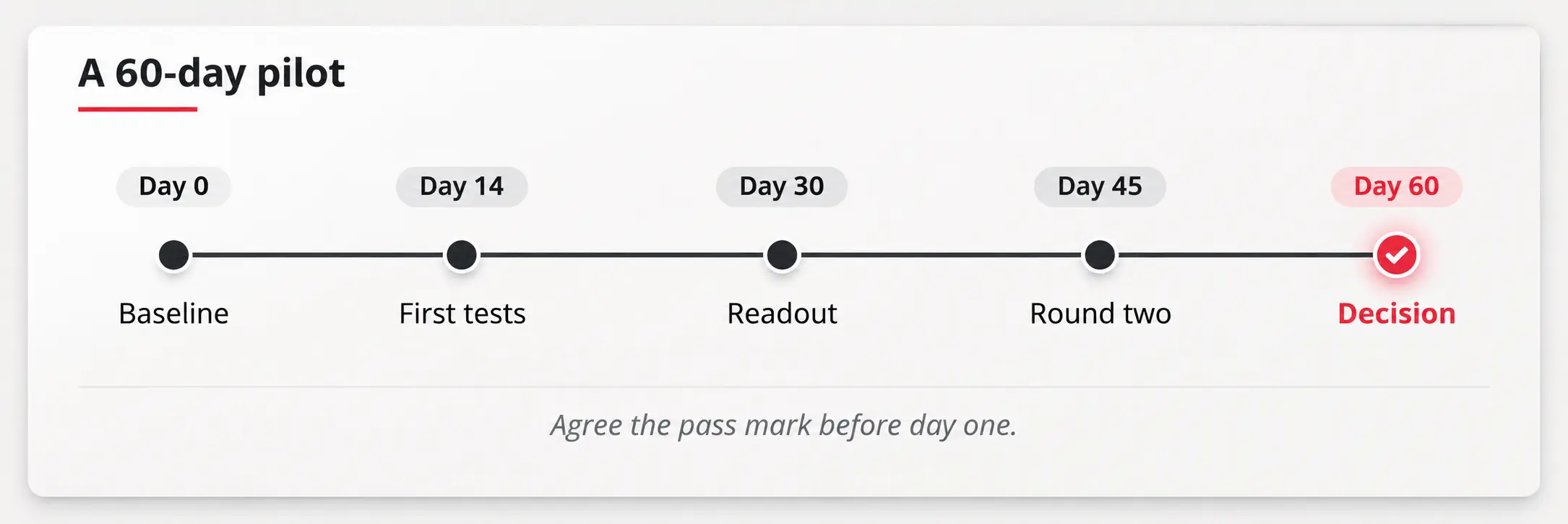
Start with an audit, so both sides agree on the baseline. What website audits reveal that marketing reports never do explains why this step catches problems that monthly reports hide.
Then agree on the pass mark in writing: the metric, the level that counts as a pass, and who makes the call. Judge on leading signals as well as outcomes, because results take time. Useful signals include how many tests ran, how quickly the team adjusted, and how honest the readouts were.
AI makes some old marketing mistakes cheaper to commit. Three are worth asking about directly.
AI-enabled is not always better. A traditional agency often fits when the work is mostly craft: a brand film, a campaign concept, a launch event, or a relationship-led PR push. Small budgets across a few channels can also get more from one experienced person than from a platform.
We do this work ourselves at LN Webworks, including SEO and Meta advertising, and we would rather you hire the right team than the wrong one. If your needs lean toward craft, say so in the brief and ask each agency how it would handle that.
AI is now standard vocabulary for agencies, which is exactly why the vocabulary no longer helps. The evidence does: a real workflow, named approvers, accounts in your name, honest readouts, and a pilot that earns a longer contract.
Comparing proposals right now? Book a Discovery Call and bring them with you. We will go through the shortlist with you, whether or not we are on it.
What is an AI-enabled digital marketing agency?
It is an agency that uses AI inside its daily work, such as analysis, testing, drafting, and reporting, while people keep control of strategy, brand voice, and approvals. There is no formal standard, so check the workflow, not the label.
How is an AI marketing agency different from a traditional agency?
It should test more, learn faster, and automate routine reporting. Strategy, accountability, and your access to a real person should not change.
Is an AI-powered marketing agency cheaper?
Production costs may fall, but the fee does not always follow. Ask what changed in the cost mix, and make sure the savings go to strategy and review, not only to margin.
Will AI-generated content hurt my SEO?
Not by itself. Google warns against using generative AI to produce many pages without adding value. Ask how the agency checks originality, accuracy, and usefulness before it publishes.
Can an AI marketing agency help me appear in AI search answers?
It can help, because the work overlaps with good SEO, but nobody controls those answers. For where to focus, see Google Search versus AI answer engines.
How long should a pilot run before I commit?
About 60 days suits most channels, since it allows two rounds of tests. Agree the metric and the pass mark first, and judge early signals as well as final results.

 AI & Enterprise Strategy, Healthcare Technology
Key Takeaways Start with administrative work, not diagnosis. Patient access, intake, and prior authorization support have high volume and clear rules, and they do not need clinical judgment. The model is the easy part. Identity, data paths, and sign-off decide whether an agent gets through a security review. HIPAA compliant AI agents need a BAA […]
 AI, AI & Enterprise Strategy
Key Takeaways Most wrong answers are right answers to the wrong file. The model quotes what search hands it. Search ranks by match, not trust. An old policy can outrank the current one. Four document failures cause most of it: stale, duplicate, conflicting, and unofficial files. An assistant exposes every folder its users can open, […]
 AI & Automation, Digital Marketing
Key Takeaways Adoption is not the problem. One 2026 B2B survey found about 95% of marketers use AI, yet only about 39% said it improved performance. The tool is rarely the cause. Teams buy licenses first and decide the jobs later, with no number to judge the result. Sort tasks before you automate them. Ask […]