AI in Marketing: What to Hand Over and What to Keep Human
Hem Kant
·
23 Oct, 2026
Picture two marketing teams that buy the same AI writing tool in the same month. Three months later, the first team published twice as much and cannot say whether it helped. The second team publishes the same amount, spends half the time on drafts, and shows the saving on one slide.
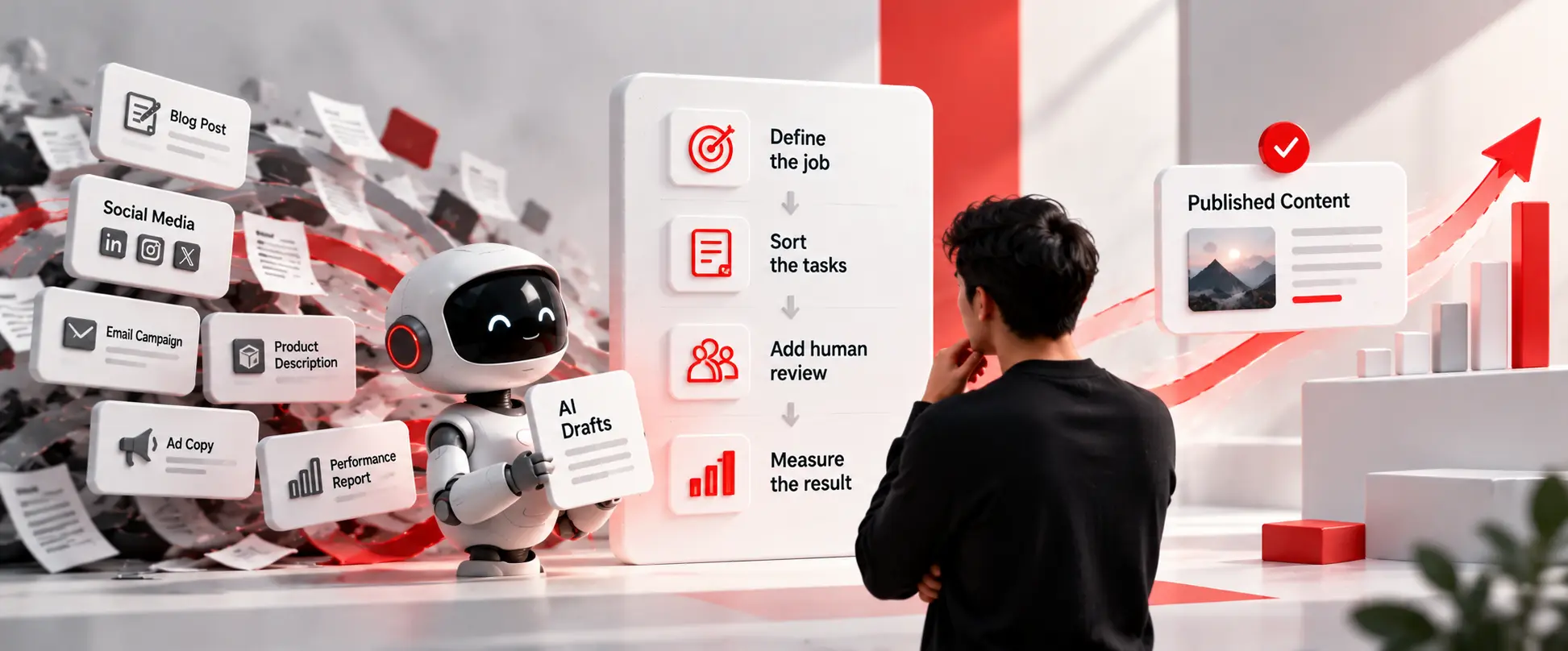
The tool did not make the difference. The second team decided what AI in marketing was for before it switched anything on. This post gives you the test that the team used, a table of tasks sorted by risk, and a simple way to measure the result.
We offer digital marketing and AI automation services at LN Webworks, so weigh our view with that in mind.
Almost every marketing team now uses AI somewhere. One 2026 B2B survey put the figure near 95%. The same research found that only about 39% of those marketers said AI improved their performance. That gap is the real story.
The gap usually has a boring cause. The licenses were handed out. The jobs were never defined. People use the tool for whatever is nearest, which tends to be the first draft of something. Drafts are the easiest output to produce and the hardest to judge.
If AI use is high and results are flat, the root issue is usually missing decisions, not missing tools. Nobody chose the jobs, nobody named a metric, and nobody set a review rule. Our guide to starting from the job and not the tool makes the same point across the whole business, and it applies here with extra force.
Before a task goes to AI, ask three questions in this order. The order matters, because risk comes first.
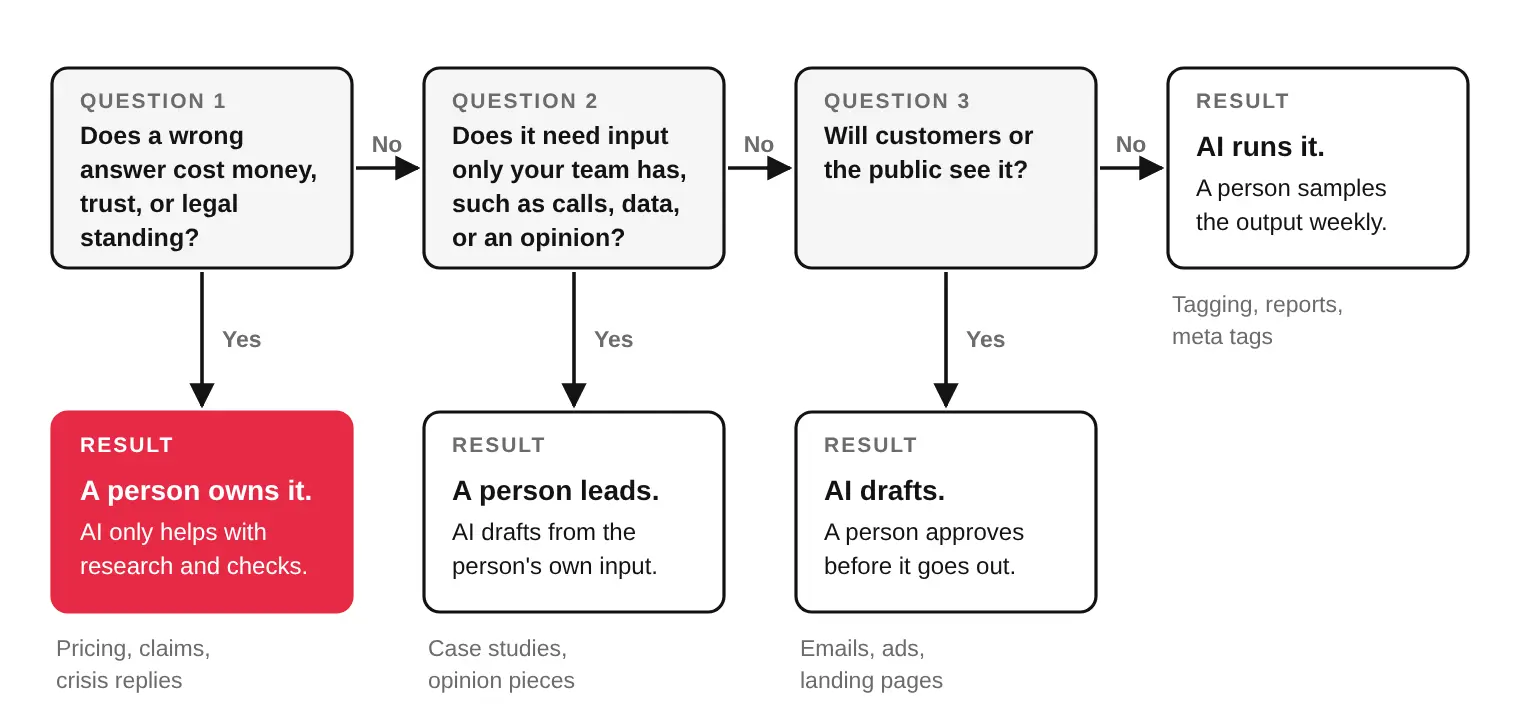
Notice what the test does not ask. It does not ask whether AI is good at the task. It asks what happens when AI is wrong, because it will be wrong sometimes, and it will sound sure when it is.
Here is how common tasks sort under the test. Treat it as a starting point and adjust it to your own risk.
| Task | What AI does |
What a person does |
| Audience and competitor research | Gathers and summarizes sources | Checks the sources and decides what matters |
| Product descriptions and meta tags | Drafts at scale from clean product data | Samples each batch and fixes the template |
| Email and ad variations | Writes options within a brief | Picks, edits, and approves before sending |
| Weekly performance reports | Pulls numbers and flags odd movement | Explains why and decides what to do |
| Case studies and thought leadership | Tidies a transcript or outline | Supplies the story, the numbers, and the opinion |
| Brand positioning and messaging | Tests wording against your guide | Owns the idea and the voice |
| Pricing, claims, and legal copy | Nothing without review | Writes and signs off |
The pattern is easy to spot. The more routine the task and the cleaner the data, the less a person needs to touch. Product descriptions work well because product data is structured. AI also repeats whatever it is fed, so the same goes for your CRM and analytics. If those systems disagree, fix the data first. Our data integration work often comes ahead of AI work for that reason.
AI changes where the slow step sits. Drafting used to be slow and review was quick. Now drafting is instant and review takes time. One person can generate ten drafts in the time another needs to check one properly.
When teams ignore this, they publish unchecked work. The result is what people call AI slop: fluent, generic, and slightly wrong. Readers notice, and so do search engines. Google’s spam policies target pages produced at scale mainly to game rankings, whether a person or a machine wrote them.
Three habits keep review manageable:
More volume also hides weak offers. If paid leads are poor, ten more ad variations will not fix it. Start with the form, the offer, and the follow-up, as we describe in our guide to Meta ads that bring low quality leads.
Choose one number per workflow before you switch anything on. Time to publish, cost per qualified lead, and revenue per email all work. Hours saved is a weak choice, because saved hours can vanish into extra review and extra content that nobody needs.
Then run a plain comparison:
Search is the one area where the measuring stick itself is changing. AI answer engines now shape how buyers find you, and what to track there differs from classic rankings. r
AI in marketing works when it has a defined job, a limit on output, and a number that proves it. It fails when it arrives as a license with no plan. The test in this post is not clever. It is a way to make three decisions on purpose that most teams make by accident.
If you do only three things this quarter, make them stops:
What you start doing instead is smaller and calmer. Sort the task, set a limit, and watch one number.
Our AI and automation team and digital marketing team cover both sides of that work. Book a Discovery Call →
How is AI used in marketing today?
Most teams use it for first drafts, ad and email variations, research summaries, reporting, and audience segmentation. Content creation is the most common use. Fewer teams use it for planning, measurement, or customer data work, even though those areas often hold more value.
Which marketing tasks should AI not do alone?
Anything where a wrong answer costs money, trust, or legal standing, such as pricing, health or financial claims, crisis replies, and legal copy. Also any piece that depends on your own stories, numbers, or opinions. AI can help with these, but a person should own them.
How do I keep my brand voice when using AI?
Write a one-page voice guide with real examples of copy that sounds like you and copy that does not. Give it to the tool with every brief. Then have an editor check for voice, because output drifts toward generic phrasing over time.
How do I measure whether AI is helping my marketing?
Pick one number per workflow, such as time to publish or cost per qualified lead. Record 30 days of baseline, change one workflow, then compare. Include review time and rework in the result, because hours saved alone can mislead.
Will AI-generated content hurt SEO?
Not by itself. Google says it looks at whether content is helpful, not how it was made. Its spam policies do target content produced at scale mainly to manipulate rankings. Publish fewer pieces that add something real, such as original data or firsthand experience.
Does a small team need an AI policy?
Yes, and one page is enough. List the approved tools, what data staff may paste in, which content needs human review, and who signs off. It protects customer data and gives new hires a clear rule on day one.

 Digital Marketing
Key Takeaways Meta does what you tell it to do. If the goal is a form fill, it finds people who fill in forms cheaply. Four things decide lead quality. They are the optimization goal, the form, the feedback you send back to Meta, and how fast your team follows up. Judge campaigns by cost […]
 AI & Automation
We sell AI work. So when we say that not every business needs an AI project, you are right to ask whether we mean it. We do, and this piece explains why. “Why does every business need AI these days” is a fair thing to wonder about. The headlines say it daily, vendors say it […]
 Digital Marketing, Digital Transformation
You have published the content. You have worked on SEO. You have fixed some technical issues and built pages around the keywords your customers search for. Still, the rankings are not moving. For some B2B companies, the problem is even more frustrating. A page that once brought consistent traffic has started slipping, while newer competitors […]