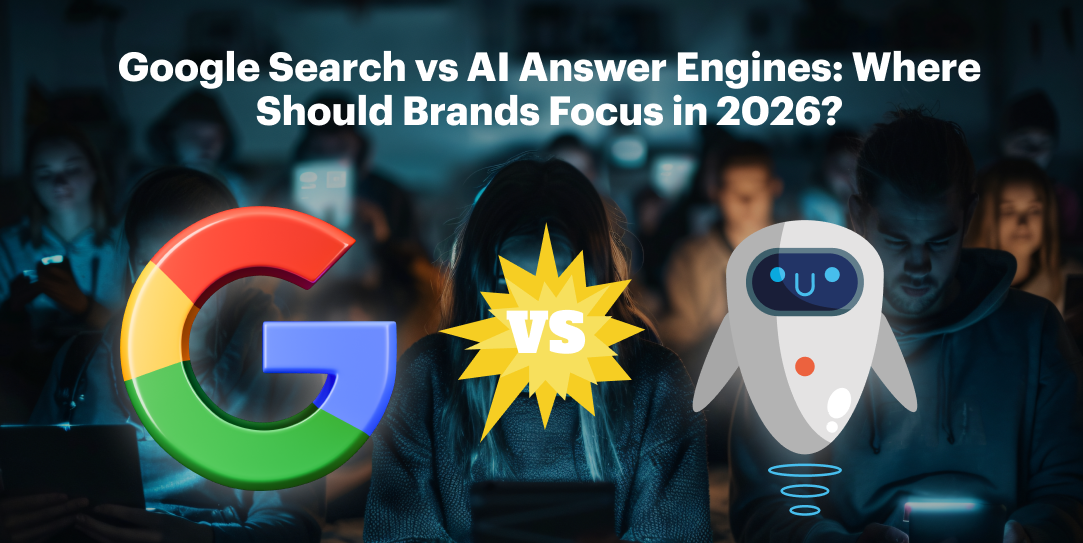
Google Search vs AI Answer Engines: Where Should Brands Focus in 2026?
Hem Kant
·
12 Dec, 2025
2026 is shaping up to be the year when search and the way people find information undergo their biggest shift since the launch of Google. For the first time, Google is no longer the only default discovery engine.
AI Answer Engines (AEO platforms) and AI-powered search engines, such as ChatGPT, Perplexity, Gemini, Claude, and even Amazon Rufus, are becoming the first stop for millions of users globally.
And unlike Google, these engines don’t show a list of links to websites; they provide answers directly, drawing from authoritative, structured, and context-rich sources.
So the big question for brands, especially in the B2B and SaaS world, is this:
Where should we focus our marketing, SEO, and content efforts in 2026?
Google Search or AI Answer Engines?
Let’s break it down and see where your brand should focus.
For the last 20 years, ranking on Google meant two things:
But AEO engines cut the visibility step entirely.
Users no longer see 10 links. They don’t skim titles and descriptions, nor do they compare websites manually. They simply ask a question and get the best distilled answer, right away.
This means 3 things:
Brands must be discoverable within the AI engine, not just on Google. This is the foundation of how brands should optimize for AI search in 2026.
Your content needs to be machine-readable (Humans will follow), factually rich, and entity-driven, exactly what most AI search engines look for.
AI engines favor sources with strong credibility signals, real expertise, real data, and real-world proof, not bragging.
Despite the rise of AEO, Google is not going anywhere. It still has:
– 90%+ mobile search dominance
– The largest ad ecosystem
– Local intent visibility through Maps
– Strong grip over product discovery (Shopping, Reviews, Local Services, etc.)
– A massive user base in emerging markets like India, LATAM (Latin America), and SEA (Southeast Asia)
But Google itself is changing at lightning speed.
Google Search is no longer the traditional 10 blue links.
With Search Generative Experience (SGE), Google is becoming its own AI Answer Engine (you must have seen the AI overview when you search any topic on Google). This evolution is shaping the future of search engines for business marketing.
So brands cannot ignore Google, but they also cannot rely on tactics that worked five years ago.
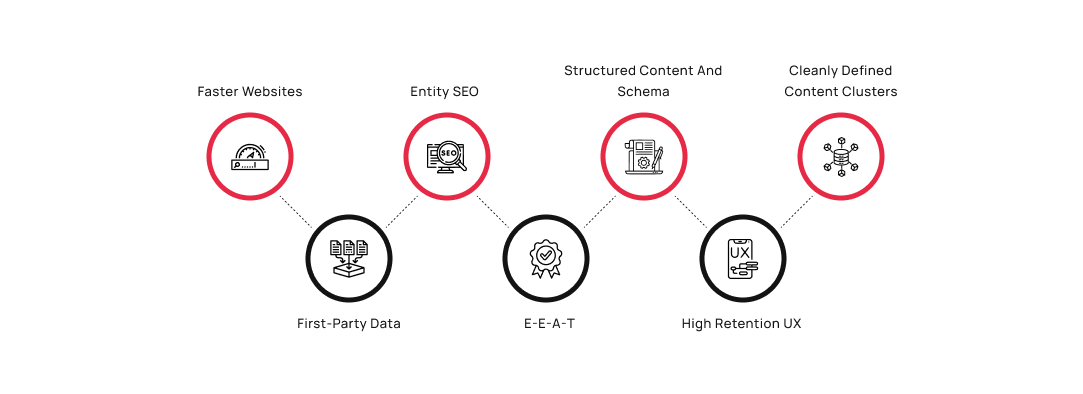
Google is essentially rewarding websites that:
Help both humans and AI understand them clearly.
AI Answer Engines operate differently.
They don’t crawl and rank pages the way Google does.
They synthesize information and generate a single, authoritative answer.
This creates three big opportunities and challenges for brands in 2026:
They pick content that is:
Thin content, generic blogs, and keyword-stuffed pages are dead on arrival.
They rely heavily on:
This gives SaaS and B2B brands a unique advantage because they naturally have expert-driven, problem-solving, data-rich content.
But only if they publish it the right way.
This is a huge opportunity.
Perplexity, ChatGPT, and Claude all pull heavily from:
Suppose your SaaS brand has strong documentation, clear features, a solid knowledge base, and a public-facing schema. In that case, AI engines are far more likely to surface your product in comparisons and recommendation lists.
This was impossible with traditional Google SEO.
The Answer is both, but with different Strategies.
Brands need to stop thinking of SEO vs AEO as a binary choice.
Google brings traffic. AI Engines bring trust and brand discovery.
Both are important if you wanna get traffic to your website.
Here’s the balanced strategy smart brands will follow:
Focus on:
Google is still the best place to win:
You should focus on:
In AEO, the goal is not to rank; it is to be cited.
If the model cites your content, your brand becomes part of the answer itself.
That’s the new visibility.
Brands must move from publishing blogs to building knowledge systems.
This includes:
✔ Blogs (for Google + humans)
✔ Docs + product content (for AI models)
✔ Use cases
✔ Case studies
✔ Glossaries
✔ Comparison pages
✔ Expert articles
✔ Q&A structured content
✔ Video transcripts
✔ Public APIs
✔ Community discussions
In 2026, the brands that win will be the ones whose content is:
This is the mindset shift most brands still haven’t made, but they should.
If your goal is traffic…prioritize Google Search.
If your goal is visibility inside AI models, then prioritize AEO. If your goal is long-term dominance, then you must do both.
You should think this like this:
One brings the visitors. The other decides whether you are worth recommending. And in 2026, recommendations will matter more than rankings.
2026 belongs to brands with real expertise. AI engines are getting smarter.
Users are getting impatient. Search is getting fragmented.
But one thing hasn’t changed:
Brands that provide real value, backed by real expertise, always win.
And whether it’s web development services, mobile app development, application development, or e-commerce SEO services, the brands that master both Google and AI will own the future of digital visibility.
If you need your brand audit, you can set a call with our brand expert.

 AI & Enterprise Strategy, Artificial Intelligence, SaaS Development, Web Development
A year ago, “vibe coding” was a term for weekend prototypes. It is not that anymore. Prompt-to-app platforms have made it possible to describe a working application in plain language and have one generated in minutes, and that capability has moved from novelty to default across a huge share of new software, including a meaningful […]
 Artificial Intelligence
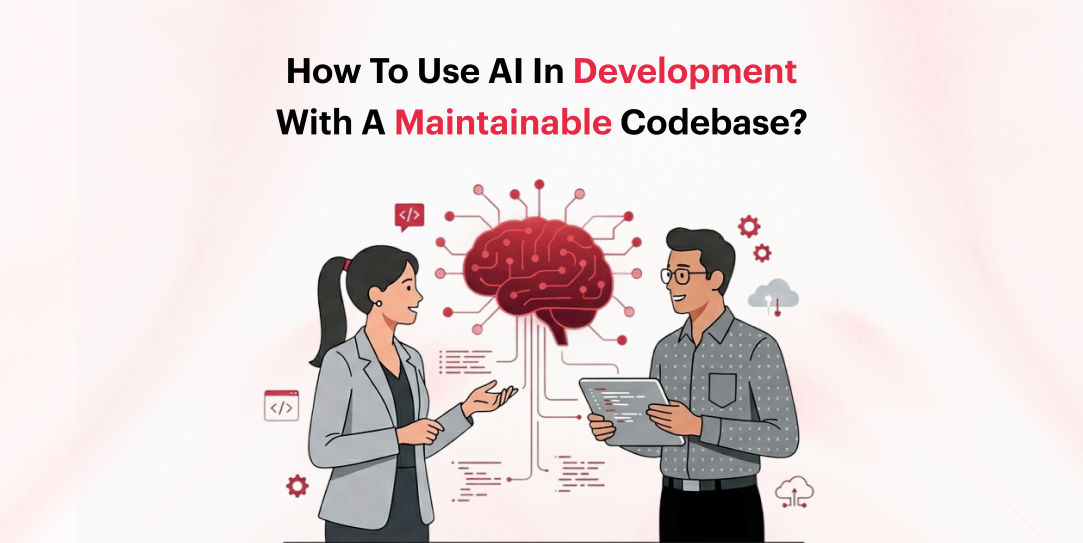
Your team ships faster than ever. Yet six months from now, nobody can explain what half the code does. You know that moment when a new engineer joins your team, opens the repo, and just… stares? Not because the code is complex in a good way. Because nothing follows the same patterns. Because half the […]
 Artificial Intelligence
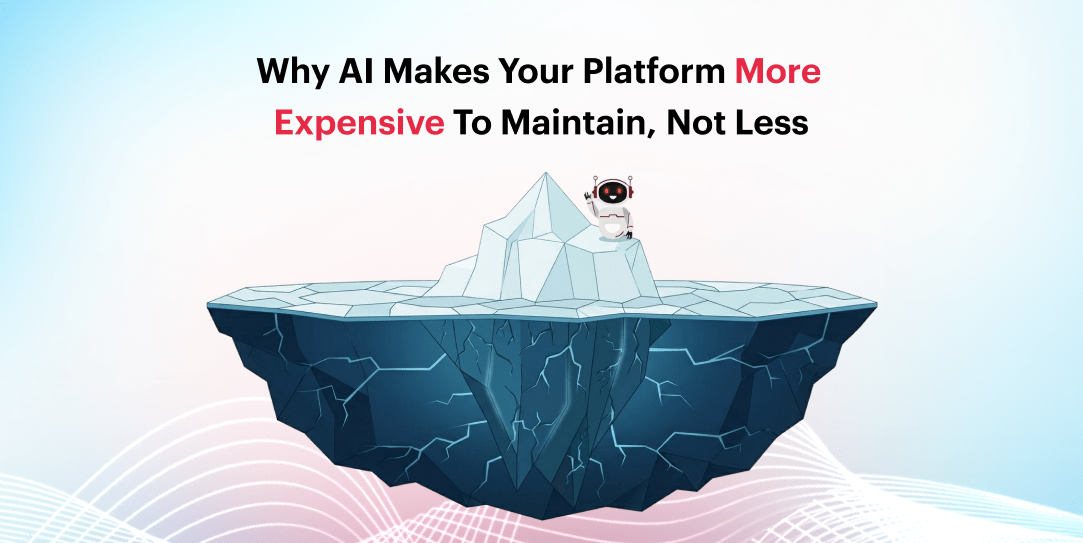
The conversation happening in the market right now about AI adoption begins with the same promise: efficiency. Lower operational costs. Automation that replaces expensive manual processes. A platform that gets smarter over time and pays for itself. The pitch seems interesting, and in some well-scoped cases, it’s even true, at first. But there’s a structural […]