Why Your RAG Chatbot is Hallucinating And Quoting the Wrong Document

LN Webworks
·
03 Nov, 2026
Your company chatbot is probably not hallucinating. It is reading a document that someone wrote four years ago, and it is quoting that document faithfully.
The difference matters because the two problems have different fixes. A made-up answer is a model problem. A wrong answer taken from a real file is a content problem, and no amount of prompt tuning will repair it. We think the second kind causes most complaints about RAG chatbot wrong answers inside companies.
If you are about to launch an internal assistant, or you already have one and trust in it is slipping, the useful question is not which model you picked. It is what the model was handed to read. Document quality and access rights decide whether an assistant earns trust. Below are four ways documents fail, one permissions trap, and a fix that costs attention more than money.
Here is how these assistants work. Retrieval augmented generation, or RAG, means the system searches your files for passages that look related to a question, then hands the best matches to a language model, which writes the reply from them. The model does not check whether a passage is current, official, or correct. It treats what it receives as the truth.
Search ranks passages by how closely they match the question, not by how much you should trust them. A 2021 policy and a 2025 policy on the same topic look almost identical to a search engine. Figure 1 shows how that plays out for one question.
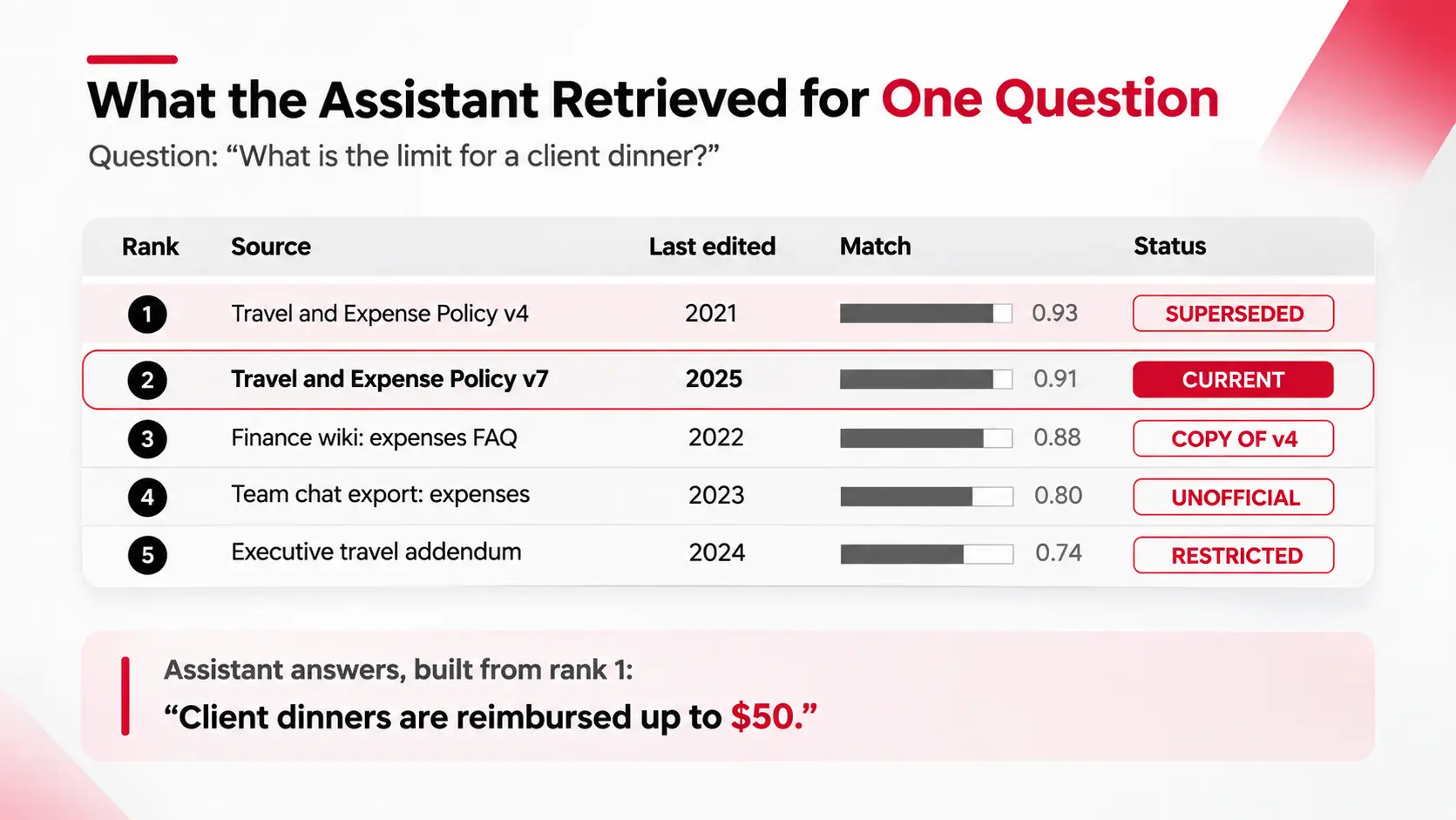
The right document is in the list. It is just second. The assistant answered from the first, and every word of the reply traces back to a real file. Nothing was invented, which is exactly why this failure feels worse than a hallucination. Our post on why AI chatbots make things up covers the other kind, where the model fills a gap with a guess. This post is about the case where there is no gap, only a bad source.
Files that worked well enough for people fail in specific ways when a machine reads them.
| Failure | What the assistant does | Who usually owns the fix |
| Stale | Quotes a policy after it changed | The team that wrote it |
| Duplicate | Finds several copies and quotes the best match | Whoever hosts the copies, often nobody |
| Conflicting | Picks one of two valid documents that disagree | Both owners, together |
| Unofficial | Treats a draft, chat export, or note as policy | Nobody |
People cope with all four without noticing. You know the wiki page is old. You know which deck is a draft. The assistant has no such sense, so it needs the labels you never had to write.
Duplicates are the quietest problem. Every time someone pastes a policy into a wiki page, a slide deck, and an email template, they create a copy that will never be updated. Search finds all of them. When one copy is old, it competes with the real document for first place.
Conflicts are harder, because neither file is wrong. A sales proposal promises round the clock support, and the contract says business hours. A person who sees both knows to check. The assistant picks one and states it plainly.
Unofficial material may do the most damage. Chat exports and meeting notes often hold a confident one-line answer, which is exactly the shape of text that makes a good quote. It carries no status, no owner, and no date that the assistant knows how to weigh.
Microsoft’s own documentation says that its Copilot only surfaces organizational data a user already has permission to view, and it tells administrators to get permissions right in services such as SharePoint. That is the correct design. It also means an assistant is a fast reader of every folder that someone forgot to lock.
Before the assistant, a badly shared salary spreadsheet could sit unnoticed for years, because nobody searched for it. Afterward, anyone can ask what senior engineers earn and receive a tidy summary. The permission mistake is old. The assistant only makes it easy to find.
Custom-built assistants carry a second risk. If you copy every document into one search index, the index has no memory of who may see what, unless you built it to. Access checks must happen at retrieval, before the model sees a passage, because once restricted text is in the prompt, no instruction reliably keeps it out of the answer. Our post on what to check before you connect an AI agent applies the same least-access thinking to tools and connections.
Fixing this does not need a new tool. It needs a short, dull piece of work that most teams skip, because nobody gets promoted for it. Gartner predicts that through 2026, organizations will abandon 60% of AI projects that lack AI-ready data, and its survey found that 63% of organizations either lack the right data management practices for AI or are unsure they have them. An internal assistant is a small, visible version of that finding.
This is the order we would work in:
The fifth step turns a clean-up into a habit. Content ages whether or not anyone looks at it, so an assistant without a review cycle becomes less trustworthy over time. Fifty questions also point to a bounded set of documents, not the whole company drive, which keeps the first pass small enough to finish.
Retrieval engineering matters, and nothing here argues against it. Reranking, filters on date and status, and hybrid search all improve results. They work best on top of labeled sources. A rule that says to prefer current documents needs a status field to read. A reranker cannot tell which of two near-identical policies is the real one if nothing in the files says so.
Tuning on a messy base also hides the problem for a while, which is worse than seeing it. If a vendor demo looks spotless, ask what content it ran on. Demos use tidy sample files. Your drive is not tidy. If you are planning an assistant like this, our AI automation services cover building and supporting them.
A company assistant is a librarian with perfect recall and no judgment. It fetches whatever is on the shelf and hands it over with total confidence. The shelf is yours.
This week, run ten real questions and read the sources beneath the answers. If the top source is wrong or outdated for even two of them, you have found your real project, and it is not a model upgrade.
If you would like a second pair of eyes on those sources, Book a Discovery Call and bring the ten questions with you. We will tell you which failure in Table 1 shows up most often, and what to fix first.
Why does my RAG chatbot give outdated answers?
Search ranks passages by how closely they match the question, not by how current they are. If an old policy and a new one read alike, the old one can rank first. The fix is to label each source as current or superseded, and to remove old copies from the index.
Will fine-tuning the model stop wrong answers?
Rarely. Fine-tuning changes how a model writes and behaves. It is a poor way to store facts that change, such as a policy or a price list. Those belong in the sources the assistant retrieves, where you can update them in one place.
How do we stop the assistant from showing confidential files?
Apply each user’s access rights at retrieval, before any passage reaches the model. Then test with real accounts, including a low-access one, and try to pull restricted content on purpose. Fix the underlying folder permissions too, because the assistant only reflects them.
How many documents should we load first?
Start with the sources behind your 50 most common questions, not the whole drive. A smaller set that you have labeled and assigned owners to will beat a large set that nobody has reviewed.
Who should own the knowledge base?
Each document needs its own named owner, usually the team that wrote it. One person on the assistant team should own the process: the question set, the monthly test, and the removal of sources that have no owner.
How do we measure whether the assistant is accurate?
Keep a fixed set of real questions with the expected source for each. Run them every month and after big content changes. Track the share of answers where the top source is the current, correct one.

 AI, AI & Automation
Key Takeaways Every server is a door. Each MCP server you connect gives an agent a way into a system you own. Access is the main risk. The protocol connects tools. Your permissions decide what the agent can do. Check six things. Access scope, server source, local servers, token handling, destructive actions, and logging. Use […]
 AI & Enterprise Strategy
Gartner has a name for something happening across the AI vendor market right now. They call it agent washing. It means ordinary chatbots and automation scripts get relabeled as agentic AI. None of the real autonomy the term implies is actually there. Of the thousands of companies marketing agentic AI today, Gartner estimates only a […]
 AI & Enterprise Strategy
Checked the weather this morning? Paid for something online? Used a map app to find directions? Each of those small moments quietly used something called an API. You never saw it happen. That is exactly the point. This piece explains what an API actually is, in plain words, with no coding knowledge needed. What Does […]