Three answers exist to “what should we build our store on,” and all three are correct, for different businesses.
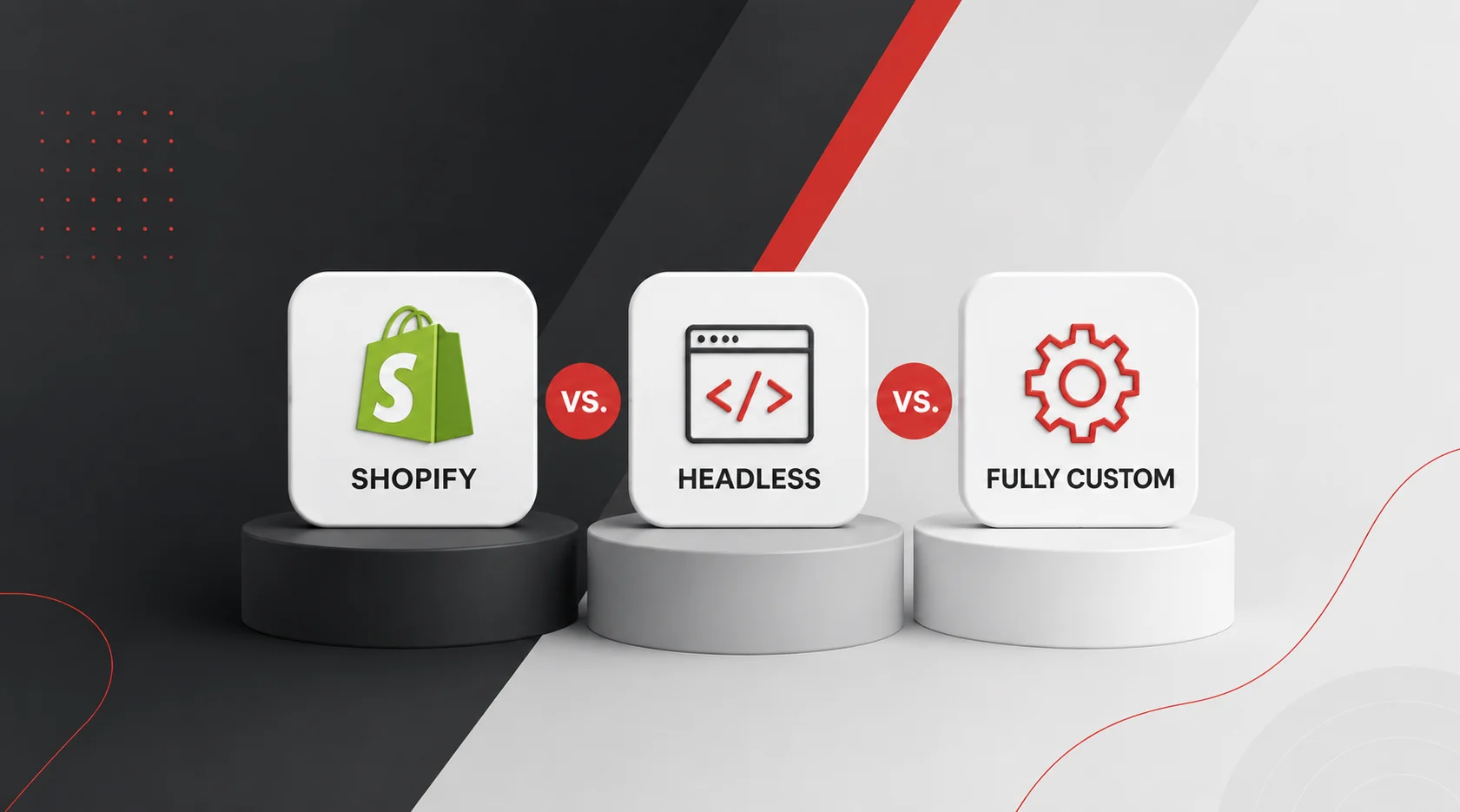
Shopify. Headless. Fully custom.
The mistake is not picking the wrong one in one direction. The mistake is picking based on which option sounds most sophisticated in a board meeting instead of which one matches the business’s actual stage, catalog complexity, and engineering capacity.
This is the same question we help ecommerce teams work through before any code gets written, and it deserves a straight technical answer, not a sales pitch for whichever platform pays the highest affiliate commission.
What These Three Options Look Like
SHOPIFY
A hosted, all-in-one commerce platform. Storefront, checkout, payments, and hosting come bundled. You configure and extend it. You do not build the foundation underneath it.
HEADLESS
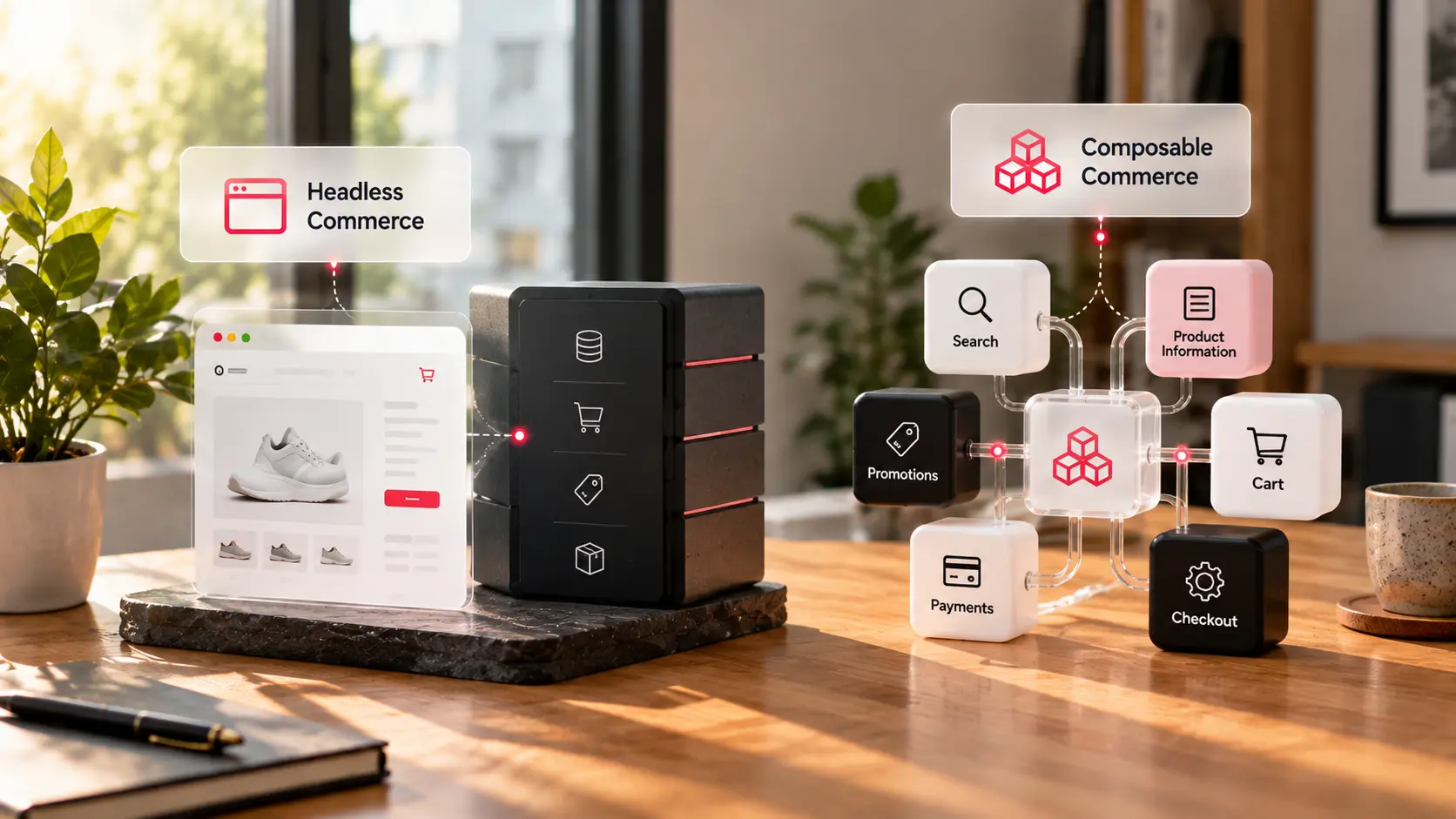
The storefront customers see gets separated from the commerce backend, inventory, orders, and payments. Two systems connected by APIs instead of one bundled platform.
FULLY CUSTOM
Every layer- storefront, cart, checkout, payment processing, inventory logic, gets built from scratch. No platform underneath. The rarest and riskiest of the three, and usually the wrong first move.
What Shopify Actually Gives You
Shopify is a monolith by design, not by accident. Storefront, checkout, and backend all run on Shopify’s own infrastructure, templated through Liquid and extended through an app ecosystem with thousands of pre-built integrations.
Shopify Plus, the enterprise tier, adds Shopify Functions, code that runs inside Shopify’s own checkout to customize discount logic, shipping rules, and payment methods without leaving the platform or building a separate checkout.
The tradeoff is architectural, not just a pricing decision. You get speed to market and a checkout flow, Shopify’s saved credentials included, that consistently converts better than most custom-built alternatives.
You give up deep control over the storefront’s underlying technology, and any commerce logic Shopify was never built to represent natively. That tradeoff is exactly right for a business still finding product-market fit.
It becomes the wrong tradeoff once the catalog, the operations, or the customer experience outgrow what templating and app configuration can represent, the same pattern we walked through in the signs your ecommerce platform has become the bottleneck.
Shopify Plus specifically closes a lot of the gap that used to push mid-sized merchants toward a full replatform. B2B functionality, multi-currency and multi-market storefronts, and checkout-level customization through Functions cover most of what used to require leaving the platform entirely.
The honest reason to leave Shopify now is narrower than it used to be, which is exactly why the decision deserves more scrutiny, not less.
What Headless Actually Changes
Headless does not replace Shopify. It can sit directly on top of it. Shopify’s own Hydrogen framework, paired with its Oxygen hosting runtime, exists specifically for merchants who want to keep Shopify’s backend, inventory, orders, and payments, while building a fully custom storefront in React instead of Liquid templates.
This buys real things: faster page loads at scale, complete design freedom, and the ability to serve the same commerce backend to a website, an app, and other channels from a single source of data.
It also buys a second codebase to maintain indefinitely, a frontend engineering team that did not need to exist under a pure Shopify setup, and a genuinely harder debugging surface when something breaks in the connection between the two systems rather than inside one.
Adoption of this pattern has grown substantially over the past few years, particularly among mid-market and enterprise merchants managing complex catalogs or multiple sales channels, though the specific adoption figures published across the industry vary widely enough that they should be read as directional, not precise.
What is consistent across the data is the shape of who adopts it: established brands solving a specific performance or channel problem, not early-stage stores hoping headless will make the product sell better.
The real cost math behind that decision- platform fees against the team you now need to run two systems instead of one- is the same total-cost-of-ownership logic we broke down in what an ecommerce platform really costs.
What Fully Custom Actually Requires
Fully custom means nobody else’s commerce logic sits underneath yours. Cart, checkout, payment processing, tax calculation, and inventory sync all get built and maintained in-house or by a partner.
This is not a bigger version of a Shopify project. It is a different category of project, with PCI compliance, fraud prevention, and payment gateway integration as first-class engineering problems rather than something a platform already solved for you years ago.
Very few businesses genuinely need this. The ones that do usually have a transaction model, a marketplace, a highly regulated payment flow, a business logic no commerce platform was built to represent, that off-the-shelf and headless options cannot bend far enough to fit.
This is the same build-versus-buy calculation behind custom CRM versus off-the-shelf SaaS CRM: custom is justified by a genuinely unusual core process, not by a general desire for more control.
Matching the Option to the Stage
| Stage |
Best Fit |
Why |
| Early-stage, single channel |
Shopify |
Speed to market beats flexibility at this stage |
| Scaling brand, multiple channels or heavy customization |
Headless (often on Shopify Plus) |
Backend stays proven, storefront gets room to differentiate |
| Marketplace, regulated payments, or unique commerce model |
Fully custom |
No existing platform represents the actual business logic |
Where This Gets Confused
The most common mistake is not choosing the wrong platform outright. It is choosing headless too early, for reasons that sound architectural but are really aesthetic: a desire for a fully custom-looking storefront before the catalog, traffic, or channel complexity actually justifies the engineering overhead.
The second most common mistake runs the opposite direction: staying on standard Shopify well past the point where app-stacking has quietly built something more fragile than a proper headless or custom build would have been, one plugin at a time, with nobody deciding that on purpose.
Neither mistake is really about the platform. Both come from skipping an honest read of where the business actually is before picking an architecture that sounds right for where it wants to be someday.
A useful gut check: count how many apps are currently stacked on the storefront to make it do things Shopify does not do natively. Two or three purpose-built apps is normal.
A dozen apps each patching a different limitation, competing for the same page load budget, slowing checkout, and occasionally conflicting with each other, is not a Shopify problem anymore.
It is a sign the store has quietly outgrown the architecture it is still running on, whether or not anyone has said so out loud yet.
If you are not sure which of these three fits where your business actually is, that is worth a direct conversation before any platform decision gets made. Book a Discovery Call, and we will give you a straight read.
Book a Discovery Call →
The Author
Hem Kant
Content Strategy and Integrity Lead (Social+ Services)
Curious by nature, Hem Kant is a strategist and writer who grounds his work in quiet reflection. He draws inspiration from the stillness of winter, clean cityscapes, good books, and honest talk (Networking). He writes with a commitment to integrity and a sharp focus on essential detail, delivering work defined by substance and insight.