AI Agent Swarms: What They Are and When One Agent is Enough!
LN Webworks
·
26 Oct, 2026
Picture the model bill for one agent answering one question. Now picture ten agents, each answering part of it, then checking each other’s work. That bill is the first thing a swarm changes, and it is rarely the last.
Vendors now describe AI agent swarms as the next step for enterprise automation. Sometimes they are right. This post explains what a swarm is, where research says it helps, where one agent does better, and which controls to set before it touches a live system. We build AI and automation systems at LN Webworks, so we have a stake in this question.
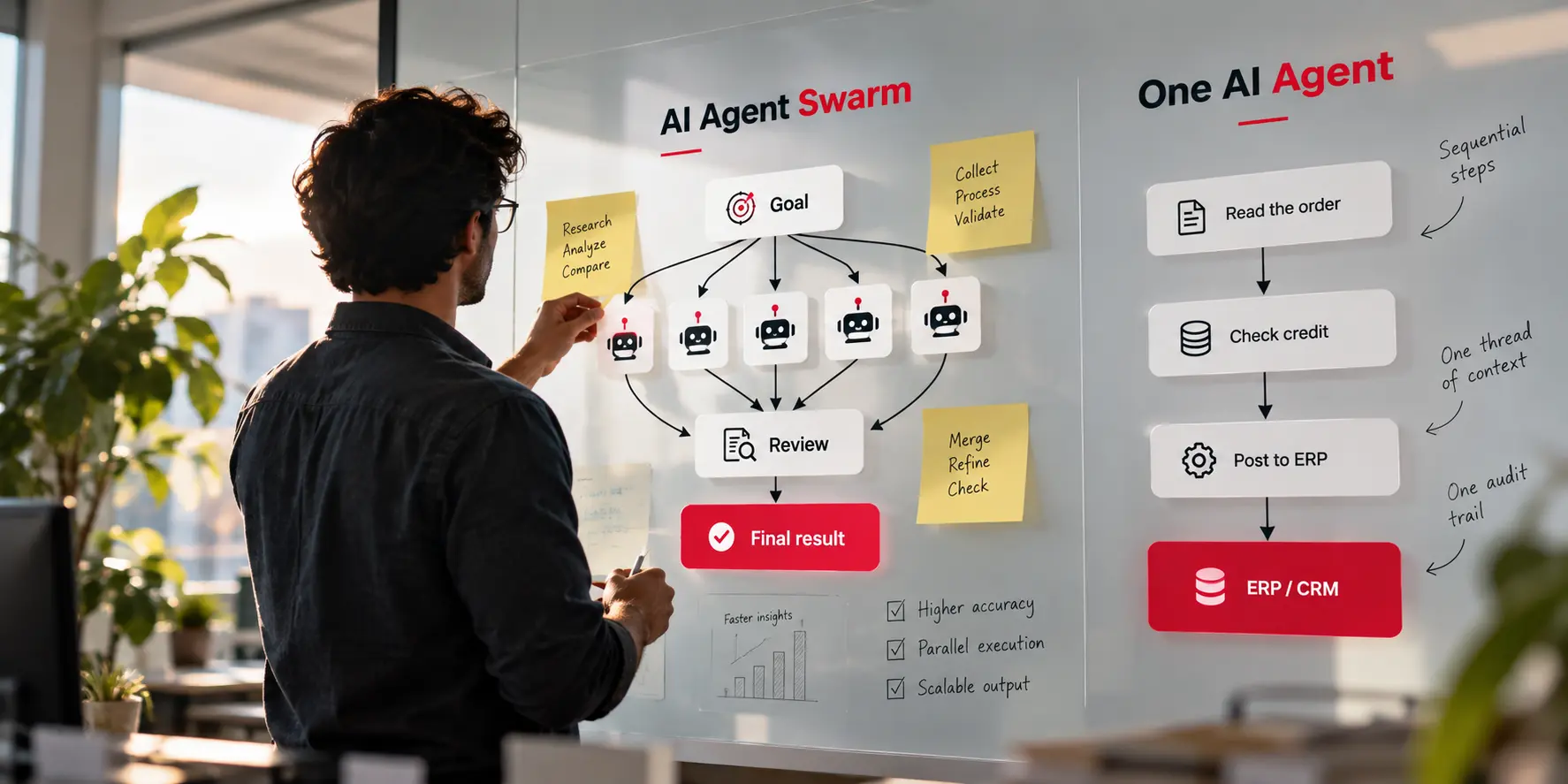
A swarm is a group of specialized agents that split one goal into parts. One agent plans and assigns the parts. Others do the work. A separate agent checks the result, and the answers merge into one output.
In the strict sense, a swarm has no leader and its agents coordinate as peers. Business systems rarely work that way. Someone must answer for the result, so most production setups keep a central orchestrator. When people say swarm, they usually mean this orchestrator and workers pattern. Our previous coverage of the difference between an AI agent and a chatbot covers the single agent that each worker is built from.
It is tempting to assume ten agents do ten times the work. The research says otherwise.
In January 2026, Google Research tested 180 agent setups across four benchmarks. On a parallel finance task, central coordination beat a single agent by about 81%. On a step-by-step planning task, every multi-agent setup did worse, by 39% to 70%.
Coordination is the reason. Every agent must pass context to the others, and each handoff can lose or distort something. With ten agents there are 45 possible pairs that can pass bad information. The same study found that independent agents amplified errors about 17 times, while a central orchestrator held that to about four times.
If a swarm performs worse than one agent, the root cause is usually the shape of the work. The task did not divide into independent pieces, so the agents spent their effort talking to each other.
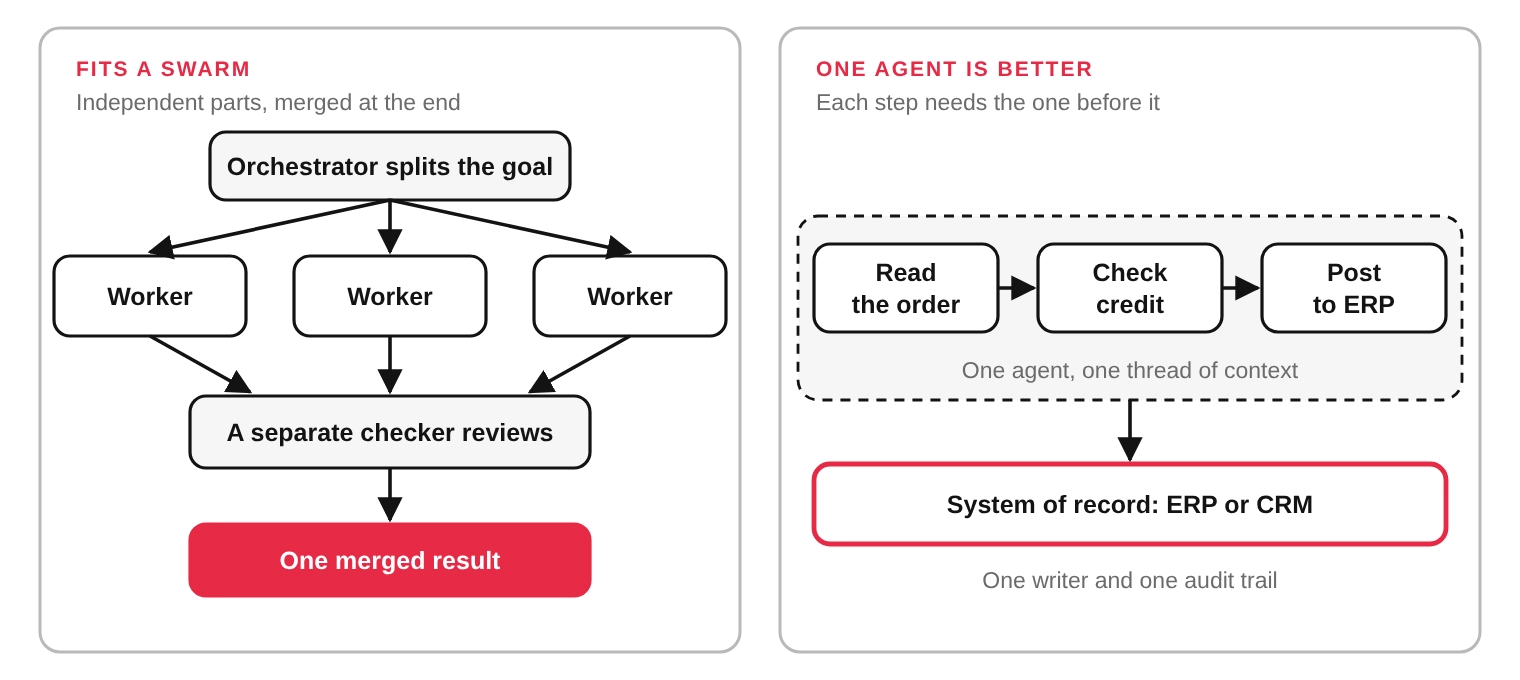
A swarm fits work that is wide, read-heavy, and independent. The parts do not need to talk to each other while they run, and a separate checker can review the combined result. Examples include:
Even then, you pay for it. Anthropic reported that its multi-agent research system beat a single agent by about 90% on an internal research test. It also used about 15 times the tokens of a chat, while single agents used about four times. Pay that multiple only when the answer is worth it. Our breakdown of what it costs to build an AI agent shows how quickly run costs add up.
One agent wins when steps depend on each other, and when the work ends in a write to a system of record. Table 1 sorts common business work by fit.
|
Work |
Better Fit |
Why |
| Researching many suppliers or sources | Swarm | Parts are independent and read-only |
| Triaging a large queue of tickets or claims | Swarm | Each item stands alone, and results can be merged |
| Checking one document against many rules | Swarm | A separate checker catches what the author misses |
| Processing one order from intake to ERP | One agent | Each step needs the result of the last |
| Updating customer or ledger records | One agent | One writer keeps one audit trail |
| Drafting one report from one data set | One agent | One context avoids conflicting choices |
The bottom rows matter most for operations teams. A swarm is easy to start. The systems it writes to are the hard part. Several agents changing the same CRM record create conflicts that nobody sees until a customer complains. If your agents will touch core systems, the connections between those systems need to be sound first, which is the work behind our data integration services.
Agents act on their own, so controls must exist before the first live run. Five cover most of the risk:
Regulated teams need this most. Our piece on agentic AI in regulated industries explains why the audit trail and the approval step matter more than the model.
Start with one agent and a measured baseline for quality, cost, and time. Add a second agent only when you can name the failure it fixes, such as a checker for a producer that misses its own errors. Measure again. If the numbers do not move, remove the agent.
Prefer a few well-defined agents to a large group. Each extra agent adds cost, delay, and another place for an error to hide. A small, boring design that you can debug beats an impressive one that you cannot.
AI agent swarms are a real tool for work that divides into independent parts and carries enough value to cover the cost. They are a poor tool for linear work and for anything that writes to shared records. The test is the shape of the work, not the size of the vendor demo.
The best argument against this advice is that models keep improving, and that today’s limits will fade. That may be true. Better models still pass context through handoffs, still cost tokens, and still need an owner when something goes wrong. Controls and a good fit with the work will matter for as long as agents act on real systems.
Describe one workflow in six lines. Tell us the trigger, the inputs, the systems it touches, who approves it, what a wrong result costs, and how often it runs. We will tell you whether it needs one agent, a few, or none, and what to set up first. Our AI and automation team builds and reviews agent systems. Book a Discovery Call →
What is an AI agent swarm?
An AI agent swarm is a group of AI agents that split a goal into parts, work on the parts, and combine the results. In business use it usually means an orchestrator agent that hands tasks to specialist agents, with a checker that reviews the output before anything is released.
Is an agent swarm the same as a multi-agent system?
Mostly. Multi-agent system is the technical term. Swarm is the popular one, and it can suggest agents that coordinate with each other without a leader. Most business systems keep a central orchestrator, because someone has to be accountable for the result.
How many AI agents are too many?
There is no fixed number. Every added agent adds model calls and more paths where messages and mistakes can travel. Ten agents create 45 possible pairs. Start with one agent, add another only to fix a failure you have measured, and stop when the gain no longer covers the cost.
Do multi-agent systems cost more than a single agent?
Yes. Anthropic reported that its multi-agent research system used about 15 times the tokens of a chat exchange, while a single agent used about four times. That cost can be worth paying for broad, high-value research. It is rarely worth paying for a simple, linear task.
Are AI agent swarms safe to run on business systems?
Only with controls in place first. Give each agent the least access it needs, set hard limits on tokens and turns, require human approval for high-impact actions, keep a replayable log, and name an owner for each control. A swarm that can write to your ERP or CRM needs all five.
Which tasks should not use a swarm?
Tasks where each step depends on the one before, and tasks where several agents would write to the same record. Order entry, ledger updates, and customer record changes fit this description. One agent with a clear audit trail usually handles them better.

 AI, AI & Automation
Key Takeaways Every server is a door. Each MCP server you connect gives an agent a way into a system you own. Access is the main risk. The protocol connects tools. Your permissions decide what the agent can do. Check six things. Access scope, server source, local servers, token handling, destructive actions, and logging. Use […]
 AI & Automation, Digital Marketing
Key Takeaways Adoption is not the problem. One 2026 B2B survey found about 95% of marketers use AI, yet only about 39% said it improved performance. The tool is rarely the cause. Teams buy licenses first and decide the jobs later, with no number to judge the result. Sort tasks before you automate them. Ask […]
 AI & Automation
We sell AI work. So when we say that not every business needs an AI project, you are right to ask whether we mean it. We do, and this piece explains why. “Why does every business need AI these days” is a fair thing to wonder about. The headlines say it daily, vendors say it […]