Is Agentic AI Ready for Regulated Industries in 2026-2027?
Hem Kant
·
09 Sep, 2026
Is agentic AI ready for healthcare and finance is the wrong framing at this point. It is already running in both, at real scale, making decisions that affect real patients and real credit applications.
The question worth asking now is narrower and more useful: has the governance around these systems kept pace with how fast they got deployed? Across the current research, the honest answer is mixed, and the gap between adoption and accountability is exactly where the real risk sits.
|
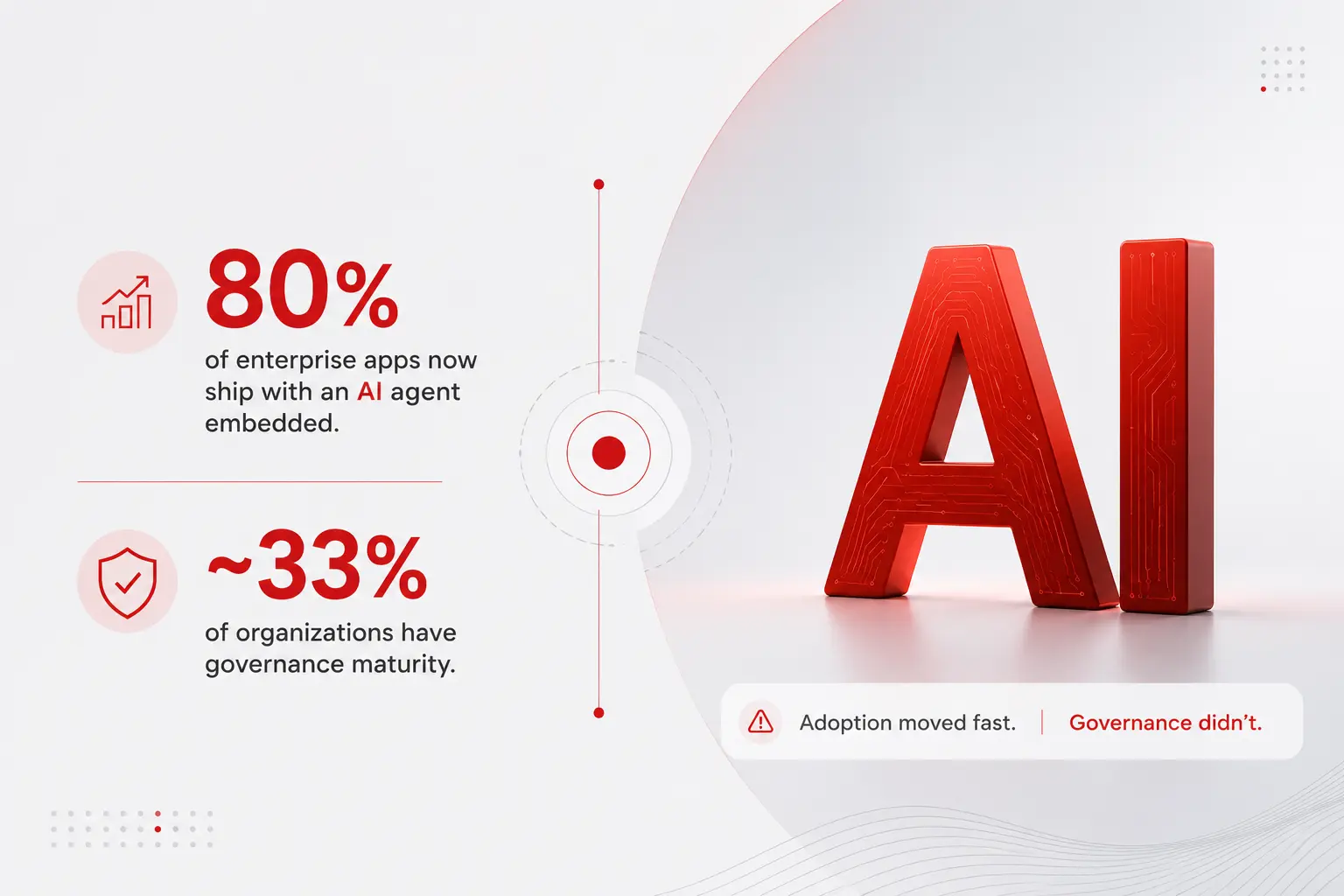
80% of enterprise apps shipped or updated in early 2026 embed at least one AI agent, up from roughly a third two years earlier |
~33% of organizations report real governance maturity for agentic AI controls, per current industry surveys |
That gap is the story. Adoption did not wait for governance to be ready, and in a regulated industry, that sequencing problem is not a minor process gap. It is the condition under which a serious compliance failure or a patient-harm incident actually happens: not because the technology failed, but because nobody was watching closely enough to catch it before it did.
Regulators have not been passive while adoption accelerated. Several major frameworks are either already active or landing within months of each other.
| Framework | Status | What It Covers |
|---|---|---|
| EU AI Act | High-risk obligations enforceable August 2026 | Credit scoring, employment, healthcare, critical infrastructure |
| Colorado AI Act | Effective February 2026 | High-risk AI systems affecting consumers |
| Fed / OCC / FDIC guidance | Existing model risk rules confirmed to apply | AI and generative AI in banking |
| FINRA Notice 24-09 | Active guidance | AI use in broker-dealer operations |
| HHS OCR HIPAA AI guidance | Active, evolving | AI systems touching protected health information |
None of these frameworks were written with a blank slate in mind.
Most extend existing model risk and data protection principles to cover agentic systems specifically, which means an organization with a mature traditional compliance program is not starting from zero.
It is starting from a foundation that now needs to stretch to cover systems that act, not just systems that predict or recommend.
The FDA has separately authorized more than a thousand AI and machine-learning-enabled medical devices as of mid-2026, a figure that has climbed steadily and shows the agency actively building review capacity for this category rather than treating it as an edge case.
That volume alone signals where regulatory attention is heading: not toward blocking agentic and AI-driven systems in regulated settings, but toward requiring documented, auditable proof that each one is being governed as carefully as it is being deployed.
The deployments holding up well share a pattern: they start narrow, not broad. A credit processing agent that ingests a specific document type, extracts required data points, validates them against internal systems, and produces a structured output inside a logged, governed environment is a fundamentally different commitment than giving the agent autonomy over the whole underwriting process.
The narrow version is auditable by design. The broad version usually is not, at least not yet, which is the same lesson we covered from the software development side in is vibe coding safe for production software: the tool is rarely the problem, skipping the review layer around it is.
That narrow-scope principle isn’t unique to regulated AI it’s the same logic behind task automation generally: the smaller and more defined the task, the easier it is to audit.
Most workflow automation, like what Zapier helps business owners do, operates at this narrow, rules-based level, agentic AI is a different, higher-stakes category entirely. The same principle shows up in CMS-level tooling too, like ECA modules for workflow optimization, which sit well below the accountability bar this article is actually about.
Two data points capture the mismatch well.
First, a widely discussed example in the financial sector: a major bank has embedded outside AI engineers to co-develop autonomous compliance agents, while its internal model validation function still operates on a quarterly review cycle built for a much slower era. The engineering moves at agent speed. The oversight built to catch its mistakes does not, yet.
Second, and more directly consequential: roughly three in four health plans now use AI in prior authorization decisions.
In Medicare Advantage specifically, appeal overturn rates run above eighty percent, meaning the large majority of denials that do get appealed turn out to have been wrong. But the patient appeal rate itself sits below one percent.
Put those two numbers together and the picture is stark: an AI system is very likely wrong when challenged, and it is almost never challenged.
That is not a technology failure. It is a governance and oversight failure, wearing an AI system as the visible symptom, closely related to the standards gap we described in our FHIR readiness framework for the same prior authorization workflows now under direct federal scrutiny.
Readiness was never really a question about whether the technology is capable enough.
Agentic systems are demonstrably capable of the tasks being asked of them.
Readiness is a question about whether an organization has built the accountability structure, logging, human review at the right checkpoints, a validation cycle that can actually keep pace with deployment speed, to operate that capability responsibly.
For a regulated organization specifically, that means the platform architecture and the compliance structure have to be designed together from the start, not bolted on after a pilot succeeds.
That is the kind of work we help clients think through directly, whether the starting point is a broader AI-enabled platform strategy or the security and compliance discipline embedded in how automation actually gets deployed and monitored.
If your organization is deploying agentic AI in a regulated context and the governance structure has not caught up to the deployment speed yet, that gap is worth closing before a regulator or an incident closes it for you.
Book a Discovery Call and we will help you find where it actually sits.

 AI & Automation
We sell AI work. So when we say that not every business needs an AI project, you are right to ask whether we mean it. We do, and this piece explains why. “Why does every business need AI these days” is a fair thing to wonder about. The headlines say it daily, vendors say it […]
 AI & Enterprise Strategy
Gartner has a name for something happening across the AI vendor market right now. They call it agent washing. It means ordinary chatbots and automation scripts get relabeled as agentic AI. None of the real autonomy the term implies is actually there. Of the thousands of companies marketing agentic AI today, Gartner estimates only a […]
 AI & Enterprise Strategy
Checked the weather this morning? Paid for something online? Used a map app to find directions? Each of those small moments quietly used something called an API. You never saw it happen. That is exactly the point. This piece explains what an API actually is, in plain words, with no coding knowledge needed. What Does […]