ECA Modules for Effective Business Automation and Workflow Optimization
Share

Automating workflows and decision-making procedures is important for efficiency in the fast-paced commercial world of today.

Event-Condition-Action (ECA) modules are designed to help businesses achieve this by enhancing operations, reducing errors, and improving productivity. At LN Webworks, a Drupal Development Company, our team experts have explored how ECA modules can automate business logic, improve decision-making, and seamlessly integrate with AI and BPMN.io for a more powerful and efficient workflow.

What are ECA Modules?

ECA modules are tools that automate business logic by defining a set of rules based on three core elements:

ECA Modules for Effective Business Automation and Workflow Optimization

  • Event: A trigger or change in the system.

  • Condition: A specific set of criteria to evaluate.

  • Action: A predefined response once the condition is met.

How ECA Modules Automate Business Logic?

1. Automation of Business Logic:

  • ECA modules help automate decision-making processes by defining a set of rules based on events, conditions, and actions.
  • Useful in workflows, monitoring, and business rule automation.

2. Improved Efficiency:

  • Reduces the need for manual intervention in routine tasks.
  • Enhances response times to changing business conditions by reacting immediately to triggers.

3. Flexibility and Customization:

  • Easily customizable rules and actions based on specific business requirements.
  • Can be adapted as business needs evolve, ensuring long-term utility.

4. Simplification of Complex Systems:

  • Helps break down complex business logic into manageable, readable, and reusable components.
  • Makes decision-making logic more transparent and maintainable.

Benefits of Using ECA Modules

Given below are some of the common advantages of ECA modules:

Reduced Human Error:

Minimizes reliance on manual input, reducing mistakes and increasing process consistency.

Real-Time Responses:

Enables instant reactions to events, ensuring that actions are performed when needed without delay.

Increased Productivity:

Automates repetitive processes, freeing up resources to focus on higher-value tasks.

Scalability:

ECA modules can be easily scaled to handle growing volumes of data or business processes.

Better Compliance & Auditing:

All actions are tied to specific conditions, making it easier to track compliance and audit trail for decision-making.

Enhancing ECA Modules with AI

ECA modules are even more powerful when integrated with AI systems. AI-powered ECA modules bring several advantages:

Event Detection:

  • AI-powered systems can monitor multiple data streams to detect events that trigger actions (e.g., anomalies, user behavior, system errors).

Condition Evaluation:

  • ECA AI evaluates specific conditions within the data (e.g., does the user meet certain criteria, or is a pattern recognized?) before taking action.

Action Execution:

  • Once conditions are met, ECA AI takes predefined actions automatically (e.g., alerting staff, initiating processes, or even triggering other AI models).

Continuous Learning:

  • AI models can learn from past events and outcomes to improve the decision-making process, optimizing over time.

Personalization:

  • ECA AI can tailor actions based on individual user behavior or specific organizational needs.

Integrating ECA with BPMN.iO

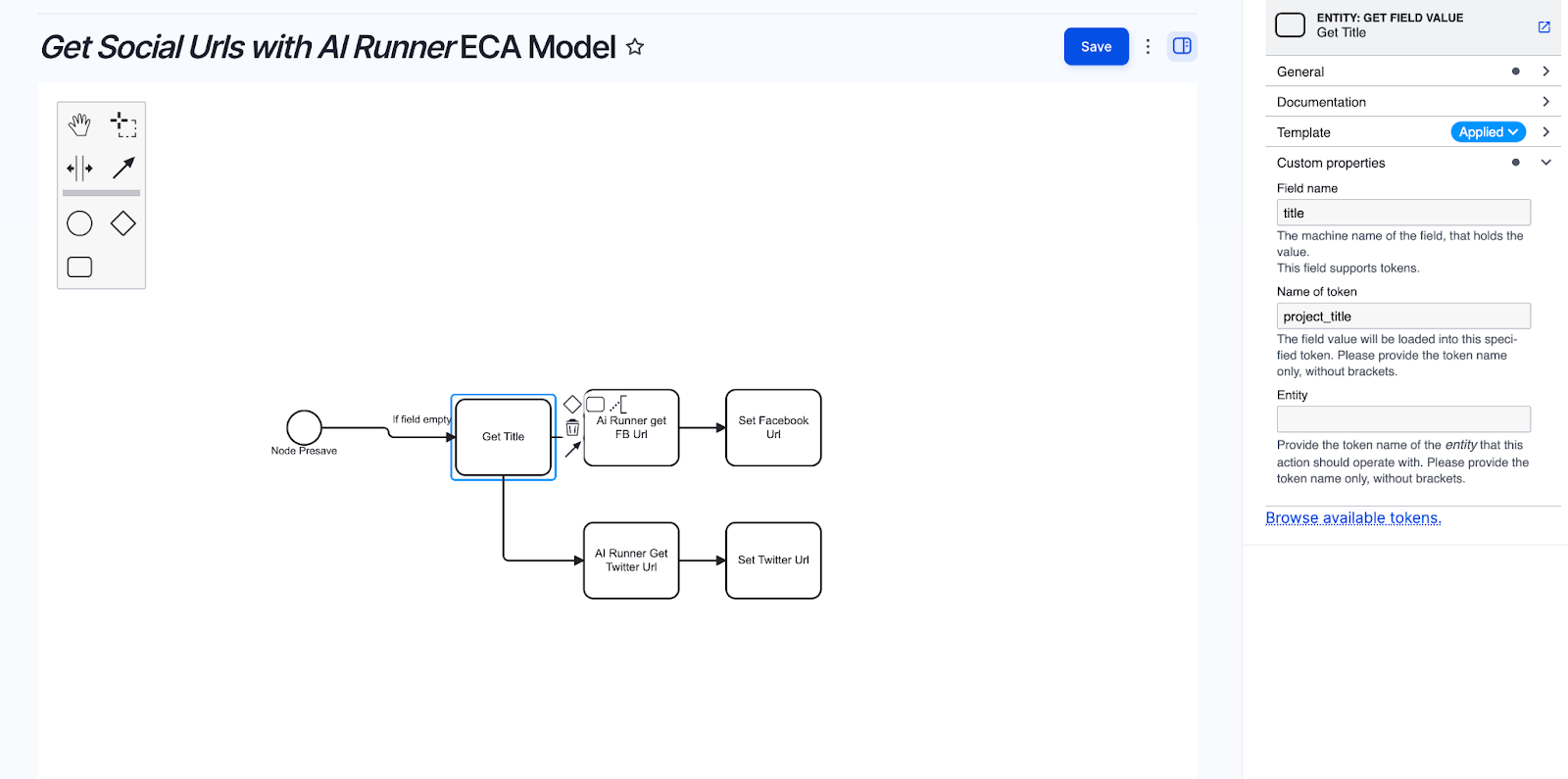
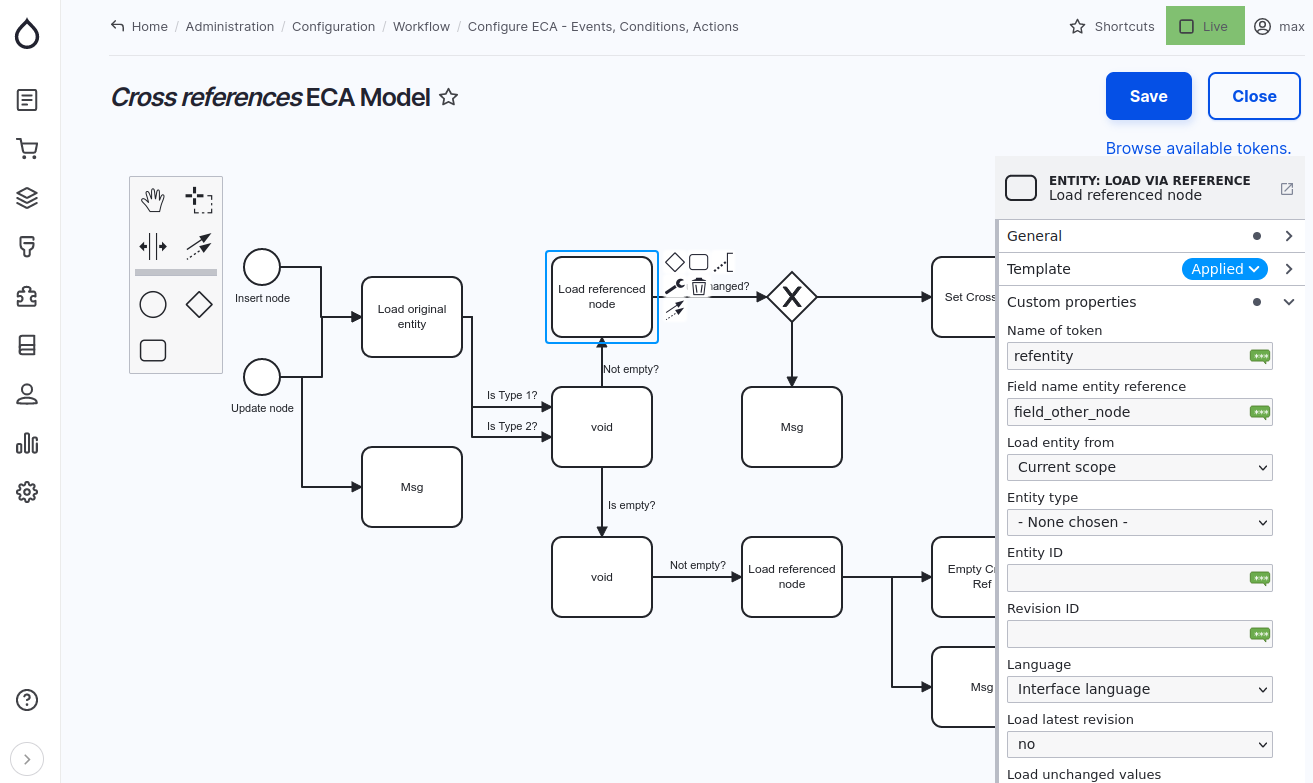
This module brings those two great worlds together and allows Drupal users to build, view and maintain their BPMN models right inside of their Drupal site:

Modeling with BPMN.io:

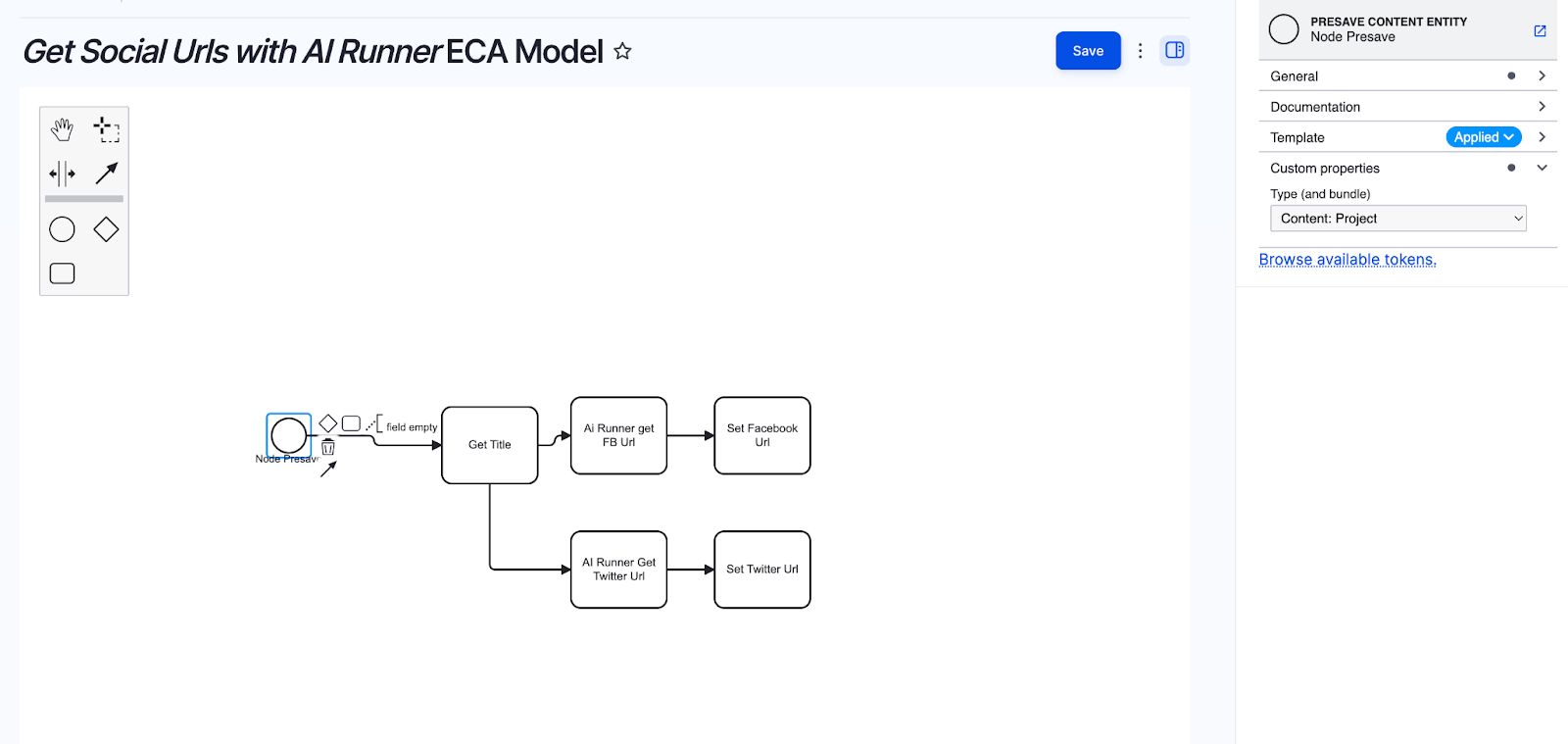
  • BPMN.io allows you to visually design business processes, integrating ECA rules to define the flow of tasks and decisions.
  • ECA rules can be represented as decision gateways or tasks within the BPMN diagram.

Event-Condition-Action Logic in BPMN:

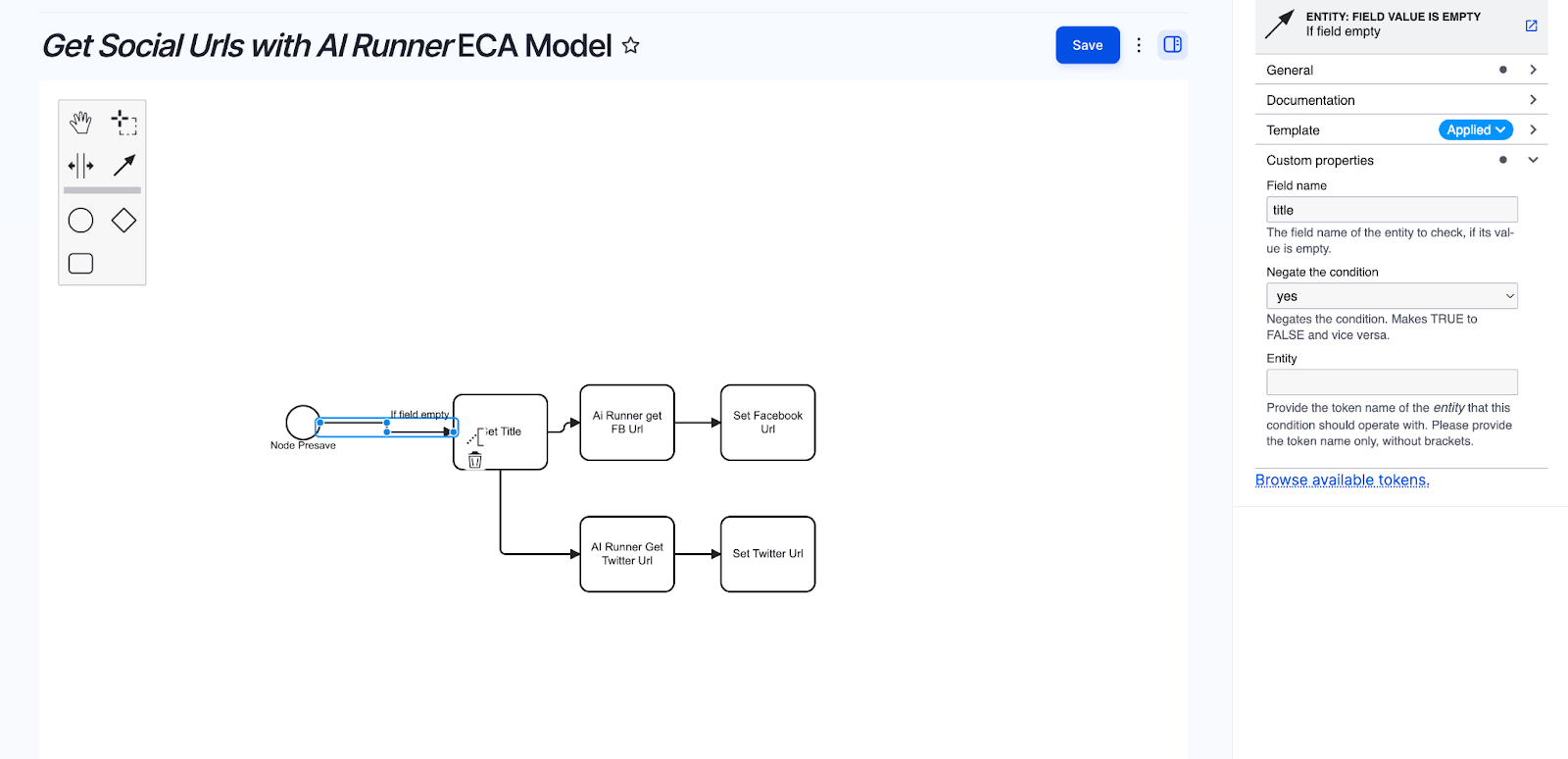
  • BPMN models can incorporate events (triggers), conditions (criteria), and actions (tasks) to execute business rules automatically during the process flow.
  • This improves process automation and reduces the need for manual input or intervention.

Process Automation:

  • As the process runs, BPMN.io engines can automatically evaluate conditions (based on real-time data), and when the condition is met, the system takes action as defined in the ECA rules.

Workflow Optimization:

  • With BPMN.io, you can visually monitor and adjust workflows, ensuring that ECA rules are working as expected.
  • It simplifies the management of complex processes by giving clear visibility into each step of the workflow.

Integration with Other Systems:

  • BPMN.io integrates with backend systems, so ECA rules can be triggered by external events or services, creating a seamless workflow across platforms.

Conclusion

Integrating ECA modules into your business logic ensures that your processes run smoothly and efficiently, making your operations more effective and future-ready.

Recently at LN Webworks, the expert team has scheduled a presentation discussing the ECA module. As a top Drupal development company our main motto is to learn new technology and stay updated with all the trends.

Contact us today to book a consultation and learn how our solutions can transform your business.

Manpreet Singh
The Author
Manpreet Singh

Drupal Expert

Read More Blogs

Chatbot vs. AI agent comparison showing a chatbot answering questions and an AI agent making decisions, taking actions, and working across systems. Other

Call center chatbot. Virtual assistant. AI agent. Copilot.  Half the vendors selling you software right now use these words interchangeably. The other half use them to mean completely different things, sometimes on the same product page. That confusion is not just annoying marketing copy. It changes what you should actually build, what it should cost, […]

AI agent development cost and pricing overview for 2026–2027 Other

AI agent is being used right now to describe two very different kinds of software, and almost nobody stops to specify which one before asking what it costs. A scripted assistant that answers a fixed set of questions is called an agent. So does a system that plans, acts across multiple tools, and adjusts its […]

Custom software pricing comparison for CRM, ERP, and HRMS projects, showing typical cost ranges from $5,000 to $2 million+. Other

Ask five agencies what a custom software project costs and you will get five variations of it depends. Technically, they are all correct. Practically, it is a useless answer to give someone trying to plan a budget, get a proposal approved, or figure out whether they are even in the right conversation before spending a […]

Privacy Overview

This website uses cookies so that we can provide you with the best user experience possible. Cookie information is stored in your browser and performs functions such as recognising you when you return to our website and helping our team to understand which sections of the website you find most interesting and useful.