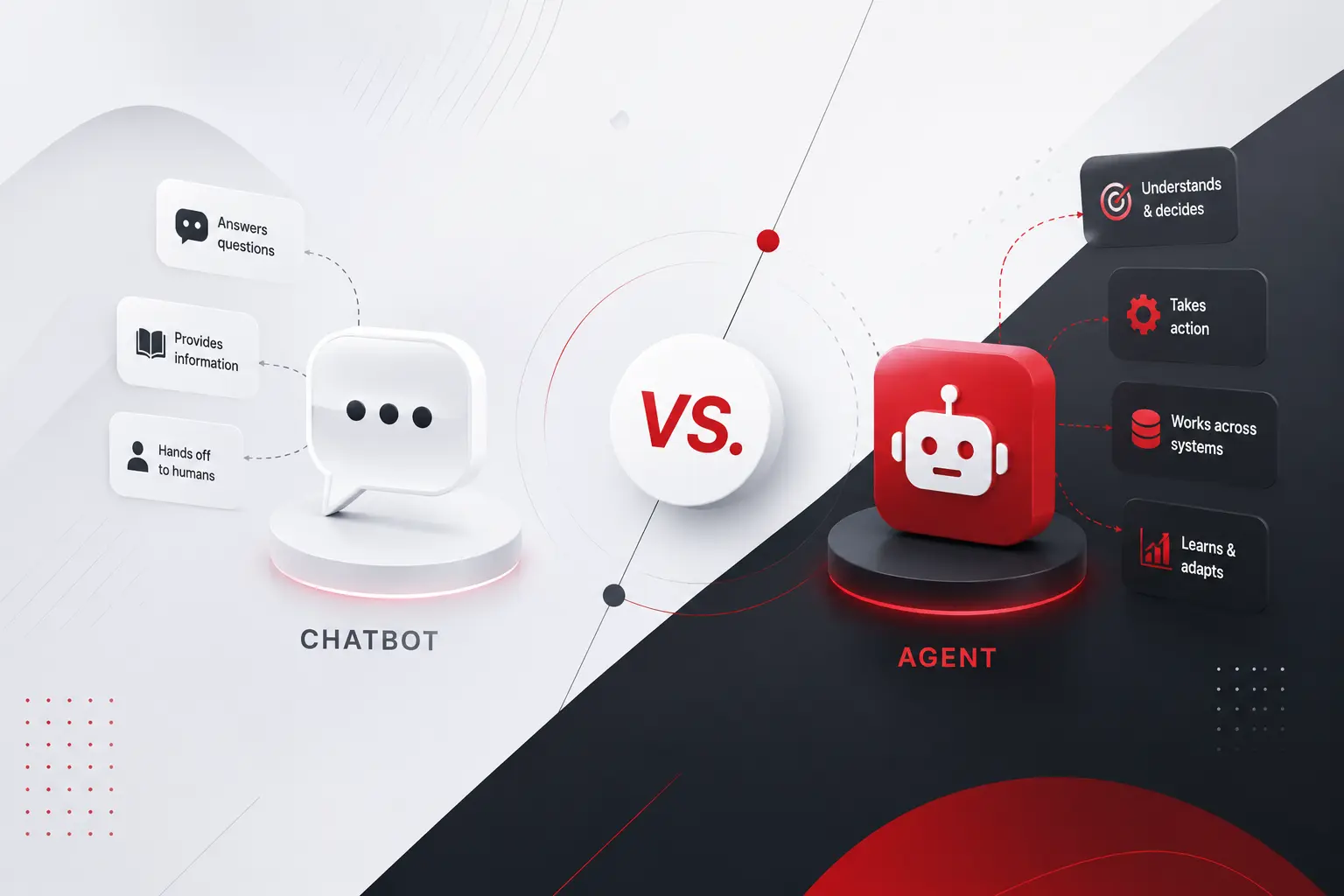
Call center chatbot. Virtual assistant. AI agent. Copilot. Half the vendors selling you software right now use these words interchangeably. The other half use them to mean completely different things, sometimes on the same product page.
That confusion is not just annoying marketing copy. It changes what you should actually build, what it should cost, and what you can reasonably expect it to do once it is live.
A support widget that answers billing questions does not need the same architecture as a system that reviews a claim, decides how to route it, and updates three connected systems on its own. Calling both of them “AI” does not make the decision between them any easier.
What a Chatbot Actually Is
A chatbot answers. That is the whole job description, however sophisticated the answering gets.
Modern chatbots are good at this: matching a question to an answer, holding a conversation across a few turns, pulling from a knowledge base, handing off to a human when they get stuck.
Some run on rigid decision trees. Others use a language model to sound more natural. Either way, the job stops at the reply. A chatbot does not check your order status in a separate system and fix it. It tells you what it already knows, or it looks something up and reports back.
That is not a limitation. For most customer-facing problems, answering well is exactly what is needed. Building anything more complicated than that is wasted engineering.
What an Agent Actually Is
An agent does not just answer. It decides, then acts, then checks what happened, and often decides again.
Ask a chatbot to fix a billing error, and it will tell you how to fix it, or connect you to someone who can.
Ask an agent to fix the same error, and it can look up the account, identify what went wrong, apply the correction in the billing system, and confirm the fix, without a human doing any of those steps by hand.
The defining trait is not how smart the conversation sounds. It is whether the system takes real actions across real systems on its own, and whether it can adjust its next move based on what it finds along the way.
Does the system only ever produce a response, or does it also change something?
A chatbot’s output is words. An agent’s output is action, sometimes with words attached to explain what it did.
One more question settles it if that still feels blurry. When the situation does not match what was expected, does a human have to step in, or does the system work out a next step on its own? Chatbots hit a wall and stop there. Agents keep going, within whatever boundaries they were given.
When a Chatbot Is Actually the Right Call?
Most businesses evaluating this decision do not actually need an agent, even when the internal pitch uses the word. If the goal is answering common questions quickly, cutting down simple support volume, or pointing someone to the right page or person, a chatbot does that job well, costs a fraction of what an agent costs, and ships in weeks rather than months.
Reaching for agent-level autonomy on a problem that only ever needed a good answer is how teams turn a support widget into a six-figure project by accident.
A retailer fielding “where is my order” and “what is your return policy” questions does not need a system that decides anything.
It needs one that answers those questions correctly, every time, and hands off the small fraction it cannot resolve. Building an agent for that use case adds cost and risk without adding value nobody was asking for in the first place.
When You Actually Need an Agent?
The case for an agent shows up when the value sits in the action, not the explanation. A system that needs to check inventory and place a reorder, reconcile a discrepancy across two systems, or triage and route a request based on several shifting conditions is doing real work a chatbot was never built to do.
If a human is currently doing that work by hand, reading something, deciding something, then updating two or three systems to reflect the decision, that is the shape of the problem an agent solves.
A logistics team manually cross-checking a shipping manifest against inventory records every morning, then updating both systems and flagging discrepancies to a supervisor, is doing exactly the kind of multi-step, multi-system work an agent is built to take over.
Nobody needs a better answer here. They need the checking, the updating, and the flagging to happen without a person doing it by hand at seven each morning.
Healthcare has been a useful proving ground for this distinction, since the stakes make the gap between informative and autonomous impossible to ignore. We looked at where that line actually sits in how AI chatbots are actually changing healthcare.
Much of what looks like an agent in that setting is still, underneath, a very good chatbot, and the places where real autonomy does show up come with a level of oversight most other industries have not had to build yet.
What This Means for Cost
The chatbot-versus-agent question is not just architectural. It is financial, and the gap is large enough to reshape a budget conversation entirely.
We broke down what actually drives AI agent development cost in more detail elsewhere, but the short version applies directly here: a well-built chatbot can run a fraction of what even a modest agent costs, because an agent’s price comes from reasoning across steps, connecting to live systems, and the guardrails that come with letting software act on its own. Confirming which one you actually need, before pricing either, is the cheapest step in the whole process.
Neither Term is the Goal
The point was never to build “an AI agent” or “a chatbot.” The point is to solve the actual problem, as simply as that problem allows. Sometimes that is a well-trained chatbot that answers ninety percent of a support queue correctly on its own. Sometimes it is a system that takes real action without anyone watching every step. Picking the more impressive-sounding option by default is how businesses end up paying agent prices for a problem a chatbot would have solved just as well.
If you are not sure which one your use case actually needs, that is worth ten minutes of conversation before either gets built. Talk to Our Team, and we will tell you honestly which one fits.
Talk to Our Team →
The Author
Shikha Kumar
Co-Founder & Director