Why Your CMS Cannot Keep Up With a Video-First Pivot?
Hem Kant
·
04 Sep, 2026
A content management system built to publish articles and a cms built to publish video are not the same product wearing different skins. That is the assumption most publishing and media teams get wrong the moment leadership signs off on a video-first strategy.
Budget goes toward producing video: cameras, editors, a streaming vendor, sometimes an entire new studio. Almost none of it goes toward asking whether the platform publishing that video was ever built to handle it.
Three to six months in, the cracks show up as encoding jobs that time out, a media library that treats a two-hour documentary the same as a thumbnail image, and an editorial team manually re-uploading the same clip to three different channels because the system cannot push it anywhere on its own.
None of this means the original CMS decision was wrong. Most publishing platforms, including common Drupal and WordPress builds, were architected article-first for good reason: text was the dominant format for two decades.
What breaks is the assumption that adding video support is a plugin decision rather than an architecture decision, the same gap we see across media and publishing organizations generally, whether the content is articles, streaming video, or both.
This piece breaks down what actually fails first, why it shows up as a content problem before anyone traces it to the platform, and what a genuine video-first foundation requires.
Four structural gaps tend to surface once video volume becomes real, well past what a single plugin was ever meant to carry.
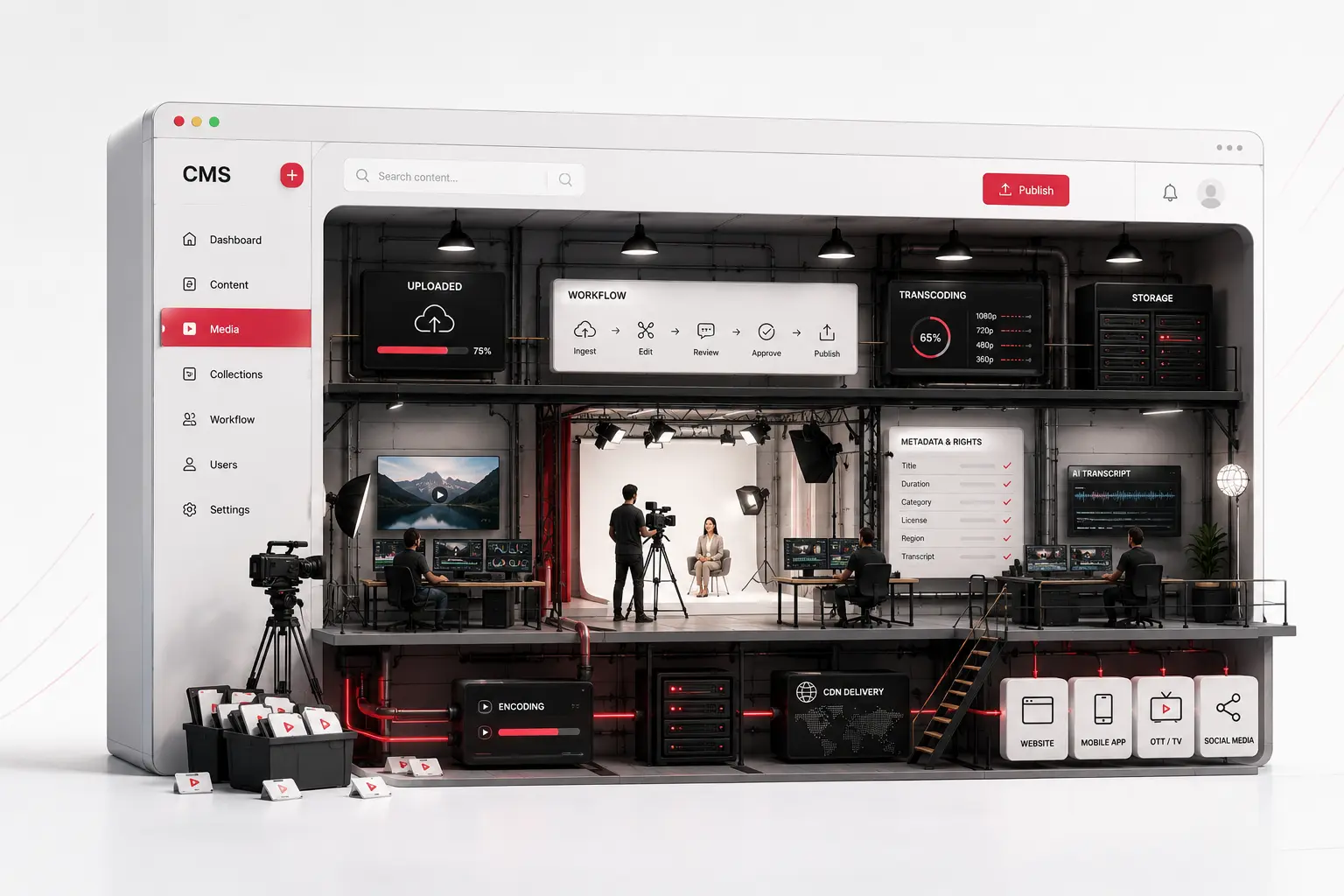
Images and PDFs are static files; the CMS stores them and serves them as-is. Video needs transcoding into multiple bitrate renditions, adaptive streaming through HLS or DASH, and delivery through a content delivery network built for large files under load.
Article-first CMS platforms rarely handle any of that natively, so video ends up bolted on through a third-party player embed, disconnected from the rest of the content system.
An article’s metadata is built around author, category, publish date, and tags. Video needs duration, chapters, captions, and transcripts, thumbnail variants for different placements, and, for anything with regional distribution, a rights and licensing window.
If the schema was never designed to hold that data, editors end up tracking it in spreadsheets instead of the system of record.
An article review is typically a single-pass approval. Video runs through ingest, rough cut, edit, encode, caption, legal or rights clearance, and scheduled release, often across multiple formats and platforms. A workflow built for one review stage cannot represent six.
A video file with no transcript or structured metadata is invisible to search and to any AI answer engine summarizing content on a publisher’s behalf.
Search indexing is built to crawl body text. Neither a search engine nor an AI answer tool can watch a video; they can only read what the system tells them is in it. Without a transcript or structured metadata, the video does not exist as far as either is concerned.
None of these gaps is visible on day one. They surface once video volume is high enough that manual workarounds stop scaling, usually the same point at which archive content starts going undiscovered because the metadata was never structured to support it in the first place.
Nobody opens a ticket that says the media library architecture cannot support adaptive bitrate streaming. What actually gets reported looks smaller: a producer manually re-uploads the same segment to the website, the app, and a social scheduler because the CMS will not push it anywhere on its own.
An editor spends an afternoon writing captions by hand because the system has no transcript field to populate automatically. A year-old video sits in the archive, technically still online, invisible in search because nobody tagged it with metadata the platform never asked for.
These read as staffing or process problems. Someone proposes a style guide, an upload checklist, and an extra hire. All of that helps at the margins, but it treats the symptom.
The actual cause sits one layer down, in a platform that was never asked to support this content model, and it usually takes several of these workarounds piling up before anyone traces the pattern back to the CMS itself rather than the team running it.
The clearest way to see the gap is side by side.
| Requirement | Article-First CMS | Video-First Requirement |
|---|---|---|
| Storage & delivery | Static file storage, direct serve | Transcoding pipeline, adaptive bitrate streaming, CDN |
| Metadata schema | Author, category, tags, publish date | Duration, chapters, transcript, rights window, thumbnails |
| Editorial workflow | Single-pass review and publish | Ingest, edit, encode, caption, rights clearance, scheduling |
| Discoverability | Indexed automatically from body text | Requires transcripts and structured metadata to be findable |
| Archive value | Ages naturally, stays searchable | Degrades without ongoing metadata maintenance |
None of these rows requires a full rebuild in isolation. Together, they explain why adding a video plugin rarely holds up past the first few months of a genuine video-first push.
A platform ready for video-first publishing usually shares a few traits, regardless of whether it sits on Drupal, WordPress VIP, or a custom build.
Content model separated from delivery channel. A headless or multisite architecture lets the same piece of content, article or video publish to web, app, and connected TV without duplicating it for each surface.
A transcoding and CDN pipeline integrated with the CMS, not bolted onto it. Video should move through encoding and delivery as part of the same publishing action an editor already takes, not a separate system someone has to remember to trigger.
Rights and licensing tracked per title and per region. Availability windows and syndication rules need to live in the system, not in a shared spreadsheet someone forgets to update when a license expires.
Metadata built for how content actually gets found now. Transcripts and structured data make video legible to search engines and AI answer tools, not just a title and a thumbnail.
This is the same underlying diagnosis that shows up whenever a platform stops matching the content or product model running on top of it.
It is the same pattern behind what happens when an e-commerce team outgrows its platform, just triggered by a different content format instead of a growing product catalog. The fix is rarely replacing everything. It is usually finding where the architecture stopped matching the content model, and rebuilding that part deliberately.
A video-first pivot becomes a platform decision before it becomes a content-strategy decision. Three questions tend to reveal whether that decision has already been made by default, without anyone deciding it on purpose.
1. Can you name every place video data currently lives?
Across the CDN, a separate digital asset manager, the CMS media library, and cold storage, without checking with three different people.
2. Does your metadata schema already include duration, rights window, and transcript fields?
Or would every existing video need manual backfill to catch up once the schema changes?
3. If a licensing or regional-availability question came up today, could someone answer it from the system?
Or would they have to go looking through emails, spreadsheets, or a colleague’s memory?
If any of those answers are uncertain, the platform question needs resolving before the content strategy moves any further.
Video-first is not a decision a team makes once. It is a platform commitment that gets made either deliberately, with the architecture built to support it, or by default, one workaround at a time, until the pattern becomes too expensive to unwind. The publishers who get ahead of this treat the platform question with the same seriousness as the content strategy, rather than as something to fix once volume forces the issue.
| A Modernization Readiness Audit gives a direct, evidence-based answer on whether your current CMS can support a video-first pivot, and exactly where it would break first if it cannot. |

 Digital Transformation
A CRM gets bought, rolled out, and quietly abandoned by half the sales team within a year. An AI tool gives a confident, wrong answer to a customer, and nobody catches it until the complaint arrives. A company’s tech stack grows to hundreds of connected tools, and not one person can say with confidence what […]
 DevOps, Platform Strategy
Gartner says 80% of large software engineering organizations will have a dedicated platform team by the end of 2026. That stat is everywhere right now. It’s also convinced a wave of 15-person startups that they need an internal developer platform immediately. Most of them are wrong. Here’s why, and how to tell which side of […]
 Mobile Development, Platform Strategy
Three options exist for building a mobile app: native, Flutter, or React Native. Only one of those three answers is stable. Native has meant roughly the same tradeoff for a decade: full platform control, two separate codebases, two separate teams or skill sets to maintain – one point in the broader native vs. web vs. […]