A CRM gets bought, rolled out, and quietly abandoned by half the sales team within a year.
An AI tool gives a confident, wrong answer to a customer, and nobody catches it until the complaint arrives.
A company’s tech stack grows to hundreds of connected tools, and not one person can say with confidence what talks to what anymore.
On paper, these are three unrelated stories about three different technologies but in reality they are not. They are the same story, wearing different outfits.
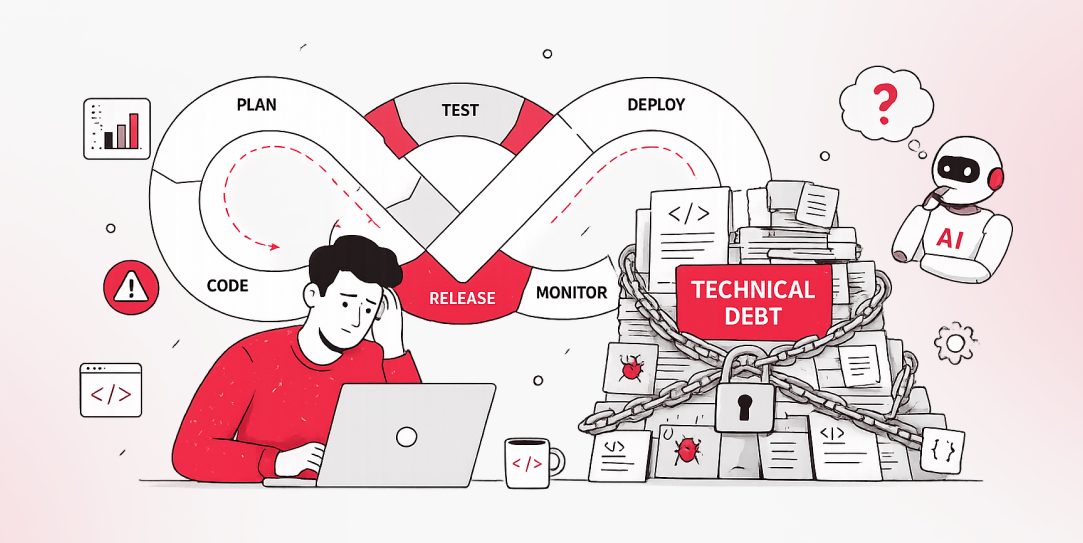
The technology almost never fails on its own. What fails is the decision to skip the boring part: who owns it, who is accountable when it breaks, and how anyone will know if it actually worked.
This is not a hunch. It is a pattern that shows up, consistently, across every piece of research we have looked at closely this year, across categories that have nothing to do with each other on the surface.
Four Studies, Four Technologies, One Repeated Finding
|
Where We Saw It
|
What The Data Actually Showed |
|
CRM rollouts
|
Over 60% of failures traced back to adoption and ownership gaps, not the platform itself. |
| AI-powered features |
Gartner found every root cause of failed AI initiatives was a data or oversight problem, not a model problem.
|
| SaaS and integration sprawl |
Half of all software purchases in a typical company happen with no central visibility at all.
|
| Internal developer platforms |
Nearly 30% of platform teams do not even measure whether their own work succeeded.
|
Four completely different categories of technology. Four completely different sets of researchers. One repeated finding, stated in slightly different words each time: the tool was rarely the reason things went wrong.
Why the Technology Gets Blamed Anyway
There is a simple reason this pattern keeps hiding in plain sight. The technology is the visible part. A CRM nobody uses is easy to point at. An AI answer that turns out wrong is easy to screenshot. A tangle of a hundred connected tools is easy to complain about in a meeting.
The missing piece is never as visible. Nobody photographs the moment a project launched without a named owner. Nobody screenshots the training session that got cut for time. Nobody notices the meeting where “we will figure out who tracks this later” quietly became the permanent plan. By the time something breaks, the actual cause happened months earlier, and it left no evidence behind except the outcome.
The Same Pattern Shows Up in Our Own Writing Too
We were not looking for this pattern when we started writing about these topics individually. It found us. Every time we dug into why a specific category of technology tends to disappoint, the answer kept landing in the same place, dressed differently each time.
- A CRM rollout fails not because the software cannot track a deal, but because nobody made the case for why a busy salesperson should bother logging one.
- An AI tool gives a wrong answer not because the underlying model is broken, but because nobody built a real check between a confident guess and a customer seeing it.
- A company ends up managing more integrations than anyone can track not because APIs are inherently risky, but because nobody owned the growing list as it grew.
- A platform team spends a year building an internal developer platform nobody can point to a clear win from, not because the platform was badly engineered, but because nobody defined what winning would even look like before the build started.
Four different articles, written months apart, about four unrelated corners of technology. Read back to back, they are the same argument, made four times without any of us planning it that way.
Two Companies Can Buy the Same Software and Get Opposite Results
If the real failure point is ownership and process rather than the tool itself, then most of the advice businesses get about technology decisions is aimed at the wrong target. A better feature list does not fix a missing owner. A cheaper subscription does not fix a skipped training plan. A flashier AI model does not fix the absence of a human checking its work before it reaches a customer.
This also explains something that otherwise looks strange. Two companies can buy the exact same software, from the same vendor, at the same price, and get completely different outcomes a year later. The software was never the variable that mattered. The decisions made around it were.
Three Questions That Matter More Than Any Feature List
Most technology evaluations start with a demo and a feature comparison. Based on everything above, that is close to the least useful place to start. A more honest starting point looks like this:
- Who, by name, owns this once the contract is signed? Not a department. A person.
- What does success actually look like, in a number, agreed before launch? Not a feeling. A measurement.
- What changes for the people using this every day, and who is teaching them that change? Not an assumption. A plan.
None of these questions show up in a sales demo. All three of them show up, eventually, in whether the investment actually holds up.
If you are staring down a technology decision and want a second, honest opinion on the ownership questions nobody else is asking, we are glad to get that second opinion.
This is the exact conversation we have with clients before any build begins.
Bring us your next decision →