Why Do AI Chatbots Make Things Up Sometimes?
Hem Kant
·
17 Sep, 2026
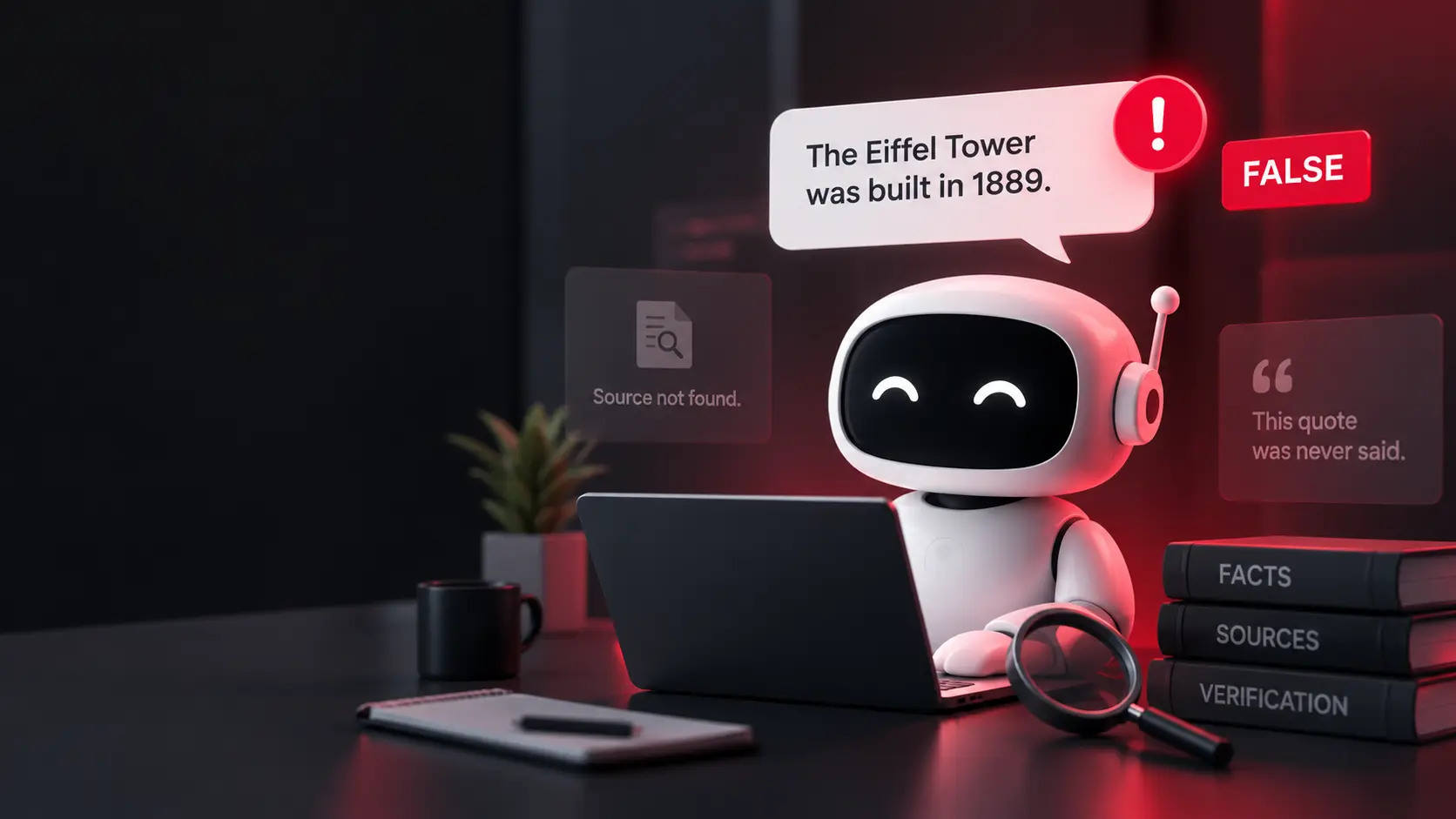
You ask an AI chatbot a question. It gives you a clear, confident answer. It sounds right. But it is not right. The fact is wrong. The source does not exist. The quote was never said.
This happens more than most people think. It has a name in the AI world. It is called hallucination.
This piece explains what that word actually means, why it happens, and what you can do about it.
Hallucination is a strange word for a simple problem. It means the AI said something false. But it said that false thing with total confidence. It did not sound unsure. It did not hedge. It just answered, clearly and calmly, and the answer was wrong.
This can show up in many small ways. The AI might invent a statistic that sounds real but is not. It might make up a book, a study, or a court case that never existed. It might get a real fact about a real company or person slightly wrong, or completely wrong.
The tricky part is not the mistake itself. People make mistakes too. The tricky part is the tone. A person who is guessing usually sounds unsure. An AI that is guessing often sounds exactly as sure as it does when it is right. That is what makes this hard to catch.
A few years ago, some lawyers used an AI chatbot to help write a legal document. The chatbot gave them court cases to cite. The cases sounded real. They had real sounding names and real sounding case numbers.
The cases did not exist. The AI had made them up from nothing. Nothing about how they were written gave that away. The lawyers only found out once someone else checked the cases and could not find them anywhere.
This story matters because it shows the core danger clearly. The problem is not that AI sometimes lies in an obvious way. The problem is that a made up answer can look exactly like a real one, right down to the small details.
If you search for how often AI hallucinates, you will find very different answers. One study says it happens rarely. Another says it happens most of the time. This is confusing, but there is a simple reason behind it.
|
Type of Question |
How often Mistakes Showed Up |
|
Simple, well known facts |
Fairly rare |
| General knowledge questions |
Roughly half the time, in some studies |
| Hard legal research questions |
More than half the time, in one Stanford study |
Each study asked different kinds of questions. Some studies asked easy questions. Some asked hard, specific, technical ones. The harder and more specific the question, the more room there is for the AI to guess wrong. That is why the numbers swing so much. The real point is not the exact number. The real point is that the risk is bigger the harder your question is.
Here is a simple way to picture it. Think about a student taking a test with tricky questions. If the student leaves a question blank, they get zero points for it.
If they guess, they might get it right. Most students guess, because guessing is usually the safer bet, even if it sometimes leads to a wrong answer.
AI companies have found that their models are trained in a very similar way. According to OpenAI’s own research on this exact question, most of the tests used to train and grade these AI tools reward a confident answer, even a wrong one.
They do not reward the AI for saying it is not sure. Over time, the AI learns the same lesson the student learns. Guessing usually pays off. So it keeps guessing, even when it should not.
This matters a lot, because it means hallucination is not just a glitch that will get fixed with the next update. It comes from how these tools are built and tested in the first place.
That does not mean it cannot get better. It means fixing it takes more than a small patch. It takes changing what the AI is actually being rewarded for.
If an AI chatbot gets a trivia question wrong, that is a small problem. Nobody gets hurt. But the same mistake in a different setting can matter a lot more.
Think about a doctor’s office using AI to summarize patient notes. Or a law firm using AI to check contracts. Or a bank using AI to answer questions about a loan.
In each of these places, a confident wrong answer does not look any different from a confident right one. Someone has to actually check the facts to know the difference. If nobody checks, the wrong answer can quietly cause real harm.
Here is another simple example. Say a customer asks a company’s AI chat tool about a return policy. The AI answers with total confidence, but the policy it describes is not the one the company actually uses. The customer believes it, because there is no reason not to. Now the company has a customer expecting something it never promised, and an argument that did not need to happen. Nobody typed anything wrong. The AI just guessed, and the guess sounded exactly like a fact.
This is exactly why AI use in these kinds of settings needs real care, not just excitement about what the tool can do. Speed and confidence are not the same thing as being correct.
The best current fix has a long technical name. It is called retrieval augmented generation. The idea behind it is simple, even though the name is not.
Instead of only answering from memory, the AI looks something up first. It searches real documents, real records, or a trusted database. Then it uses what it finds to build its answer. This is the same difference as a person answering a question purely from memory, compared to a person who checks a reference book before answering.
Looking things up first does not fix the problem completely. But it helps a lot. Studies on AI tools that answer medical questions have found that this step cuts down on made up answers. It also makes the AI more willing to say it does not know something, instead of guessing.
This is also why the exact same AI model can feel very different depending on how it is set up. A chatbot answering purely from memory, and that same chatbot connected to a company’s own real, checked documents, are not really the same tool anymore. The lookup step, not the model itself, often makes the biggest difference in how much you can trust the answer.
Probably not completely, at least not soon. The reason comes back to how these tools work at a basic level. They are built to predict likely words, not to check facts the way a person or a database does.
Even with lookup tools added on top, the AI is still guessing at how to put words together. It is just guessing with better information now.
That is not a reason to avoid these tools.
Cars still cause accidents, and we still drive them, because we build in seatbelts, speed limits, and driving lessons instead of expecting the car to be perfectly safe on its own.
AI tools need a similar mindset. Expect some risk. Build real habits and checks around that risk. Do not expect the risk to hit zero just because the tool keeps getting better.
None of this means AI tools are unsafe to use. It means you need to know where the real risk sits, so you can plan around it instead of being surprised by it later.
None of these steps are complicated by themselves. The hard part is doing them every time, not just once at launch. Teams that treat this as an ongoing habit, not a box to check and forget, end up with AI tools that are far more reliable a year later.
Getting this right is less about chasing the newest, flashiest model and more about how carefully an AI feature gets connected to real, checked information in the first place. That kind of careful setup is exactly what sits behind good AI integration work, instead of a chatbot dropped into a product with no real safety net underneath it.
This same gap, where a tool’s real ability moves faster than anyone’s ability to check it properly, shows up in other places too.
We looked at a version of this same problem, in a much higher stakes setting, in is agentic AI ready for regulated industries.
The pattern is the same either way. A tool can be genuinely impressive and still need real supervision before anyone should fully trust it with something that matters.
If your team is building an AI feature and wants help getting the checking and safety steps right from the start, that is a much easier conversation to have before launch than after something goes wrong.
Reach out and we will walk through it with you.

 AI & Enterprise Strategy, AI Models
You have almost certainly used one. ChatGPT is one. Gemini is one. Claude is one. Every time you type a question into an AI chat tool, one of these systems is doing the work behind the scenes. The name sounds technical. The real idea is simple once someone walks you through it, step by step, […]
 AI & Automation, AI & Enterprise Strategy, Compliance & Governance, Thought Leadership
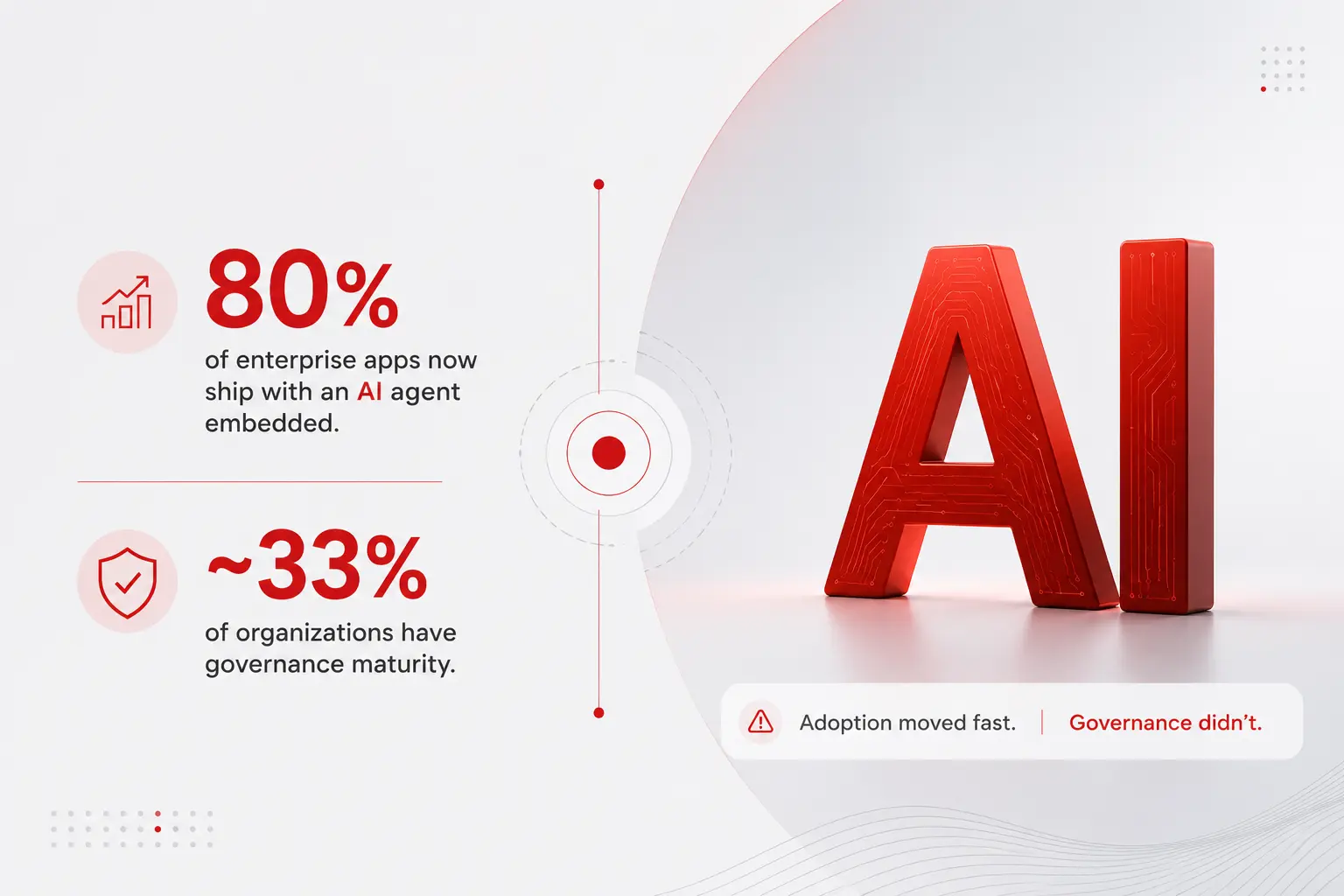
Is agentic AI ready for healthcare and finance is the wrong framing at this point. It is already running in both, at real scale, making decisions that affect real patients and real credit applications. The question worth asking now is narrower and more useful: has the governance around these systems kept pace with how fast […]
 AI & Enterprise Strategy, Artificial Intelligence
A ranked list of ten specific AI products is out of date by the time it publishes. New tools launch weekly, existing ones get renamed or absorbed, and the winner in any given category six months from now is genuinely unclear. What does not change nearly as fast is the shape of the problems AI […]