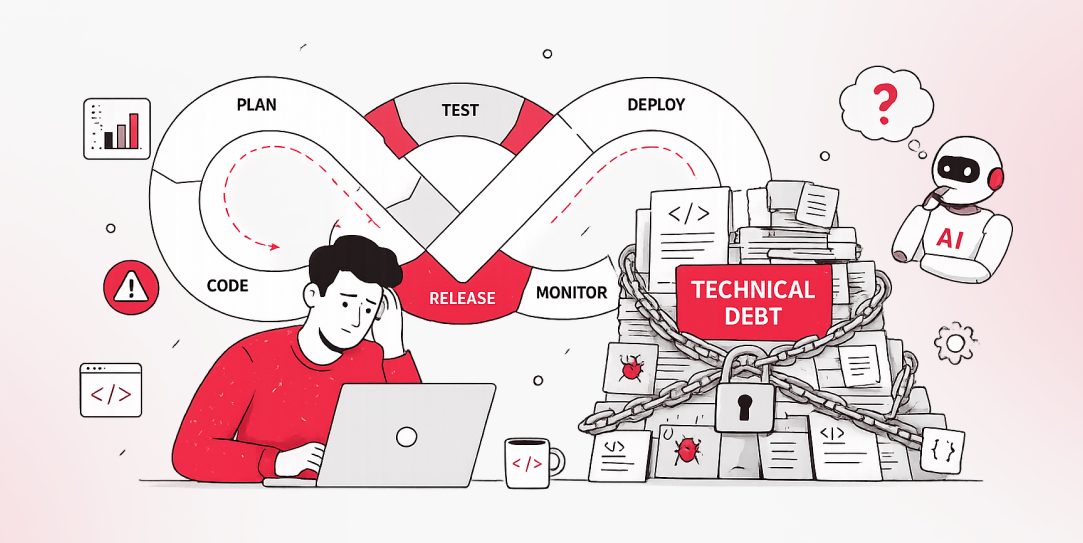
Your Release Cycle Isn’t an AI Problem. It’s a Technical Debt Problem
LN Webworks
·
07 Sep, 2026
It’s tempting to blame this year’s AI coding tools for a slower release cycle. Sometimes that’s exactly right. But for most SaaS platforms, the AI tooling isn’t the root cause. It’s the accelerant, finally showing you a problem that was already there.
Ask your engineering lead why the last release slipped, and you’ll get an answer about a flaky test suite or a delayed dependency. Ask your CTO, and you’ll get a completely different answer about an architecture decision made two platform versions ago. Both are right. Neither is the whole story.
That’s the real problem with SaaS platform technical debt in 2026.
It rarely lives in one system, one team, or one cause that you can fix in a focused sprint.
In this article, we’ll get into: why root-cause analysis keeps failing engineering teams, the four kinds of technical debt actually driving your slowdown, where AI tooling really fits into the picture (and where it doesn’t), the diagnostic questions worth running before your next planning cycle, and what changes once you’re fixing the real cause instead of the symptom.
Every engineering leader has sat through this postmortem. A release slips. Someone traces it back to a bug, a dependency, or an incorrect estimate. You scope the fix, replan the sprint, and three months later, it happens again, in a different part of the codebase, with a different specific cause.
That pattern repeats because the individual causes are symptoms, not the disease.
Deloitte’s 2026 Global Technology Leadership Study puts technical debt at 21 to 40 percent of the average company’s total IT spend. That’s not one misbehaving system. That’s a structural fail spread across your architecture, your processes, your data layer, and the parts of the platform nobody’s touched since the company was a third of its current size.
Root-cause analysis fails here because most teams look for the cause inside the release that slipped. The real cause usually lies upstream, in decisions made months or years earlier that only surface when a new feature has to interact with the system they live in.
Technical debt isn’t one thing. Treat it like one thing, and your remediation plan will fix the visible slice and miss everything still compounding underneath.
Software Improvement Group breaks it into four categories, and each one slows releases through a different mechanism.
| DEBT TYPE | WHAT IT LOOKS LIKE | WHY IT COMPOUNDS |
| Architecture debt | Circular dependencies, tightly coupled services, a monolith you can’t safely partition | Around 80 percent of technical debt is projected to be architectural by 2026-27, meaning refactoring alone won’t fix it |
| Process debt | Skipped test stages, undocumented deploy steps, and manual QA standing in for automation | Every new engineer inherits the gap, and the workaround quietly becomes the standard |
| Data debt | Inconsistent schemas, stale data models, pipelines sized for a scale you’ve outgrown | AI and analytics initiatives stall first, since they need clean data, the platform was never built to produce |
| Legacy debt | Modules only one or two engineers still understand, frameworks past vendor support | Knowledge walks out the door when that engineer leaves, and the next change costs multiples of what it should |
Most platforms aren’t carrying just one of these. They’re carrying all four, at different depths. That’s exactly why is our release cycle slow resists a single answer and a single fix.
These four categories echo a broader pattern we see across most projects, the same web development challenges around performance, scalability, and security tend to resurface as technical debt if they’re not addressed early.
There’s a reason this is getting louder now, and it’s fair to connect it to AI.
AI-assisted development is compressing the front half of the software lifecycle: writing code, generating boilerplate, drafting tests, faster than teams have ever produced them. But writing code faster doesn’t make weak architecture stronger. It just means you hit its limits sooner.
Google Cloud’s DORA research, based on more than 39,000 technology professionals, found that a 25 percent jump in AI adoption tracked with a 1.5 percent drop in delivery speed and a 7.2 percent drop in system stability.
Teams are producing more, and the platforms underneath are absorbing that pace unevenly, depending on how much architecture debt was already sitting there.
The upstream cost shows up before a single new feature ships, too. It is found that almost a third of CIOs say more than 20 percent of their new-product budget gets eaten by debt-related issues before development even starts.
The debt isn’t just slowing releases. It’s taxing the roadmap before the roadmap begins.
If AI-driven review bottlenecks are the piece you’re living with day to day, we’ve covered that specific mechanism in Why Your AI Tools Are Making Your Release Cycle Slower. That piece is about the review queue. This one is the layer underneath it: the architecture, process, and data debt that AI-generated velocity is now running headfirst into, whether or not your team has adopted AI tooling at all.
If your team can’t say with confidence which of the four debt types above is actually driving your slowdown, that’s exactly the gap a Modernization Readiness Audit is built to close: a structured, two-week assessment that maps platform risk, dependency exposure, and readiness before you commit to a fix.
Most engineering orgs debate solutions before they’ve agreed on the diagnosis.
Answer these first.
RUN THIS BEFORE YOUR NEXT PLANNING CYCLE
Teams that can answer all five with real data are rare. Teams that can’t are usually still debugging symptoms every quarter instead of the cause.
The payoff is measurable, not theoretical. Teams that actively manage technical debt free up engineers to spend up to 50 percent more time on work that actually moves the business, and the lowest-debt platforms see higher revenue growth meaningfully as a result. Teams carrying high technical debt, by contrast, report three to five times more production incidents than low-debt peers, and ship features two to four times slower.
The difference isn’t effort. Every team in that comparison is working hard. It’s whether that effort is going against a diagnosed problem or a guessed one.
We see this pattern in almost every modernization audit we run for SaaS platforms this year: it’s usually the four-category breakdown above, not one single AI-driven bottleneck, actually eating the roadmap.
None of this requires a rebuild. Most platforms carrying compounding debt don’t need to start over. They need an accurate map of what’s actually fragile, what’s safe to leave alone, and what order of fixes restores release confidence without stalling the roadmap for two quarters.
If your release cycle has been quietly getting slower and nobody can point to a single cause, that’s worth 30 minutes of your team’s time to talk through. Let’s talk about your platform.

 Digital Transformation
A purchase request lands in a manager’s inbox on Monday. She is traveling, so it sits. On Wednesday it gets buried under forty newer emails. By Friday, the person who asked is not sure whose turn it is, so finance steps in and sends a reminder. The request was approved the following Monday, six days […]
 Digital Transformation, Platform Strategy
Picture the same Tuesday morning, a few months from now. Someone closes a deal in the CRM. The billing record updates itself in the background. Nobody opens a second tab. Nobody retypes a single detail. That is not a fantasy. It is what actually happens once this problem gets fixed, and it is a smaller […]
 Digital Transformation
A system does not become a problem simply because it is old. Some platforms run reliably for a decade or more. Others become difficult to change after only a few years. The difference is not the date the system was built. It is what the system now costs your business to maintain, change, secure, and […]