Subscription and Paywall Infrastructure: Build vs. Buy in 2026-2027
LN Webworks
·
05 Aug, 2026
Most build-versus-buy conversations about paywalls start in the wrong place. They start with architecture, but they should start with your revenue model.
A publisher running a hard paywall for a loyal, committed subscriber base is solving a completely different infrastructure problem than a media brand testing a dynamic, engagement-based meter across three content verticals.
Pick a vendor, or commit to a build plan, before you have answered that question, and you are the team explaining six months from now why the expensive new infrastructure solved the wrong problem.
This matters more in 2026 than it did five years ago. Subscription revenue stopped being a side experiment alongside advertising.
For many publishers, it is now the larger, steadier number on the revenue report, and that changes what is actually at stake here. The paywall is not a UI feature anymore.
It is core revenue infrastructure, sitting next to billing, identity, and content delivery, not something bolted onto a CMS template as an afterthought. This shows up constantly across media and publishing organizations as one of the same recurring problems: subscription and ad data sitting in separate systems that never reconcile into one number anyone actually trusts.
So here is what buying a paywall solution actually gets you, what building one actually requires, the real cost logic behind both paths, and how to make the call without just going with whichever option a vendor pitched first.
Before you get anywhere near build versus buy, there is a model decision sitting underneath it, and it changes what either path actually needs to cover.
A hard paywall puts all your content behind a subscription, with no free access at all. That works if you already have a loyal, established readership and content nobody else has, proprietary data, investigative reporting, expert analysis, the kind of thing readers cannot just find somewhere else for free.
A soft or freemium paywall keeps a portion of your content open and gates the rest, which is how most publishers protect ad revenue while a subscriber base builds underneath it.
A metered paywall gives every reader a fixed number of free articles before the gate comes down, and it is the most common starting model because it lets you test willingness to pay without cutting off casual traffic on day one.
Then there is the dynamic paywall, where access rules shift per reader based on engagement, loyalty, or how likely that specific person is to subscribe.
This is the model picking up the most ground right now, because it stops treating the paywall as a fixed gate and starts treating it as a revenue optimization system.
| Model | What It Requires | Best Fit |
|---|---|---|
| Hard paywall | Simple entitlement check, subscription status only | Established, loyal subscriber base |
| Soft/freemium | Content-tagging by tier, partial access logic | Balancing ad revenue with early subscriptions |
| Metered | Per-reader counter, reset logic, identity tracking | Testing willingness to pay |
| Dynamic | Real-time engagement scoring feeds access rules | Mature subscription programs optimizing conversion |
The model you run decides how much infrastructure buying or building actually has to cover. A hard paywall is close to a yes-or-no check. A dynamic paywall needs a live decisioning system reading engagement data in something close to real time, and that is a very different commitment than most teams expect when the conversation starts with should we build or buy.
“Buy a paywall” is doing a lot of work in that sentence. It actually covers three fairly different categories of vendor, and mixing them up is where most build-versus-buy comparisons go wrong.
Enterprise subscription and identity platforms are built for large publishers running complex rules across multiple properties. They are deep on personalization, testing, and audience segmentation, but you pay enterprise pricing and sign up for an enterprise implementation timeline to get there.
Membership and gating platforms sit a level down: purpose-built infrastructure that plugs into your existing website and handles subscriptions, billing, and member data without forcing a rebuild, the right fit if you want a solid access-control layer without owning everything underneath it.
Then there is platform-native monetization, publishing, and monetizing inside somebody else’s ecosystem, where discovery, payments, and delivery all come bundled in. It is the fastest way to launch, but you do not own the subscriber relationship or the data behind it, the way you would otherwise.
Every category here trades ownership for speed. The faster a paywall is launched, the less of the subscriber relationship you actually keep.
That tradeoff, not the price tag, is usually what should drive the decision. If you are planning to build a serious first-party data and retention strategy around subscriber behavior, that loss of ownership matters a lot more than what shows up on the monthly invoice.
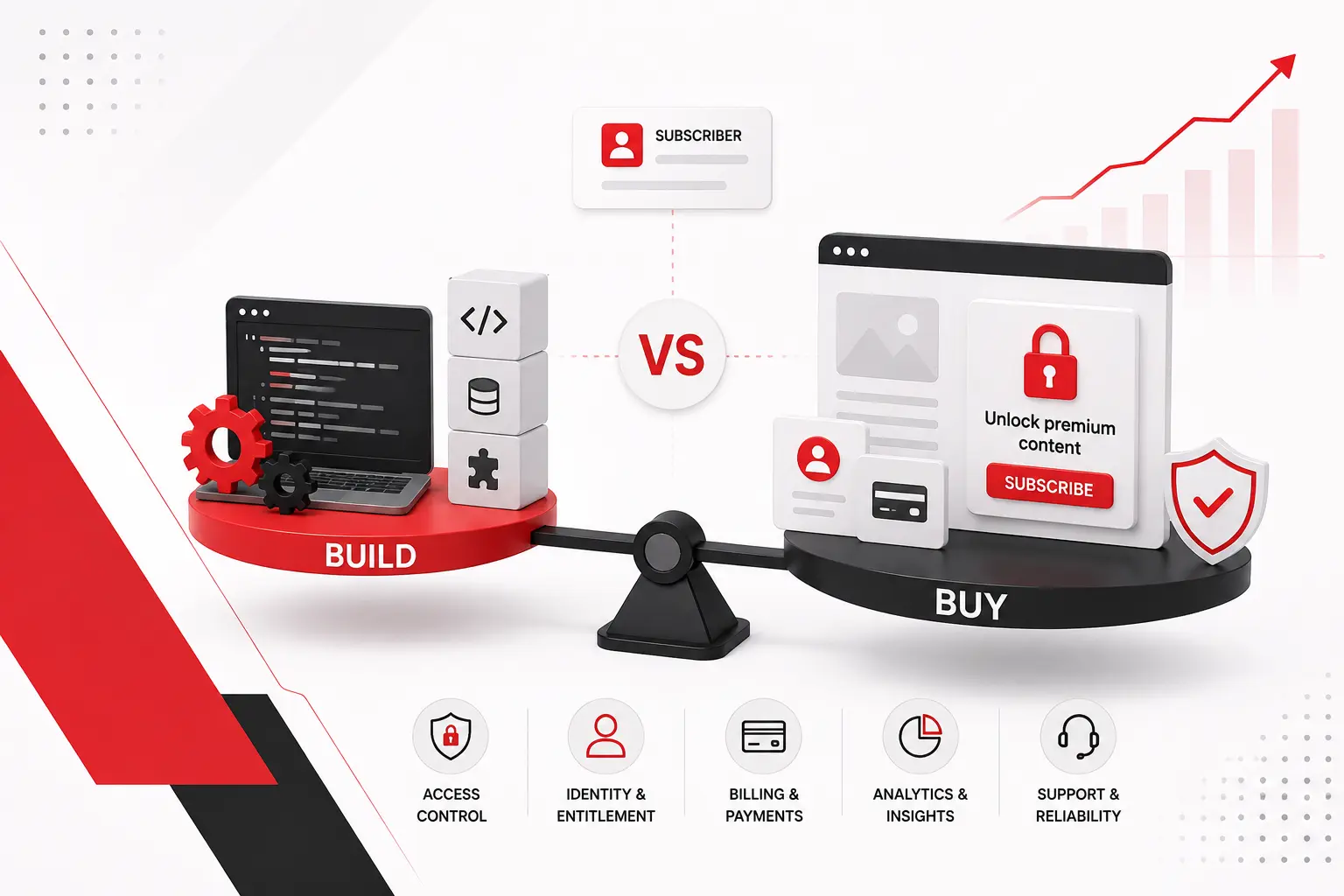
Building subscription and paywall infrastructure is not one system. It is five, and they all have to work together, in real time, for every single request a reader makes.
You need entitlement and access control: the logic that decides, on every request, whether this specific reader can see this specific piece of content, based on subscription status, meter count, or engagement rules.
You need billing and dunning, recurring payment processing, plus the retry and recovery logic for failed payments; dunning is the term for that, which quietly eats a meaningful chunk of preventable churn when it is handled badly.
You need identity and authentication, a reliable way to recognize a returning reader across devices, because metering and entitlement rules do not mean much if the system cannot consistently tell who is reading.
You need content-gating integration that reaches your CMS and CDN, not just what renders in the browser, or the paywall is a suggestion rather than an actual gate. And you need analytics and churn signals feeding back into the rules, because a dynamic or metered model is only as good as the engagement data feeding its decisions.
None of these five pieces is exotic engineering on its own. What makes building genuinely hard is keeping all five in sync, continuously, which is exactly the gap our media and publishing clients describe when their subscription and ad data live in separate systems that never reconcile into a number anyone trusts.
| Dimension | Buy | Build |
|---|---|---|
| Time to launch | Weeks | Two to four quarters for a full stack |
| Cost structure | Subscription fee or revenue share scales with subscribers | Upfront engineering, then ongoing maintenance |
| Control over rules | Limited to the vendor’s rules engine | Full control, at the cost of building it |
| Data ownership | Partial to full, depending on vendor category | Full, by default |
| Lock-in risk | Real: migrating subscriber and billing data later is expensive | None, but internal-knowledge dependency replaces it |
This is the same math behind any platform total-cost-of-ownership decision. The sticker price on either option is rarely the number that matters.
A vendor’s monthly fee looks cheap next to an internal build’s engineering cost, right up until you run the revenue share on a growing subscriber base over three to five years, and the math flips. It works the other way too: a build that looks expensive upfront can end up the cheaper option at scale, but only if you already have the engineering capacity to actually maintain it.
Paywall infrastructure does not sit next to your CMS; it sits inside the same request path. Every piece of content the CMS serves has to pass through an entitlement check before it reaches the reader, which means the two systems need a real integration, not a script tag someone layered on top of a template.
This is the same gap we walked through in why an article-first CMS breaks under a video-first pivot: platforms built for one content model do not just stretch to cover a different one.
A CMS that was never built with entitlement logic in mind treats a subscriber exactly the way it treats an anonymous visitor, and that is exactly the kind of gap that shows up as content leaking past a paywall it was supposed to sit behind.
Rights and licensing windows make this worse. If you are running regional content restrictions alongside a paywall, both systems have to agree, in real time, on who gets to see what, without contradicting each other.
Rather than one clean answer, three questions tend to point you toward the right path.
How complex are your access rules actually going to get?
A single hard paywall with one subscription tier is a reasonable buy candidate, almost no matter how big you are. A dynamic model running multiple tiers, regional rules, and engagement-based logic starts to strain what most off-the-shelf rules engines can actually support.
Does your engineering team have the capacity to own this for the long haul?
Building entitlement and billing infrastructure is not a project you finish; it is a system you maintain at the same priority level as the CMS itself. A build decision without a team committed to keeping it running usually turns into a system nobody wants to touch within eighteen months.
How much does the subscriber relationship, and the data underneath it, need to stay in-house?
If you are planning to build a real first-party data and retention strategy around subscriber behavior, you have a stronger case for owning more of the stack yourself, even if it costs more up front.
Most publishers do not land cleanly on one side or the other. They land on a hybrid: buy whatever is genuinely a commodity, and build, or tightly integrate, whatever is genuinely what sets them apart.
In practice, most working setups look less like buying the paywall and more like buying what is genuinely a commodity and building the layer that connects everything else. A payment processor handles billing.
An identity provider handles authentication. What actually gets built, or at least integrated deliberately instead of left as three disconnected systems, is the layer reconciling subscription status, engagement data, and content access into one picture, instead of three dashboards nobody fully trusts.
That is close to what shows up under metering, dynamic paywalls, and revenue system integration work in practice: buy what is commodity, and treat the reconciliation layer, the thing tying subscription billing, ad serving, and CRM into one real revenue-per-subscriber number, as the part actually worth owning.
The build-versus-buy question does not really have a permanent answer. A metered paywall that made sense at ten thousand subscribers can be the wrong architecture at two hundred thousand.
A vendor that was the fast, sensible choice at launch can become the exact thing holding your subscription business back five years later.
Treat this as infrastructure you revisit on a real schedule, not something you only look at once it breaks, and you end up compounding subscriber revenue instead of rebuilding the same system twice.
A Modernization Readiness Audit will tell you, specifically, whether your current paywall and subscription setup can support the model you actually need, or where a rebuild, integration, or vendor switch would pay for itself fastest.
Book a Modernization Readiness Audit →

 Platform Strategy, Web Development
Key Takeaways Drupal 10 reaches end of life on 9 December 2026. After that, core gets no new releases and no security advisories. Check your minor version today. Drupal 10.6 is the last release, and earlier minor versions have already lost security coverage. The move from 10 to 11 is an in-place upgrade, not a […]
 Legacy Modernization, Platform Strategy
Key Takeaways Modernization is a set of decisions, not a rewrite. For each system you choose one of five moves: keep, wrap, move, rebuild in slices, or retire. Start with a business reason you can write in one sentence, then map what you have before you touch any code. Change small slices while old and […]
 Platform Strategy
The firm that writes your software owns it, unless your contract says otherwise. That is the starting point under US copyright law for software built by an outside firm, and the Copyright Office’s own guidance explains why. It is easy to miss, because nothing in a pitch, a proposal, or an invoice ever brings it […]