SIS vs. LMS vs. Custom Portal: What Does a Growing Institution Actually Need?
Hem Kant
·
04 Sep, 2026
A student information system tracks who is enrolled. A learning management system tracks what they are learning. Somewhere between those two, growing institutions keep running into a third problem that neither system was built to solve, and everyone starts arguing about which one should own it.
| QUICK ANSWER:
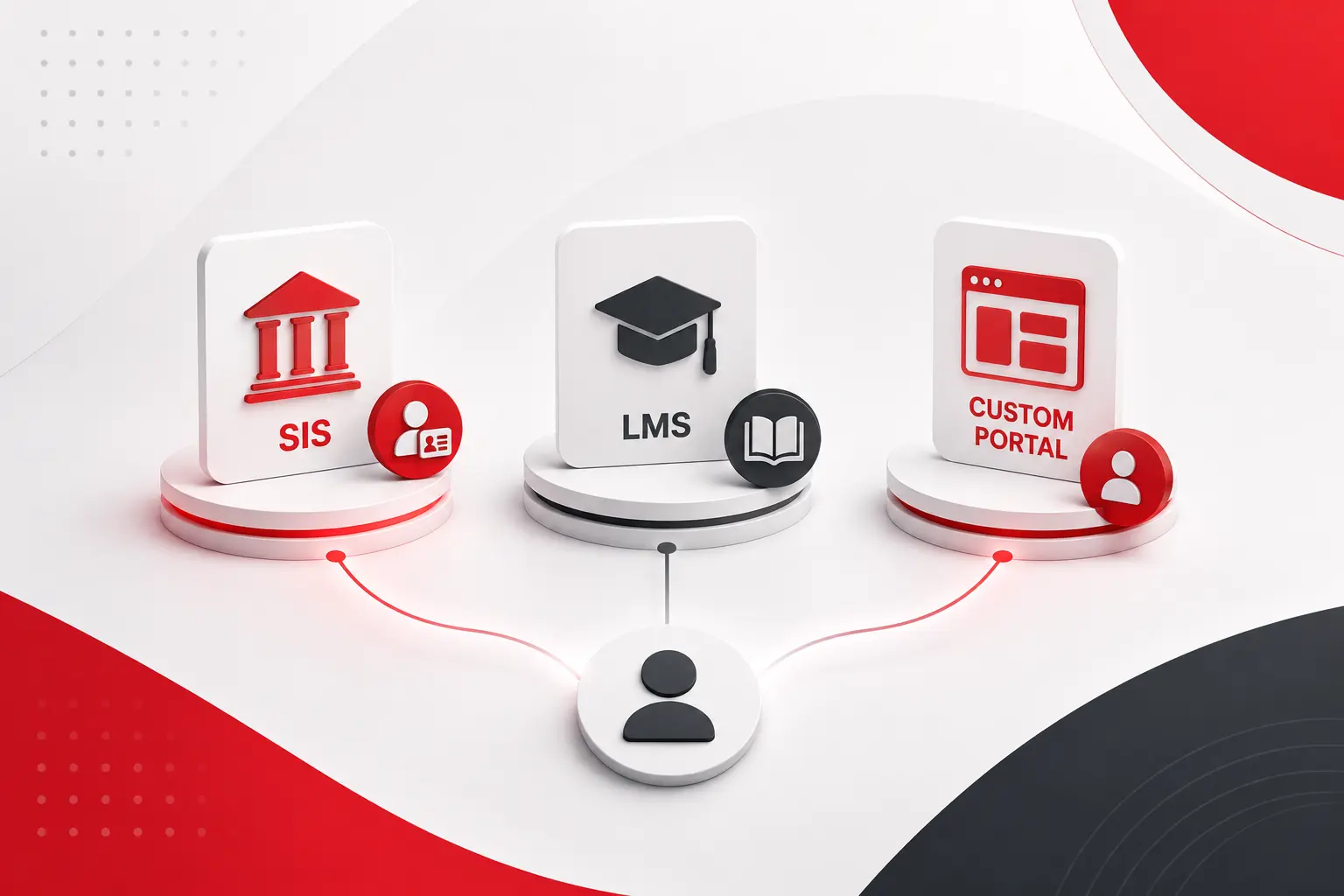
An SIS (student information system) is the official system of record for enrollment, grades, financial aid, and compliance data. An LMS (learning management system) is where coursework, assignments, and instruction actually happen. Neither is designed to give students and staff one unified view across both. A custom portal, when it is the right call, is not a third database; it is an integration and identity layer that connects the SIS and LMS a school already runs. |
That third problem usually shows up as a portal question. Students want one place to check their schedule, their grades, their financial aid status, and their course materials, and neither the SIS nor the LMS was designed to be that single front door on its own.
Solving it well starts with understanding what each system is actually for, because most of the wasted spend in this category comes from institutions buying more of the wrong tool to fix a problem it was never built to address.
A student information system is the institution’s system of record. Enrollment, registration, transcripts, financial aid status, attendance, and the data an institution reports to accreditors and government agencies for compliance all live here.
If a fact about a student needs to be official, auditable, and consistent across every department that touches it, the SIS is where it belongs.
What an SIS is not built for is teaching. Most platforms have added lightweight gradebook or course-list features over the years, but these are convenience layers, not real learning environments. Asking an SIS to deliver coursework is asking a filing cabinet also to run the classroom.
The stakes here are higher than they look. Data that lives in the SIS often feeds accreditation reporting, financial aid disbursement, and government compliance filings directly.
An error or a gap in that record is not just an inconvenience; it can hold up a student’s aid check or complicate an institution’s standing with an accrediting body.
That is part of why institutions are cautious about replacing an SIS wholesale, and why a configuration or integration fix is usually the right first move before a full migration gets discussed.
A learning management system exists to deliver and manage instruction. Course materials, assignments, discussion boards, in-progress grading, and the actual delivery of coursework happen here.
An LMS is built around a course and a term, not around a student’s entire academic record.
That distinction matters more than it sounds. The grade a student sees in an LMS mid-semester is a working number. The official, permanent grade lives in the SIS once the term closes. Treating the LMS as a source of truth for anything administrative is a common, avoidable mistake.
Institutions usually notice this the hard way, during a semester when a student disputes a grade, or an instructor’s LMS gradebook does not match what got submitted to the registrar. Neither system is wrong in that moment. They were simply never meant to agree automatically, which is exactly the kind of gap that either needs a documented process or a real integration, not a system swap.
Most SIS-to-LMS and third-party tool integrations run on a standard called LTI, Learning Tools Interoperability, maintained by 1EdTech (formerly IMS Global).
The current version, LTI 1.3, uses OAuth 2.0 and OpenID Connect to authenticate users and pass information like enrollment status, course roles, and grades between systems securely, without forcing a student or instructor to log into each tool separately.
Canvas, Blackboard, Moodle, and Brightspace all support it, which is why most third-party tools plug into an LMS the same way regardless of which platform an institution runs.
LTI solves the authentication and data-exchange problem well. It does not solve governance on its own. An institution still has to decide what data a given integration is allowed to touch, how long that data is retained, and who is accountable if a third-party tool mishandles it. Standards handle the plumbing. Institutions still own the decisions about what flows through it.
Connecting an SIS and LMS does not violate FERPA on its own, but it does raise the exact questions FERPA is built around: who can access a student’s record, and for what legitimate purpose.
A standards-based integration like LTI 1.3 handles secure authentication and reduces the risk of data leaking through insecure custom connections. It does not replace an institution’s own responsibility for data handling agreements with vendors, retention policies for data once it leaves the SIS, and scoping access so a third-party tool only sees what it actually needs.
This is where a lot of well-intentioned integration projects create risk without anyone noticing at the time. A tool that requests broad access to student records because it is faster to set up that way, rather than the narrow access it actually needs, is a compliance liability sitting quietly until an audit or an incident surfaces it.
The portal need comes from the gap between the SIS and LMS, not from a missing feature in either one.
A student checking financial aid status, a class schedule, and this week’s assignments today is opening two or three separate logins to do it. That gap is what people mean when they start asking for “a portal,” and it is exactly the kind of fragmentation we see constantly across higher education platform work: systems that overlap in purpose but were never built to share data, forcing staff and students into manual workarounds nobody designed on purpose.
This is not a niche complaint. EDUCAUSE’s 2026 Top 10 report, themed “Making Connections,” puts data literacy and de-siloing among the sector’s top priorities for the year, and industry coverage of the report has directly linked unmanaged system fragmentation, sometimes called digital clutter, to enrollment and retention risk rather than treating it as a back-office inconvenience.
A registrar’s record that does not reflect a course drop logged in the LMS is not just untidy data. It can produce a billing error or a missed advising flag for a student who actually needed help.
Buying a bigger, more expensive SIS or LMS rarely closes that gap, because the gap does not live inside either system. It lives in the space between them. This tends to get worse, not better, as an institution grows.
A single department with one program can paper over the gap with a shared spreadsheet and a few dedicated staff who know the workarounds by heart.
A multi-campus institution running several programs, each with its own history of platform choices, cannot rely on informal knowledge to hold that together, and the manual reconciliation that used to take an afternoon starts eating entire weeks during registration and financial aid cycles.
A well-built portal is an integration and identity layer, not a third database competing with the SIS and LMS. It pulls the right data from each system and presents it as one experience, rather than storing its own separate copy of the truth.
That distinction is the difference between a portal that becomes a third silo nobody trusts and one that actually reduces the number of places someone has to check.
| System | Core Job | Source of Truth For |
|---|---|---|
|
SIS |
Enrollment, records, compliance |
Official grades, transcripts, financial aid, attendance |
|
LMS |
Course delivery, teaching |
In-progress coursework, assignments, discussion |
|
Custom Portal |
Unified access layer |
Nothing new; it presents SIS and LMS data in one place |
This is a similar logic to the build-versus-buy question we walked through in custom CRM versus off-the-shelf SaaS CRM: the portal is rarely worth building from a blank page. It is worth building as the connective layer between systems the institution already trusts, once those systems have proven they cannot talk to each other on their own, and once someone has mapped exactly what data needs to move where, and under what access rules.
If the complaint is that students cannot register, check financial aid status, or find an official transcript easily, that is an SIS problem, and more often a configuration or vendor issue than a case for replacing the whole system.
If the complaint is that coursework feels disorganized, or instructors cannot deliver content the way they want to, that points at the LMS, and often at how it was implemented rather than which platform was chosen in the first place.
If the complaint is that no single place shows everything a student or staff member actually needs, and the vendors on either side cannot solve that themselves, that is a portal and integration problem, the kind of gap Systems Integration work is specifically built to close, connecting SIS, LMS, CRM, and identity systems so data moves reliably instead of getting re-entered by hand in three places.
Most institutions that struggle here have perfectly capable systems already. What they are missing is the layer that connects them, the standards-based integration to move data safely, and the governance to keep that connection reliable as departments, programs, and vendors keep changing underneath it. Replacing a system that was never actually broken rarely fixes a fragmentation problem, and it is usually the more expensive path besides.
A Platform Architecture Audit is a faster way to find out whether your gap is inside the SIS, inside the LMS, or in the space between them, before committing to a bigger purchase.

 Legacy Modernization, Platform Strategy
Key Takeaways Modernization is a set of decisions, not a rewrite. For each system you choose one of five moves: keep, wrap, move, rebuild in slices, or retire. Start with a business reason you can write in one sentence, then map what you have before you touch any code. Change small slices while old and […]
 Platform Strategy
The firm that writes your software owns it, unless your contract says otherwise. That is the starting point under US copyright law for software built by an outside firm, and the Copyright Office’s own guidance explains why. It is easy to miss, because nothing in a pitch, a proposal, or an invoice ever brings it […]
 Digital Transformation, Platform Strategy
Picture the same Tuesday morning, a few months from now. Someone closes a deal in the CRM. The billing record updates itself in the background. Nobody opens a second tab. Nobody retypes a single detail. That is not a fantasy. It is what actually happens once this problem gets fixed, and it is a smaller […]