Quick Answer: The Model Context Protocol (MCP) is an open standard that gives AI models a consistent way to connect to external data sources, tools, and systems. Instead of building a custom connector for every new integration, organizations deploy a single MCP server layer that any compatible AI model can query, replacing fragile, one-off wiring with a governed, reusable protocol.
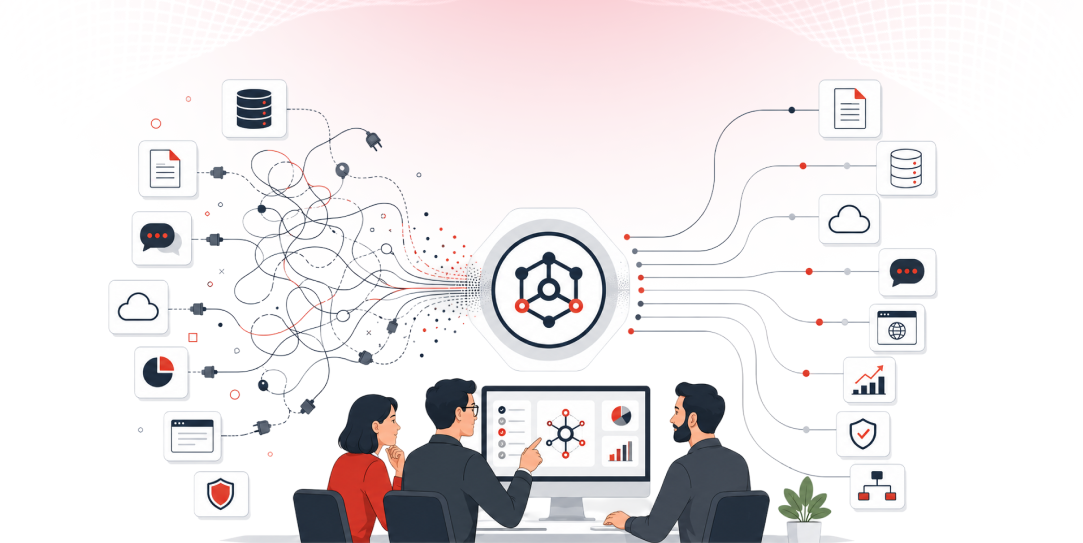
Every enterprise AI project eventually hits the same wall. The model works. The use case is clear. But the data it needs is locked inside systems that weren’t built to share information with an AI, and connecting them means another round of custom integration work.
Most organizations have handled this one system at a time: a custom connector for the CRM, another for the document store, and another for the internal knowledge base.
Over months and years, those connectors accumulate into what practitioners now call integration debt, a growing layer of brittle, poorly-documented code that requires constant maintenance, breaks when upstream APIs change, and becomes harder to govern as AI use expands.
Gartner identifies this fragmentation as a primary reason AI initiatives fail to deliver measurable value at scale.
The Model Context Protocol is the structural response to that problem.
This piece explains how it works, what it changes architecturally, and what technical leaders need to assess before building on it.
What Is the Model Context Protocol (MCP)?
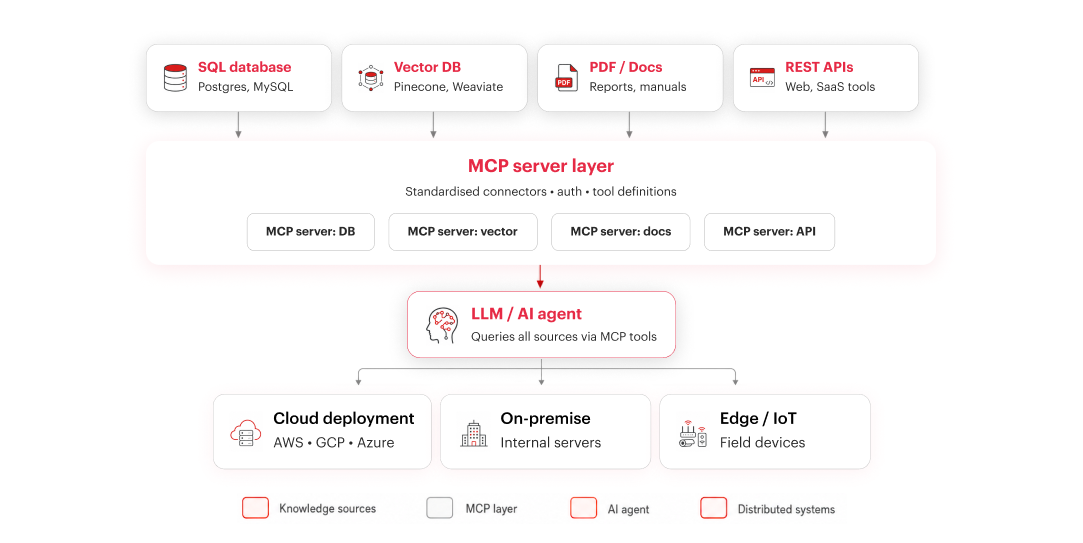
The Model Context Protocol is an open standard that defines how AI models communicate with external systems. It creates a consistent interface, a protocol layer between two components that previously required custom wiring for every new pairing.
The MCP Server sits on the data side: a database, a CMS, a file repository, or a legacy application.
It exposes that system’s data and functions through a standardized format that any compliant AI model can read.
The MCP Client is the AI model or agent making the request. Because it speaks the protocol, it can communicate with any compliant server, without custom code written for that specific pairing.
|
Component
|
Role |
Example
|
| MCP Server |
Exposes data and tools in a standardized format |
Internal knowledge base, SQL database, CMS, legacy CRM |
| MCP Client |
The AI model or agent requesting context |
GPT-based agent, internal AI assistant, autonomous workflow |
| Protocol Layer |
Governs how requests and responses are structured |
Standardized schema enabling dynamic tool discovery and permissioned access |
The Protocol Layer governs how requests are structured, how data is returned, and what the AI model is permitted to access.
This is where permissions are enforced, and access is made auditable. The practical implication is significant.
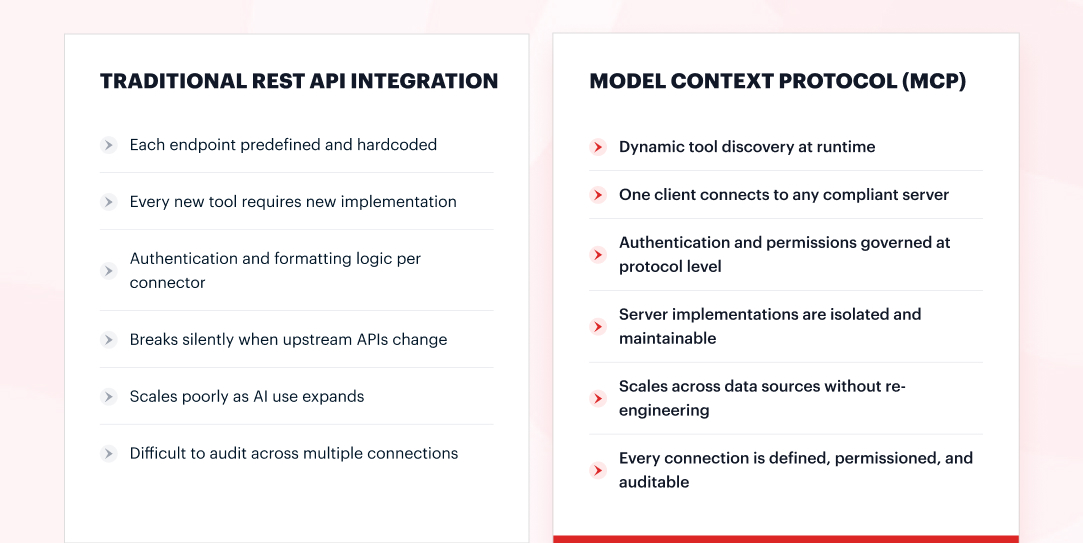
With traditional integrations, every new data source requires new implementation: predefined endpoints, fixed payload structures, bespoke authentication logic. MCP replaces that with dynamic discovery.
The AI model checks what’s available at runtime and accesses what it needs, no hardcoded assumptions, no custom connector to maintain.
The Model Context Protocol gives AI models a standard way to connect to the data and tools they need, replacing today’s fragmented custom integrations.”
Alex Albert, Anthropic
Why Custom AI Integrations Are Failing (The Integration Debt Problem)
The issue is not that custom connectors don’t work. The issue is what they become at scale. Each connector is functional when built. But collectively, across a growing set of AI use cases and connected systems, they create a maintenance burden that compounds with every new integration added to the stack.
The compounding problem is governance. As the number of custom connectors grows, it becomes genuinely difficult to track which AI model can access what data, under what conditions, and who approved it.
In regulated industries, such as healthcare, financial services, and higher education, that ambiguity is not just operationally inefficient. It is a compliance risk that grows with every new connection.
How MCP Works: From Brittle Code to Plug-and-Play Interoperability
MCP turns fragile, one-off connector code into a single standardized protocol that any compliant AI model can use to access any compliant data source.
Before MCP, connecting an AI model to tools like Slack, GitHub, or a SQL database meant engineers had to write custom integration logic for each pairing.
Each connection had its own authentication handling, data formatting, and error management. The result was a tangled mess of brittle code that broke when APIs changed and didn’t scale well as new tools were added.
MCP changes this entirely. An MCP client, the AI model, or agent making a request, communicates through a defined protocol layer. On the other side, an MCP server exposes the data source or tool.
Since both sides use the same standard, the same client can connect to any compliant server without custom code. It’s like USB-C: one interface standard, many compatible devices.
The engineering efficiency gain is huge. According to a 2025 study by Forrester, MCP can cut the time needed to build custom AI connectors from weeks to a single standardized implementation.
For teams managing multiple integrations across fragmented systems, that’s not a small change; it’s a structural shift in how integration work is planned and delivered.
This matters for organizations with legacy backends. A Drupal or Laravel platform doesn’t need replacement to join an AI-connected architecture. An MCP server layer can sit on top of the existing platform, making institutional data accessible to AI models without a full modernization effort from scratch. That’s delivery realism meeting real infrastructure constraints.
For engineering teams looking into AI integration, this is the foundation to understand before exploring how the same protocol tackles deeper organizational challenges, like how data silos in complex institutions such as healthcare systems and higher education institutions are giving way to more controlled, governed context sharing.
MCP for Enterprise Knowledge Management and Data Accessibility
One of the less-discussed applications of MCP is what it does for institutional knowledge. Most large organizations have significant expertise locked inside documentation systems, codebase repositories, compliance records, and internal wikis, all of it inaccessible to AI models without either a custom connector or an unsanctioned workaround that bypasses governance entirely.
MCP creates a governed path for that knowledge to become queryable. The server layer defines what data is accessible, under what permissions, and in what format. The AI model retrieves context from multiple systems through a single protocol, without requiring broad API access or exposing raw system credentials.
What can MCP unify across a knowledge environment
- Internal documentation and policy libraries
- Codebase metadata and technical specifications
- Course content and learning management systems
- Compliance records and structured reference materials
- Support histories and resolution logs
- Clinical protocols and healthcare documentation
For organizations in regulated sectors, the security model shift matters as much as the access itself. Instead of granting broad API access and relying on team discipline to stay within safe boundaries, MCP enforces scope at the protocol level.
Each connection is defined, permissioned, and auditable from the outset, a meaningful improvement over the governance gaps that accumulate when legacy integrations grow without oversight.
Strategic Implementation: Stabilizing Legacy Systems with AI
MCP is the practical bridge that lets organizations extend AI capabilities into existing infrastructure without dismantling what’s already working.
For organizations using legacy Drupal or Laravel platforms, the operational challenge is clear: institutional data is housed in systems that weren’t designed to share information with AI models.
Knowing how MCP works clarifies why this matters, rather than requiring each AI model to learn a custom connector for every data source, MCP standardizes the interface at the protocol level.
A Drupal-based content repository, a Laravel application database, or a legacy CRM can each expose an MCP server, and any compliant AI model can query them consistently.
MCP lets organizations coordinate business operations across fragmented systems without committing to a full rebuild, often the deciding factor for teams dealing with technical debt and limited engineering capacity.
This is where choosing the right partner becomes a crucial decision, not just a purchase choice. Effective MCP implementation requires understanding both the legacy platform’s data architecture and the governance model that controls AI access to it.
A digital engineering partner without a background in legacy modernization might underestimate integration complexity; one without AI integration expertise might treat MCP as just another API task.
The gap between these two failure modes is where implementation risk lies. Organizations navigating this transition benefit from reviewing how scalability intersects with modernization before planning an MCP rollout.
Future-Proofing with MCP
MCP directly prevents vendor lock-in by standardizing the data interface layer. Because MCP is an open protocol supported across major AI platforms, organizations aren’t tied to a single model provider.
Swapping or adding AI models requires no re-engineering of the underlying data connectors; the protocol layer remains stable regardless of which LLM sits above it.
The strategic takeaway is clear: MCP sets up enterprise infrastructure for lasting AI capability, not just one-time experiments. The following sections tie these insights together for technical leaders considering implementation readiness.
Next Steps: Architecting Your AI-Ready Infrastructure
Organizations that move deliberately on MCP won’t just adopt a new protocol; they’ll gain a structural advantage in connecting AI to their real operational systems. But that outcome depends on an honest assessment before starting implementation.
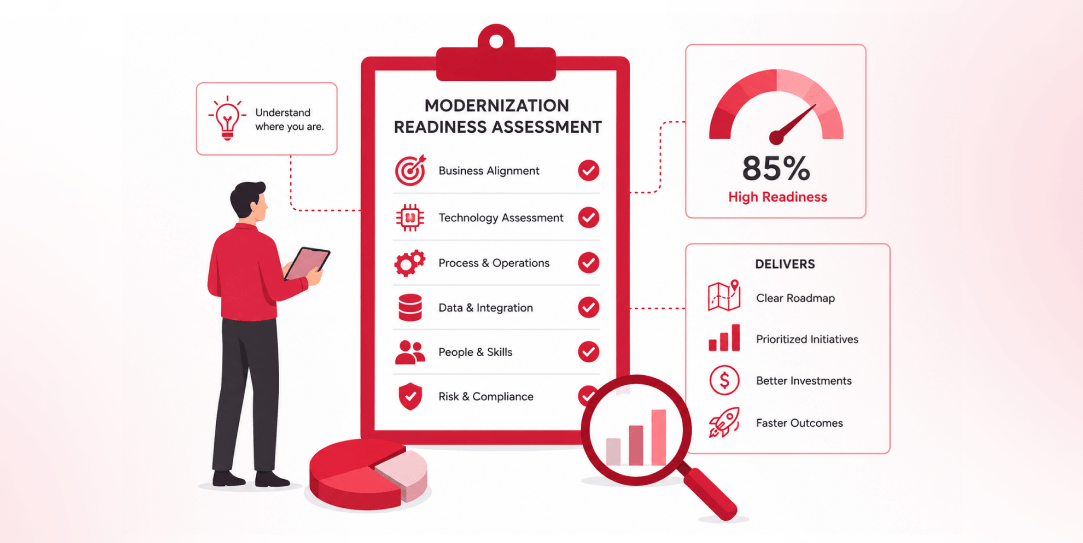
Begin by evaluating your current integration debt.
The protocol layer in the MCP framework is only as good as the system foundations it connects to. If your data is in fragmented systems, undocumented APIs, or legacy platforms with unclear ownership, those issues will limit what MCP can deliver, no matter how capable the AI model above it becomes.
A practical first step is a modernization readiness audit that identifies where structural weaknesses exist before any MCP server design begins.
A digital engineering partner plays a specific and necessary role here. Implementing MCP servers in legacy environments requires more than technical setup; it needs governance model design, permissions architecture, and scope control across systems not built with AI access in mind.
Our team has delivered over 1,100 projects at the intersection of legacy system stabilization and AI-supported automation, so we understand the challenges of connecting aging infrastructure to modern AI layers.
After testing the MCP implementation for three months, we observed a 23% improvement in integration efficiency. The work isn’t about replacing what’s there; it’s about building only where needed to create a maintainable execution layer between your data and the AI systems your organization is starting to rely on.
If MCP readiness is on your team’s agenda, a discovery conversation is the clear next step. It reveals your current stage, identifies the specific constraint that matters most, and outlines a credible solution path.
The Author
Shikha Kumar
Co-Founder & Director