Why Your EHR and Billing System Still Can’t Talk to Each Other?
Hem Kant
·
09 Sep, 2026
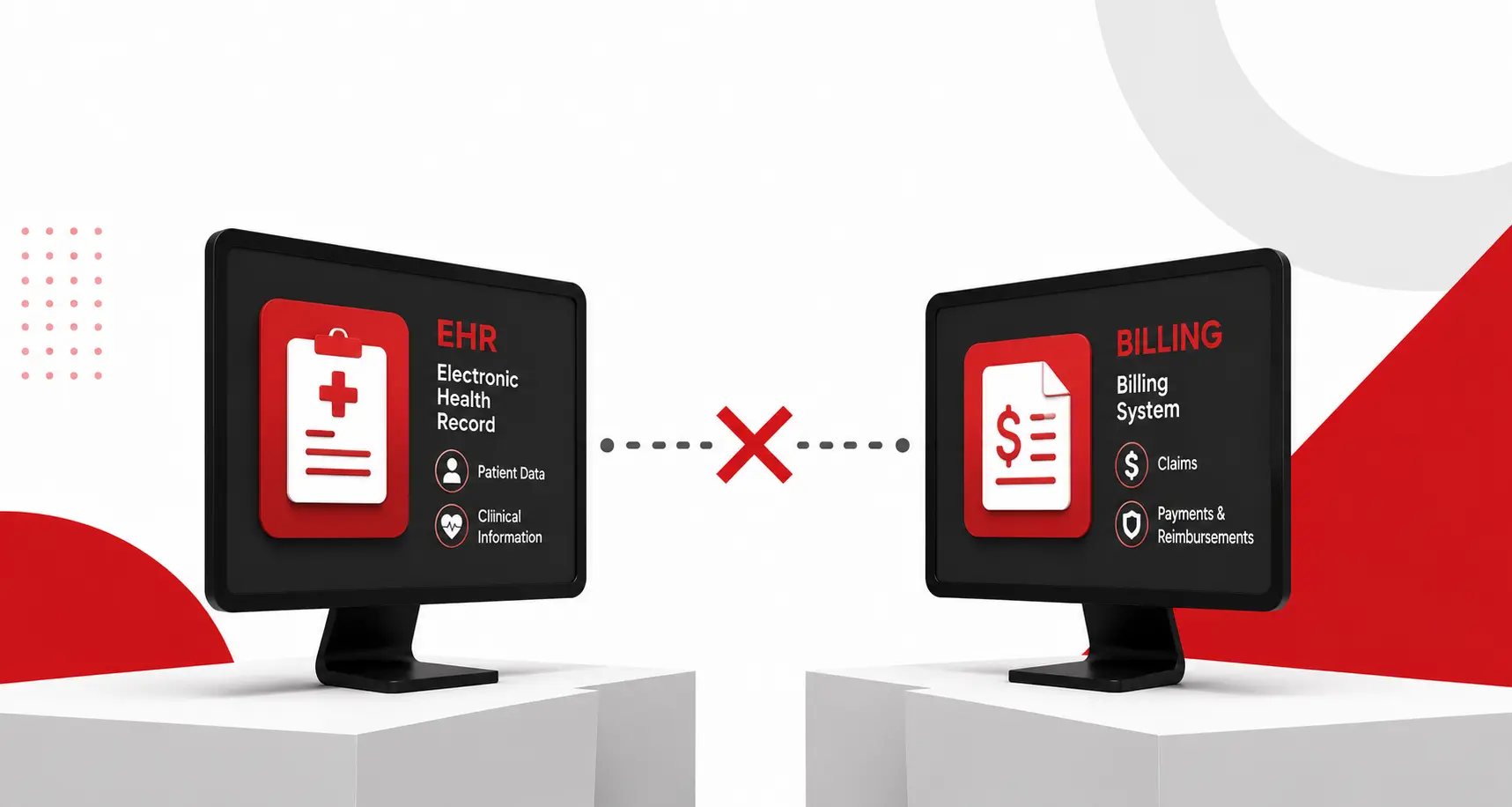
Most explanations for why an EHR and a billing system do not talk to each other assume the problem is a bad integration, a vendor that cut corners, or a connection nobody maintained properly.
That framing is usually wrong. The real reason is more fundamental, and once you see it, the recurring billing errors, the manual re-entry, and the claim denials stop looking like bugs and start looking like the predictable result of connecting two systems that were never built to speak the same protocol in the first place.
The EHR was built to describe clinical reality: what a patient was diagnosed with, what was ordered, what the results showed.
The billing system was built to describe a financial transaction: what service was rendered, under what code, billable to whom, at what rate.
Those are genuinely different jobs, and healthcare IT solved them with genuinely different standards, decades apart, for different audiences.
|
THE CLINICAL SIDE HL7 v2 / FHIR HL7 v2 is a legacy, pipe-delimited messaging format from the late 1980s, still used heavily inside hospitals for admissions, lab results, and orders. FHIR is its modern, REST API-based successor, increasingly used for both clinical and administrative exchange. |
THE BILLING SIDE X12 EDI A completely separate standard, mandated by HIPAA for claims (837), remittance advice (835), and eligibility checks (270/271) between providers, clearinghouses, and insurance payers. It predates modern healthcare IT and was built for a different purpose entirely. |
Neither standard is aware the other exists. A system that speaks fluent FHIR has no native way to generate a valid X12 837 claim, and a billing platform built around X12 has no native way to parse a FHIR clinical resource.
Anything connecting the two is, by necessity, a translation layer, not a simple data pipe, which is exactly the kind of connection most likely to break quietly rather than obviously.
A clearinghouse sits between the billing system and every payer, validating a claim’s X12 structure and payer-specific requirements before routing it onward. Without one, a billing system would need a direct, custom connection to every insurer it deals with, which is exactly the kind of point-to-point sprawl that becomes unmanageable fast.
Major clearinghouses, Availity, Optum, Trizetto, Office Ally among them, exist specifically to absorb that complexity so a provider only has to integrate with one system instead of hundreds.
The clearinghouse solves the payer-connectivity problem. It does not solve the deeper one: getting accurate clinical documentation translated correctly into a billing-ready claim in the first place, which is where most of the actual friction between an EHR and a billing system lives.
A clearinghouse can catch a claim that is missing a required field or formatted incorrectly. It cannot catch a claim built from a diagnosis code that was never quite right in the first place, because from the clearinghouse’s perspective, that claim was perfectly well-formed.
Coding is usually where it starts. A diagnosis documented one way in the clinical chart needs to map to a specific ICD-10 code, and a procedure needs to map to the correct CPT or HCPCS code, correctly and consistently, or the claim gets rejected before a human ever sees it.
Manual claim submissions carry meaningfully higher error rates than validated electronic ones, and every rejected claim is a delay in getting paid, plus staff time spent tracing down what went wrong.
Timing is the second recurring failure. A charge that should post automatically from a documented encounter instead sits waiting for someone to manually transfer it into the billing system, introducing both delay and a fresh opportunity for transcription error.
And because the clinical and billing systems were never sharing one data model to begin with, a change on one side, an amended diagnosis, a corrected procedure code, does not automatically propagate to the other. Someone has to notice, and fix it by hand, in both places.
| Failure Point | What Happens | Root Cause |
|---|---|---|
| Coding mismatch | Claim rejected or denied by payer | Clinical documentation not mapped cleanly to ICD-10/CPT codes |
| Delayed charge capture | Slower reimbursement, cash flow gaps | No automatic bridge between encounter documentation and billing |
| Duplicate data entry | Staff time, higher error rate | Clinical and billing systems maintain separate records of the same encounter |
None of these failure points require a system outage to cause damage. A billing team that spends two extra hours a day chasing rejected claims because coding did not translate cleanly is absorbing a real, ongoing cost that never shows up as a single dramatic incident, only as a revenue cycle that runs consistently slower and leaner than it should.
It is tempting to assume the industry-wide push toward FHIR eventually resolves this gap on its own. It will not, at least not on any near-term timeline.
Recent CMS interoperability rules are expanding FHIR into prior authorization workflows specifically, requiring payers to expose FHIR APIs for that use case. But core claims submission and remittance advice, the 837 and 835 transactions that every reimbursement actually runs through, have no announced FHIR replacement.
The industry processes an enormous volume of X12 transactions every year, and a full migration away from that standard, even if formally proposed, would take the better part of a decade.
That means the realistic path forward is not waiting for one universal standard to replace the other. It is building a proper translation and mapping layer between the two that already exist, one that handles the coding logic correctly, keeps both systems in sync as encounters get documented and billed, and does not depend on a person catching every mismatch by hand.
If your EHR and billing system are held together by manual workarounds and someone’s institutional memory, that is worth a direct conversation before the person who understands the workaround leaves. Book a Discovery Call and we will help you map where the actual gap is.

 Higher Education, Platform Strategy, Systems Integration
Ask an IT director at a growing university what breaks when they try to unify their systems, and the answer rarely starts with the software. It starts with a department that will not adopt the new standard, a data-sharing agreement nobody wants to sign, or a budget line that funded the project but not what […]
 API Strategy, Platform Strategy, SaaS Development, Systems Integration
An enterprise deal usually gets signed by the people least equipped to know whether it is technically achievable. That is not a criticism of sales; it is how the roles are supposed to work. But a contract that promises a specific integration timeline, a specific uptime guarantee, or a specific data migration, without engineering confirming […]
 Platform Strategy, SaaS Development, Systems Integration
An API serving ten clients and an API serving a hundred are not the same system wearing a bigger traffic number. The rules that hold at one scale stop holding at the other, whether anyone wrote them down or not. What follows is not a wish list. It is the specific discipline, in versioning, rate […]