What the ADA Title II Extension Means for Your Institution’s 2026–27 Roadmap, Practically!
 Hem Kant
·
01 Jul, 2026
Hem Kant
·
01 Jul, 2026
We broke down what the DOJ’s April 2026 Interim Final Rule actually changes, and what it didn’t, in our explainer on the new ADA Title II timeline. This piece picks up from there with the part that most explainers skip: how a higher ed institution should actually utilize the window the rule just created.
Two questions matter more than anything else right now, and neither one is a regulatory question. Which deadline actually applies to your institution? And what should happen, quarter by quarter, between now and then? Get those wrong, and the extension doesn’t help you; it just delays when you find out.
THE SHORT VERSION, IF YOU NEED IT: On April 20, 2026, the DOJ extended ADA Title II compliance deadlines by one year. Large jurisdictions now have until April 26, 2027; smaller jurisdictions and special districts until April 26, 2028. WCAG 2.1 Level AA is unchanged, and the underlying obligation was never paused.
Does the 2027 or 2028 Deadline Apply to Your Institution
This is where we see the most confusion, and it is a population question, not an enrollment question. The deadline is set by the size of the jurisdiction your institution sits in, using 2020 Census figures, not the number of students or employees on your campus.
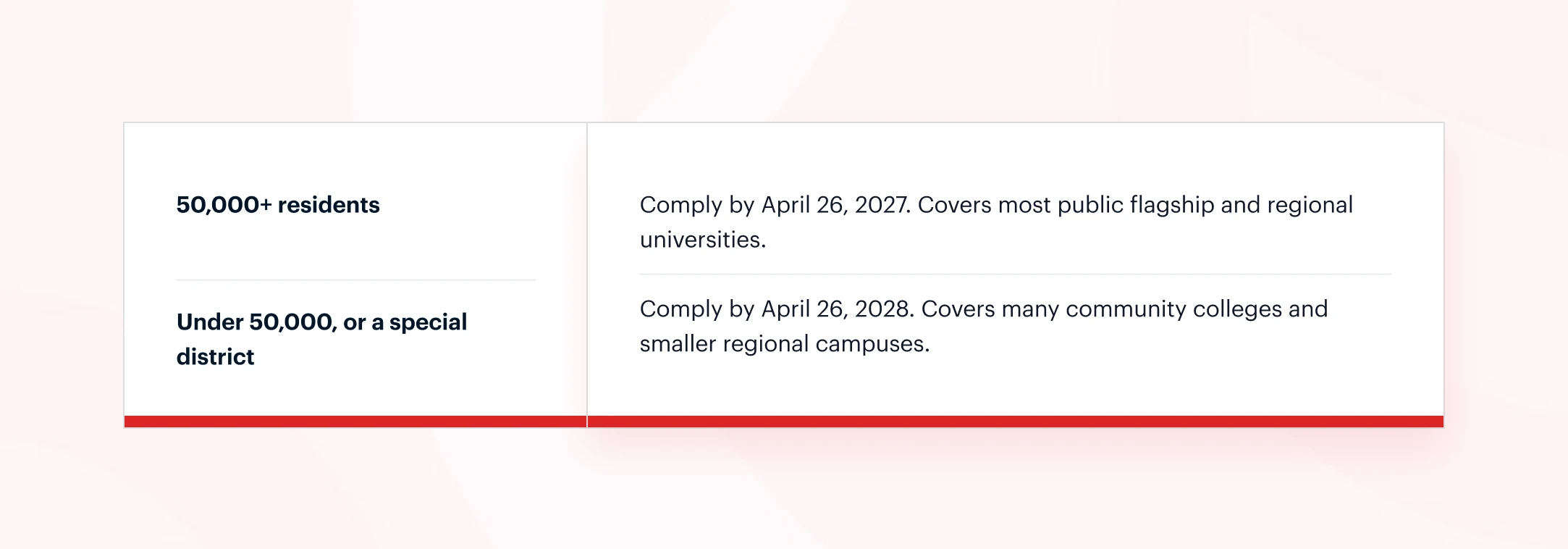
A large research university in a small town can land in the 2028 bucket. A community college inside a major metro area can land in the 2027 bucket. Check your jurisdiction’s population, not your enrollment headcount, before you set internal target dates.
Most institutions can confirm this in under an hour.
Pull the 2020 Census population figure for the city, county, or special district your institution legally sits within, available through the Census Bureau’s QuickFacts tool, and document it alongside your deadline determination.
If your institution spans multiple jurisdictions, a state university system with satellite campuses in different counties, for instance, check each campus separately. A flagship campus in a major city and a satellite campus in a rural county can land on different deadlines under the same university system, which means a single system-wide roadmap may need two separate target dates baked into it from the start.
The Section 504 Wrinkle for Campuses With Health Services
Title II is not the only clock running on your campus, and it is easy to miss the second one entirely.
A SEPARATE TRACK, A SEPARATE DEADLINE: HHS enforces its own digital accessibility rule under Section 504 of the Rehabilitation Act, and it has not extended its timeline alongside DOJ’s. Entities with 15 or more employees still face a May 11, 2026, deadline. Entities with fewer than 15 employees have until May 10, 2027.
If your institution runs a student health center, counseling services that bill through insurance, or a teaching hospital, that arm likely receives HHS funding and falls under Section 504, separately from your Title II data for the institution at large.
The two often sit with different teams: IT or web governance usually owns Title II remediation, while student health services may report through an entirely different compliance structure with its own vendors and its own platforms.
There is a broader version of this same problem that applies to nearly every institution, not just the ones with a teaching hospital attached.
Accepting Pell Grants, federal student loans, or federal research grants triggers Section 504 obligations on its own, independent of whether your institution is a Title II public entity.
If your institution touches federal student aid in any form, and almost all do, treat Section 504 as a parallel, year-round obligation.
Build the 2026–27 Roadmap, Quarter by Quarter
A deadline twelve to twenty-four months out is easy to deprioritize until it isn’t. The institutions that come out ahead treat April 2027, or April 2028, as a series of internal checkpoints rather than a single date on a compliance calendar.
- Q3 2026: Confirm jurisdiction classification for both Title II and HHS-funded properties. Audit admissions/financial aid flows, LMS core workflows, library and research databases, event registration and campus map tools, and mobile apps. Pair automated scanning with manual testing.
- Q4 2026: Prioritize by traffic and risk, not ease of fix. Admissions, registration, financial aid, and emergency notification systems carry the highest exposure. Assign a named owner per page family.
- Q1 2027: Run the main remediation sprint. STEM content, PDFs, and legacy LMS materials are usually the bottleneck. Build governance now so new content stops reintroducing fixed gaps.
- Q2 2027: Verify and document. Re-test priority pages, confirm conformance, and keep a paper trail. 2028-deadline institutions shift from remediation to governance here.
The Risk of Treating the Extra Year as a Pause
Federal ADA web accessibility complaints reached roughly 8,800 in 2024, a seven percent increase year over year, per Seyfarth Shaw’s tracking. Those figures track Title III, but the enforcement trend applies across the board.
There is also a quieter, internal risk specific to how campuses budget. Institutions that built momentum and funding ahead of the original April 2026 deadline are now competing for the same dollars against departments that did nothing and are pointing to the extension as justification.
Title II enforcement is not hypothetical for schools specifically, either. The Michigan Alliance for Special Education alone has filed more than 2,400 web accessibility complaints against public schools and districts, resulting in over 1,000 resolution agreements with the Office for Civil Rights. There is no reason to expect higher ed to get a quieter version of it.
What “Done” Actually Looks Like
A point-in-time audit followed by a remediation sprint gets you compliant on the day you finish it. It does not keep you compliant six months later, because higher ed sites do not sit still.
The institutions handling this well build governance into the publishing process itself: accessibility checks before content goes live, a named coordinator with actual authority, and tooling that surfaces problems to content creators directly.
The further-along ones also track a small set of accessibility KPIs tied explicitly to legal exposure and upcoming accreditation self-study cycles.
Not Sure Where Your Institution Stands?
LN Webworks runs Platform Architecture Audits built for higher ed: jurisdiction classification, WCAG 2.1 AA conformance scanning, and a prioritized remediation roadmap.
Book a Platform Architecture Audit.
FAQs
Frequently Asked Questions
Does the ADA Title II extension pause our institution's compliance obligations?
No. The DOJ’s Interim Final Rule moved the compliance date, not the underlying obligation. Institutions are still expected to be actively working toward WCAG 2.1 AA conformance during the extension period.
How do we know if our institution falls under the April 2027 or April 2028 deadline?
It depends on the population of the jurisdiction your institution sits in, based on 2020 Census data, not your enrollment or staff headcount.
Does the extension affect our HHS Section 504 obligations for student health services, too?
No. HHS has not extended its own Section 504 timeline. Entities with 15+ employees still face a May 11, 2026, deadline; fewer than 15 have until May 10, 2027.
Should we wait until closer to our deadline to start remediation work?
No. Every covered entity in your population tier shares the same compliance window, so consultants and engineering partners will be booked solid before each deadline.
Author