Key Takeaways
Advisory lists read like a wall of jargon. “Use-after-free,” “double free,” and “out-of-bounds write” each describe a real flaw, but a list of names will not tell you whether your site is one of the places it can be reached.
This guide goes through the PHP security fixes released this week one at a time. For each fix, you will see what the flaw is, what has to be true for it to matter, and which setting or code pattern to check on your own systems.
It does not repeat the release overview. It goes straight into the fixes themselves.
For the release dates, the versions, and the rollout order, see the overview of what was fixed and what to do now. This guide starts where that one stops.
The ratings below are the CVSS v4 scores the PHP project assigned in its GitHub security advisories. Seven fixes are rated Critical at 9.2, four are rated High, and six are rated Moderate. The eighteenth is an upgrade of the uriparser library bundled with PHP, which has no advisory of its own. The PHP 8 changelog lists all eighteen under PHP 8.5.13.
Older branches carry fewer fixes, because some flaws only exist in newer code:
Three terms come up often:
One pattern runs through the critical group. PHP’s own notice says those issues need either a non-default configuration or an uncommon setup, and the advisories bear that out. It also means the checks matter more than the headline score.
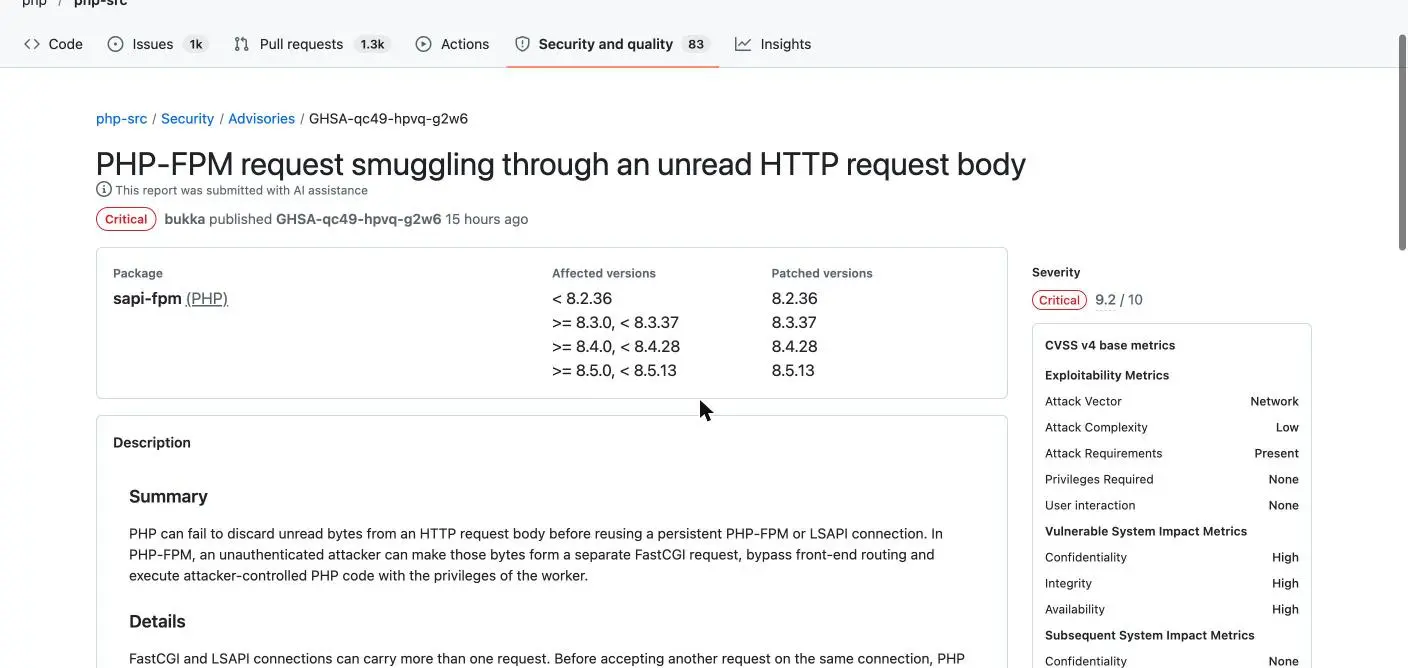
PHP can fail to discard unread request-body bytes before it reuses a persistent connection to PHP-FPM or LSAPI.
The leftover bytes can then be read as a second request that the web server never saw or approved. In the advisory’s demonstration, that forged request sets values such as SCRIPT_FILENAME, REMOTE_ADDR, and PHP_ADMIN_VALUE, then uses allow_url_include and auto_prepend_file with php://input to run attacker-supplied PHP.
Settings from the forged request can carry over to later requests handled by the same worker.
Standard nginx and Apache setups that close the connection after each request are not affected by the demonstrated attack. The behavior dates back to PHP 5.6.0, when php://input began to be read lazily. For LSAPI, the advisory describes request desynchronization but no demonstrated code execution.
Interim step: keep fastcgi_keep_conn and enablereuse off, and keep FPM and LSAPI listeners away from untrusted networks. The advisory warns that reading php://input to the end is not reliable as the only defense.
Source: github.com/php/php-src security advisories
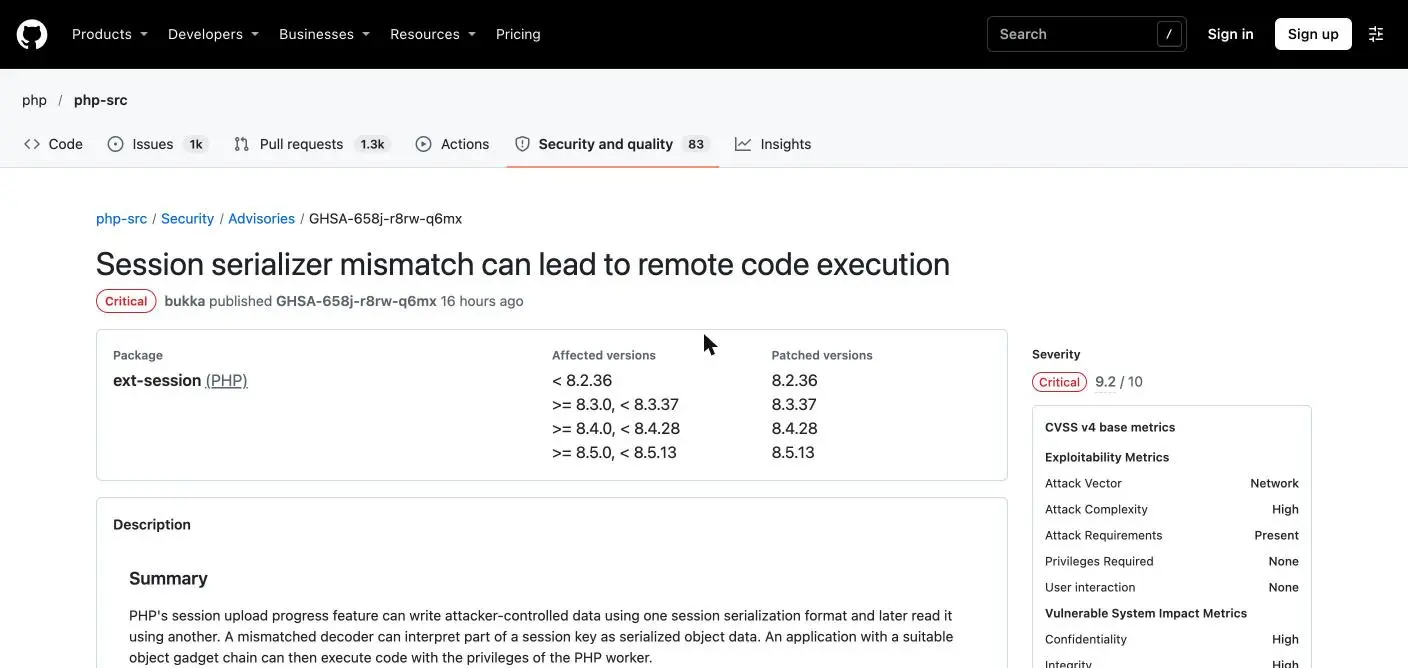
PHP’s session upload progress feature can write attacker-controlled data in one serialization format that is later read in another.
A mismatched decoder can interpret part of a session key as serialized object data. If your application has a suitable gadget chain, an attacker can then run code with the privileges of the PHP worker. A gadget chain is code already present in your project or its libraries that does something dangerous when an object is rebuilt from data.
The report demonstrated the attack with a Guzzle gadget on 8.2.35, 8.3.36, 8.4.27, and 8.5.12. Upload progress has existed since PHP 5.4.0. This is the flaw PHP flagged ahead of time with a one-line workaround.
Interim step: set session.upload_progress.enabled=0 and restart the workers.
Source: github.com/php/php-src security advisories
This PHP session vulnerability is not limited to upload progress. It sits in the default files session handler, and the affected code goes back to PHP 4.1.0. The function that saves a session writes into an existing file, so an interrupted write can leave a file containing parts of two different serialized sessions. That mixed content is why a deserialization gadget chain in your application is the other ingredient.
It needs three things together: attacker influence over session data, an interruption at a useful point in the write, and an application with a deserialization gadget chain. The advisory says other session storage implementations are not affected by this specific defect. The temporary measure it gives is the same upload progress setting as above.
This fix applies to PHP 8.3 and newer, and the advisory calls it an incomplete fix for CVE-2026-109619, one of the October PHP2Shell flaws. If session shutdown is interrupted and the request memory is released, PHP can keep a pointer to a script filename.
A later request handled by the same worker can then release that stale string, which is a heap use-after-free.
The advisory says an attacker who can make session cleanup fail this way may corrupt memory or crash a reused worker. It says code execution could follow in principle, but has not been demonstrated through this specific field.
PHP now clears the recorded session filename and line number during session initialization. It also terminates the PHP process if a module’s request-shutdown handler bails out, so a worker never serves another request with half-cleaned state.
Interim steps: avoid fatal errors in callbacks reached during session cleanup. For PHP-FPM, setting pm.max_requests=1 and restarting the workers prevents the demonstrated sequence from reaching a second request in the same worker, at a performance cost. The advisory states that disabling session upload progress does not address this path, and that enabling OPcache alone is not a reliable mitigation.
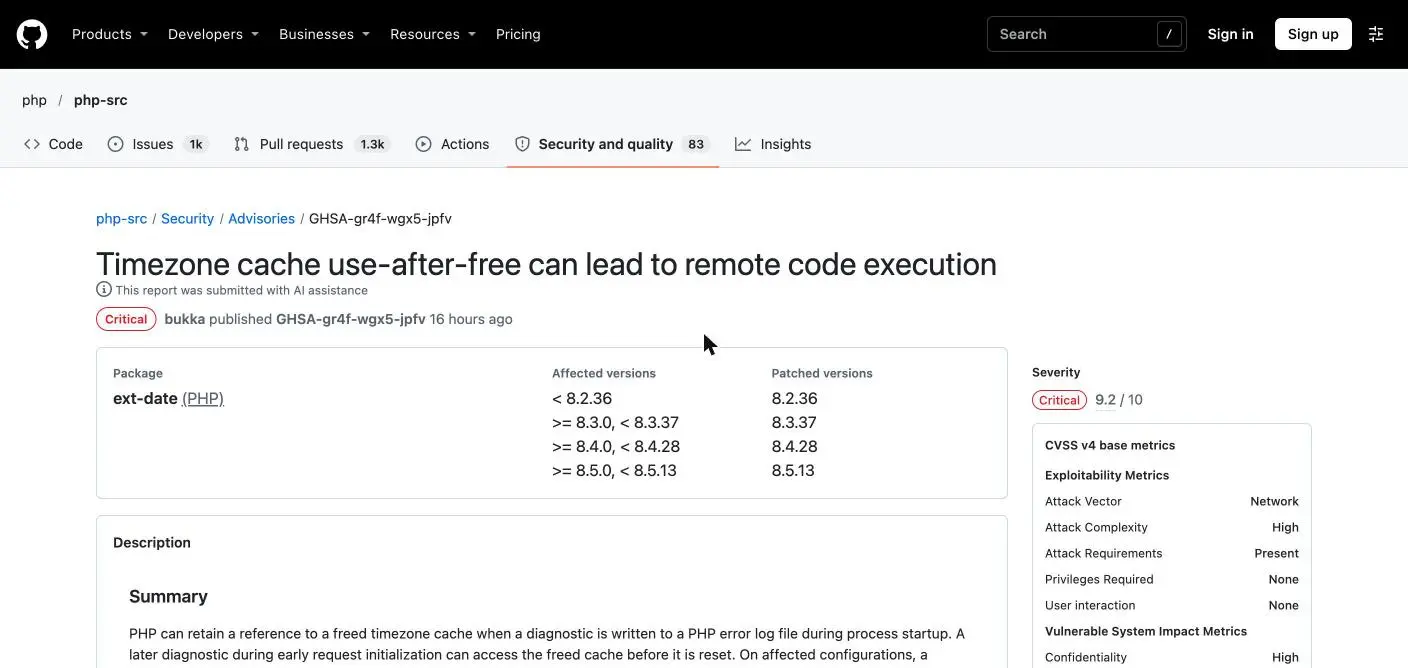
PHP can retain a reference to a freed timezone cache when a diagnostic is written to a PHP error log file during process startup. A later diagnostic during early request handling can then touch the freed cache.
A diagnostic at startup, PHP error logging to a file, and another early diagnostic in a fresh worker. The advisory says code execution was demonstrated locally in PHP-FPM and Apache on a non-thread-safe build, and it rates the attack vector as network-reachable but high in complexity.
A practical check: open your PHP error log and look at what a clean worker starts to write. If a startup produces warnings or notices, the first condition is already met.
Source: github.com/php/php-src security advisories
This fix is in PHP 8.5 only. A use-after-free can occur while PHP collects arguments for a backtrace that involves __call() or __callStatic().
What must be true for the demonstrated remote attack: fatal_error_backtraces=1 and zend.exception_ignore_args=0, request data the attacker can use to influence memory allocation, a reachable magic method call, and a fatal error. The php.ini-production template ships with zend.exception_ignore_args turned on, so check whether anyone changed it.
Also 8.5 only, and also tied to October. PHP 8.5.12 fixed a use-after-free of the last_fatal_error_backtrace global by clearing it during executor shutdown. The advisory describes further scenarios in which a fatal diagnostic during later shutdown work fills the global again after the request heap has been released.
The two cases described produced heap use-after-free and worker crashes. The advisory says code execution through those specific entry points has not been demonstrated, but it rates the flaw as high on confidentiality, integrity, and availability.
Interim step: set fatal_error_backtraces=0, restart all workers, and make sure request-specific configuration cannot turn it back on.
Two of the seven critical fixes build on the October fix for CVE-2026-109619. One is called an incomplete fix, and the other covers further scenarios found after it.
When worker output capture is enabled, PHP-FPM can dispatch an epoll event that refers to a freed worker record. An attacker who can already run PHP in an unprivileged worker can use this to run commands with the privileges of the FPM master, which commonly runs as root.
Local code execution in a worker, a pool with catch_workers_output enabled, the epoll event backend, and the ability to manipulate worker lifetimes and keep inherited pipe descriptors. In a container, the result is the master’s container privileges.
This matters most on shared hosting and on servers that run several sites under one FPM master, because it lets one compromised site reach beyond its own pool.
Interim step: disable catch_workers_output. Running the master without root limits the damage but does not correct the flaw, and disabling Curl or OPcache removes only parts of the demonstrated exploit chain. The advisory lists PHP 8.1.20 to 8.1.34 as affected.
An attacker who can modify an OpenSSL-signed Phar archive, without touching the trusted public key, can make PHP accept arbitrary contents. They change the archive’s signature type to a keyless hash such as SHA-256 and replace the signature with a matching digest. An application that then executes the archive runs attacker-controlled PHP.
The application relies on an OpenSSL-signed Phar with a public key installed through a trusted channel, the attacker can alter or replace the archive but not the key, and the application loads the archive afterwards. Many PHP tools ship as Phar archives, so look at your deployment scripts and CI images as well as your application.
Interim step: get the publisher’s public key through an authenticated channel and install it as <archive>.pubkey with permissions that stop the update or download path from removing or replacing it. If you cannot protect the key on its own, verify the archive with another mechanism that pins a trusted key before PHP loads it.
PHP’s HTTP and FTP stream wrappers can send data without encryption when the scheme has an uppercase S, as in HTTPS://, httpS://, or FTPS://. Code that fetches such a URL with file_get_contents() or fopen() may expose passwords, tokens, cookies, request bodies, or file contents to anyone who can watch the connection.
This is a logic flaw, so nothing crashes and nothing in your logs will look wrong. The URL can come from a setting, from user input, or from a redirect. The advisory says the issue has existed for URLs passed by an application since PHP 5.2.0.
Interim step: write the scheme in lowercase before passing it to any stream function. If redirects are allowed, turn off automatic redirects and validate and normalize every redirect target, because normalizing only the first URL does not protect a redirected request.
A malicious HTTP server can make PHP’s built-in HTTP stream wrapper burn CPU by splitting one response header across a very large number of continuation lines. An application that fetches an HTTP or HTTPS URL this way can become slow or unavailable.
The attacker controls a response your application fetches through the built-in wrapper. The advisory is explicit that allow_url_fopen alone does not make you remotely vulnerable. The attacker must also trigger a suitable outbound request or influence a server you already contact. It lists affected versions from 8.1.32, 8.2.28, 8.3.18, 8.4.5, and 8.5.0 upward, so PHP 8.1 is again in scope.
Interim step: limit outbound requests to trusted destinations, including redirect targets. An egress proxy that enforces header size and count limits can reject hostile responses before PHP sees them. Execution limits and request_terminate_timeout cap how long a worker stays busy but do not remove the parsing problem.
The php-cgi binary can read memory outside the supplied path information when a web server passes inconsistent script and path values. The advisory scopes this to php-cgi in both CGI and FastCGI mode, with cgi.fix_pathinfo=1, which is the default.
The out-of-bounds read dates to PHP 4.3.0 and the write to 5.2.4, based on code inspection.
Interim step: set cgi.fix_pathinfo=0 for php-cgi and confirm that your routing still works, or correct the web server mapping so the path PHP receives names the existing script. In the advisory’s Apache example, rewriting to the URL instead of the absolute filesystem path avoided the issue. In my experience, php-cgi turns up mostly on older and shared hosting setups, so confirm whether the binary exists on your servers before assuming you can skip this.
PHP-FPM can include attacker-controlled request metadata, unescaped, in the full status response. An unauthenticated attacker can plant HTML or JavaScript in a worker’s scoreboard entry, and it runs in the browser of whoever later opens the full HTML status page. The attacker does not need access to the status endpoint itself. An earlier fix for CVE-2026-6735 escaped some fields, and this one covers the user and script fields it missed.
The status endpoint is enabled, attacker metadata can reach the pool through some request path, and a person or tool renders the full status data as HTML. For the authentication-user variant, the front end must pass the Basic authentication header to FPM.
Interim step: disable the status endpoint or stop using its full HTML output. If you need the data, use a consumer that treats every field as untrusted text. Restricting who can open the page helps, but it is not complete, because the payload can be planted through a separate application request and then served to a trusted operator.
The first lets a crafted SOAP request, or a response from a malicious or compromised SOAP server, make PHP expose a small amount of uninitialized heap memory.
The value reaches the attacker only if the application returns the decoded array. The second is a use-after-free triggered by XML that contains a document type definition and an entity reference in an attribute value. An unauthenticated attacker who can reach an exposed SOAP endpoint can crash the worker, and repeated requests can disrupt the service.
Authentication does not protect you if the application parses the SOAP request before checking who sent it.
Interim steps: restrict access to SOAP endpoints, or disable them where practical, and use only trusted SOAP services and WSDL definitions. For the first flaw, reject encoded arrays whose arraySize has no valid dimension, and avoid returning unvalidated decoded arrays to untrusted clients.
This fix covers PHP 8.4 and 8.5, where the modern DOM API lives. The serializer for Dom\XMLDocument and Dom\HTMLDocument can incorrectly share ownership of a generated namespace prefix between an element and its descendant. An application that calls saveXml() on attacker-controlled XML or HTML can free the same memory twice and crash the process.
A remote attack needs the application to parse attacker-controlled XML or HTML with the modern DOM API and then serialize it with saveXml(). Applications that do not XML-serialize untrusted documents are not exposed to that path.
Interim step: avoid saveXml() on untrusted documents. For HTML documents where XML output is not needed, saveHtml() avoids the affected serializer.
Both are 8.5 only. PHP’s RFC 3986 URI implementation can return a truncated or invalid string, instead of an error, when a very large URI is converted back to text. The input has to be large enough to reach roughly the 2 GiB boundary, and the PHP process needs enough memory to build it, so normal application limits on URI length keep demonstrated inputs out of reach.
Interim step: enforce a byte-length limit on untrusted URI input, well below 2 GiB.
The changelog also records an upgrade to uriparser 1.0.3 for CVE-2026-48841. I did not find a separate PHP advisory for it, so I cannot say more about its conditions.
Reading by score hides the useful question, which is whether your environment has the ingredient each flaw needs. Table 1. Setup ingredients and the fixes they unlock
| If your setup has | Fixes that matter most | Setting or pattern to check |
| Persistent connections from the web server to PHP-FPM or LSAPI | CVE-2026-129289 | fastcgi_keep_conn, enablereuse, and code that opens php://input |
| Sessions with upload progress or a switched serializer | CVE-2026-115560, CVE-2026-126714 | session.upload_progress.enabled, session.serialize_handler, and ini_set() before session_start() |
| PHP errors logged to a file | CVE-2026-129496 | Warnings written when a worker starts |
| PHP 8.5 with fatal error backtraces | CVE-2026-129474, CVE-2026-129182 | fatal_error_backtraces and zend.exception_ignore_args |
| Several sites under one PHP-FPM master | CVE-2026-129291 | catch_workers_output and whether the master runs as root |
| Code that fetches remote URLs | CVE-2026-128064, CVE-2026-127960 | URL schemes in capitals, redirect handling, outbound allow lists |
| Phar archives in deployment | CVE-2026-128090 | Where the .pubkey file lives and who can write to it |
| php-cgi, SOAP, DOM, or the FPM status page | CVE-2026-129538, CVE-2026-15353, CVE-2026-129506, CVE-2026-129501, CVE-2026-129292 | cgi.fix_pathinfo, public SOAP endpoints, saveXml() calls, status endpoint |
Gadget chains deserve a special mention. Two of the critical session flaws need one, and they live in your own code and libraries, not in PHP. A platform architecture audit is one way to find them, and it also tells you which of the settings above you actually use.
Many PHP sites sit behind NGINX, and NGINX published its own fixes the same week. This is a separate flaw, and it is not part of the PHP list above.
The most serious NGINX fix is CVE-2026-123007, a flaw in HTTP/2 flow control that some researchers call NGINX2root.
According to the CVE record, it can cause a heap buffer overflow. An attacker could crash a worker or corrupt its memory, and code execution is possible where ASLR is disabled or can be bypassed.
NGINX lists versions 1.9.5 through 1.31.8 as vulnerable and the fix in 1.30.7 and 1.31.9. The record rates it 9.2 Critical on CVSS v4. It matters only for configurations that use HTTP/2.
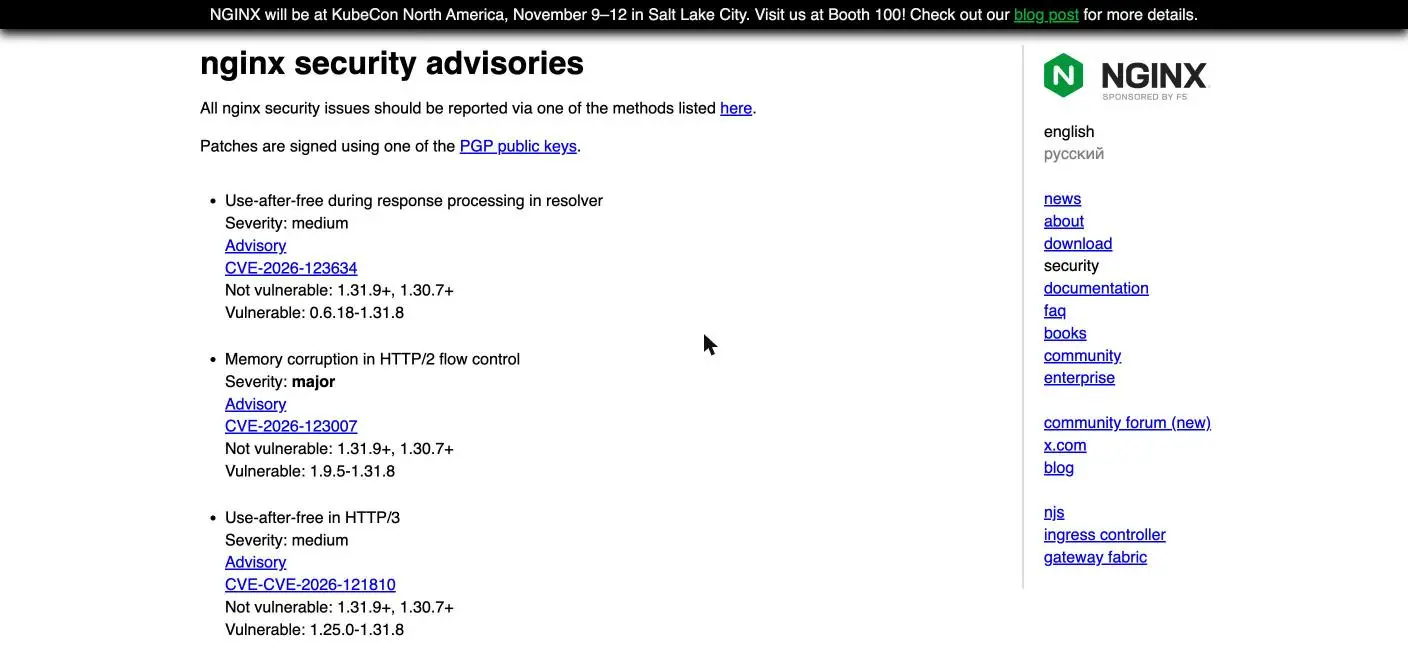
Source: nginx.org security advisories
Run nginx -v, and look for HTTP/2 with nginx -T 2>/dev/null | grep -i http2. Use the F5 advisory if you cannot update straight away. Do not confuse this with the fastcgi_keep_conn check for PHP-FPM, which is about how NGINX talks to PHP. The HTTP/2 flaw is about how NGINX talks to browsers.
The 19 November PHP security fixes look alarming as a list, and much less so once each one is matched to the setting it needs. A few conditions decide most of your exposure: persistent connections to PHP-FPM, session upload progress, error logging, and the PHP 8.5 backtrace settings. The rest are narrower, and several only matter if your code fetches remote URLs, loads Phar archives, or exposes SOAP.
As far as we can tell from the sources, no attacks on this batch had been reported at the time of writing, but the October flaws were attacked within days.
If you would rather not work through the table alone, book a Discovery Call, bring your server and site list, and we will go through which of these fixes apply to you.
Which of the 18 PHP security fixes are the most serious?
Seven are rated Critical at 9.2 in the PHP project’s GitHub advisories: PHP-FPM request smuggling, the session serializer mismatch, partially overwritten session files, the session shutdown use-after-free, the timezone cache use-after-free, and two backtrace flaws in PHP 8.5. PHP says the critical issues need a non-default configuration or an uncommon setup, so the settings decide your real exposure.
Is the PHP-FPM request smuggling flaw a risk on a default nginx or Apache setup?
The advisory says standard nginx and Apache setups that close the connection after each request are not affected by the demonstrated attack. The risk appears when the web server keeps persistent connections to PHP-FPM, for example with fastcgi_keep_conn on in nginx, and an application path opens php://input without reading it fully.
Does turning off session upload progress cover all the session flaws?
No. It is the interim step for CVE-2026-115560 and the temporary measure given for CVE-2026-126714. For the session shutdown flaw, CVE-2026-129481, the advisory says disabling upload progress does not address that path.
Are any of these fixes not memory bugs?
Yes. The Phar signature downgrade, the mixed-case HTTPS and FTPS URL flaw, and the unescaped fields on the PHP-FPM status page are logic flaws. They work without crashing anything, which is why they can be easy to miss in your logs.
Do these fixes reach PHP 8.1?
The PHP project does not release 8.1 fixes for them. Two advisories, for CVE-2026-129291 and CVE-2026-127960, list 8.1 versions as affected. On 8.1, rely on the interim settings in the advisories unless your vendor backports the fixes.
Do I need to change my code after updating?
The advisories I read do not describe required code changes. One behavior change is worth testing: the session shutdown fix ends the PHP process if a module’s request-shutdown handler bails out, so you may see a worker restart where it used to continue.

 Patch Management, Website Security
Key Takeaways Patch the October release first. PHP 8.5.12, 8.4.27, 8.3.36, and 8.2.35 fixed two critical remote code execution flaws that attackers have already tried to exploit. A second round is scheduled for 19 November (Today). PHP says the releases cover all supported versions, and the worst issue is rated critical. Until then, turn off […]
 AI & Enterprise Strategy, Digital Marketing
Key Takeaways AI-enabled is a label, not a standard. Judge an agency on its real workflow, not on the words in its pitch. A good AI-enabled agency gives the volume work to AI and the judgment to people. Scanning, drafting, testing and reporting are automated. Strategy, brand and approvals are not. Human oversight is the […]
 AI & Enterprise Strategy, Healthcare Technology
Key Takeaways Start with administrative work, not diagnosis. Patient access, intake, and prior authorization support have high volume and clear rules, and they do not need clinical judgment. The model is the easy part. Identity, data paths, and sign-off decide whether an agent gets through a security review. HIPAA compliant AI agents need a BAA […]