How to Modernize a Legacy SaaS Platform Without a Big-Bang Rewrite?
Shikha Kumar
·
28 Sep, 2026
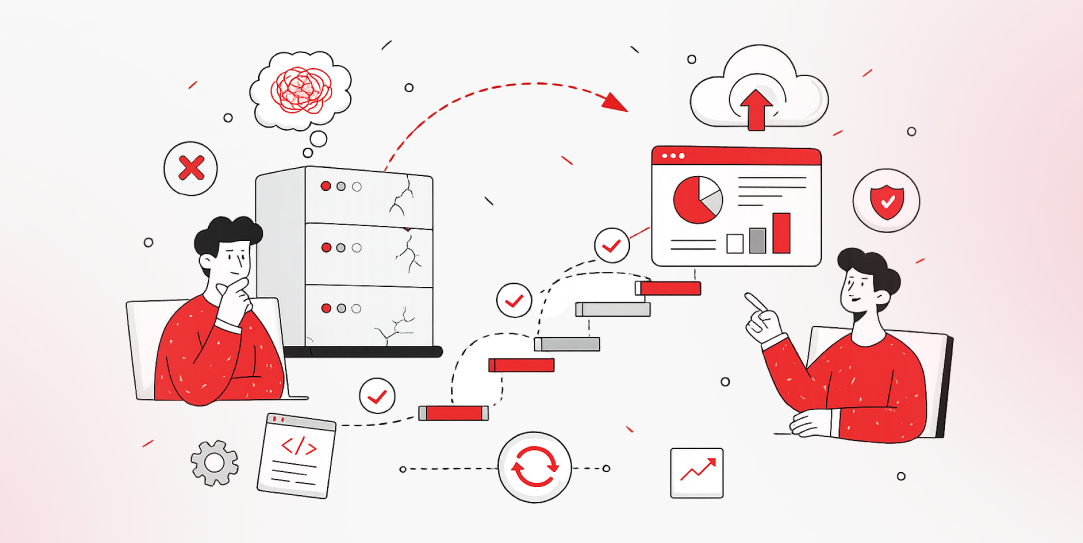
The fear is real, and it isn’t irrational. Committing to modernize a legacy SaaS platform means picturing the worst-case scenario: a rewrite that consumes two quarters, a roadmap that goes dark while engineering rebuilds from scratch, and a business that has to hold its breath, hoping the new system works as well as the old one on day one.
That fear is legitimate. It’s also based on the wrong model of what modernization means.
The mistake most teams make isn’t wanting to modernize. It’s assuming modernization has to mean a full rewrite. It doesn’t, and for most legacy SaaS platforms, it shouldn’t.
In this asset, here’s what we’ll get into: why “just rewrite it” feels obvious but rarely works out, what a failed big-bang attempt actually costs, the sequenced alternative that real companies have used at scale, how to pick a safe first slice, and when a full rewrite genuinely is the right call.
Looking at an aging codebase, the instinct makes sense. The system is slow and patched together, and everyone quietly agrees it would be easier to tear it down and start clean. A full rewrite promises a fresh foundation and an end to the workarounds.
Here’s the problem with that instinct: a full rewrite is, by definition, a large project, and size is the single strongest predictor of software project failure.
The Standish Group’s CHAOS Report, which has tracked this for decades, found that small projects succeed about 90 percent of the time. Large projects succeed less than 10 percent of the time. Rewriting an entire SaaS platform doesn’t fall into some safer category of its own. It’s exactly the kind of large project that data is describing.
Size kills projects for a simple reason: the bigger and longer the project, the more time there is for something to go wrong before anyone can tell. Requirements drift over the months it takes to build. The business keeps changing underneath the plan. And because nothing ships until the very end, there’s no way to course-correct; the new system goes live and has to work, all at once, cold.
A big-bang rewrite is, structurally, a large project. It inherits all the risk that comes with size: requirements drift over the months it takes to build, the business keeps changing underneath it, and the team loses the ability to course-correct until the very end, when the new system finally goes live and has to work.
It’s the same pattern we see across the SaaS platform teams we work with: ambition scales with the codebase, and so does the risk of betting it all on one release.
Large IT initiatives mean budgets north of $15 million. That’s where most enterprise SaaS rewrites actually land, once you count engineering time, QA, and the roadmap work you delayed to make room for it.
Those large initiatives run 45 percent over budget on average. They deliver 56 percent less value than promised. That’s according to joint research from Oxford and McKinsey.
That’s not a rounding error. That’s the rewrite costing more than planned. While doing less than promised. Right when the business was counting on it to unblock the roadmap.
There’s a quieter cost, too. While engineering is heads-down on the rewrite, the old system stops getting new features. Customers notice. Sales notices. The two quarters you were worried about at the start? Those become the two quarters your competitors use to catch up.
That’s the exposure worth pricing out before you commit to a plan. Not after. It’s exactly what a Modernization Readiness Audit is built to do.
There’s a well-established pattern for this, proven at a scale most modernization conversations never reference. It’s called the strangler fig pattern, named by Martin Fowler in 2004 after the way a strangler fig tree gradually grows around a host tree and replaces it, one section at a time, without the host ever coming down first.
Applied to software, the idea is simple. Instead of replacing the whole platform at once, you put a routing layer in front of it (for web-facing platforms, a CDN layer such as CloudFront and S3 configured with Terraform can play that role) then migrate one capability at a time behind that layer -the kind of infrastructure work that often starts with getting configuration management tools like Ansible installed and standardized first, then deploying each migrated service with Argo CD and Helm.
The old system keeps running and keeps serving customers. Each migrated piece ships independently, gets validated against real production traffic, and only then does its legacy counterpart get retired.
Shopify used this approach to move its Rails monolith (one of many web app frameworks teams build on) to services. Netflix used it to migrate out of its own data centers into the cloud. GitHub used it to migrate off MySQL. None of them stopped shipping to do it.
If you haven’t already pinned down which kind of debt, architecture, process, data, or legacy is actually driving your slowdown, that diagnosis is worth doing first – start by finding out exactly how much technical debt is costing your budget, then see Your Release Cycle Isn’t an AI Problem. It’s a Technical Debt Problem for the breakdown. Sequencing works best once you know which system actually needs to go first
| DIMENSION | BIG-BANG REWRITE | SEQUENCED MODERNIZATION |
| Business continuity | Feature work largely pauses for months | Roadmap keeps shipping throughout |
| Risk exposure | All risk lands on one release day | Risk is isolated to one slice at a time |
| Course correction | Only possible before or after, never during | Built into every migrated slice |
| Time to first value | Nothing ships until the whole system is done | First migrated slice can ship in weeks |
| Rollback | Means reverting the whole platform | Means rerouting one slice back |
Notice that every row on the sequenced side describes a smaller decision than the row next to it. That’s the actual mechanism at work here: sequencing doesn’t remove risk from the project, it breaks one enormous, irreversible decision into many small, reversible ones. A bad big-bang rewrite is a crisis. A bad slice is a Tuesday.
The hardest part of sequencing isn’t the technology. It’s deciding what to migrate first.
A GOOD FIRST SLICE USUALLY HAS THREE TRAITS:
A reporting endpoint or a product catalog is usually a safer starting point than the order-and-payment core of the system. Save the tangled center for later, once the team has built the muscle and the routing infrastructure, to handle it safely.
We’ve walked SaaS teams through exactly this exercise; a few are documented in our case studies.
Sequencing isn’t dogma. For a genuinely small application, or a system built on a language version so old it can’t support the libraries a modern rebuild needs, a rewrite can be the more efficient path. There’s less to preserve and less risk to isolate. The pattern earns its keep on large, business-critical, tightly coupled systems, which describes most legacy SaaS platforms, but not all of them.
The honest first step either way is the same: understand what you’re actually carrying before you commit to how you’ll replace it.
The fear behind “we can’t afford to stall for two quarters” is a fear of the wrong plan, not of modernization itself. Replace the platform in sequence, prove each slice in production, and the business never has to hold its breath waiting for one release day to go right.
If you’re ready to figure out where your first slice should be, that’s exactly what a Modernization Readiness Audit maps out: which systems carry the most risk, which are safest to migrate first, and what sequence gets you real progress without stalling the roadmap. From there, our Upgrade Track lays out exactly how that sequencing gets executed
Let’s talk about your platform.

 Legacy Modernization, Platform Strategy
Key Takeaways Modernization is a set of decisions, not a rewrite. For each system you choose one of five moves: keep, wrap, move, rebuild in slices, or retire. Start with a business reason you can write in one sentence, then map what you have before you touch any code. Change small slices while old and […]
 Platform Strategy
The firm that writes your software owns it, unless your contract says otherwise. That is the starting point under US copyright law for software built by an outside firm, and the Copyright Office’s own guidance explains why. It is easy to miss, because nothing in a pitch, a proposal, or an invoice ever brings it […]
 Digital Transformation, Platform Strategy
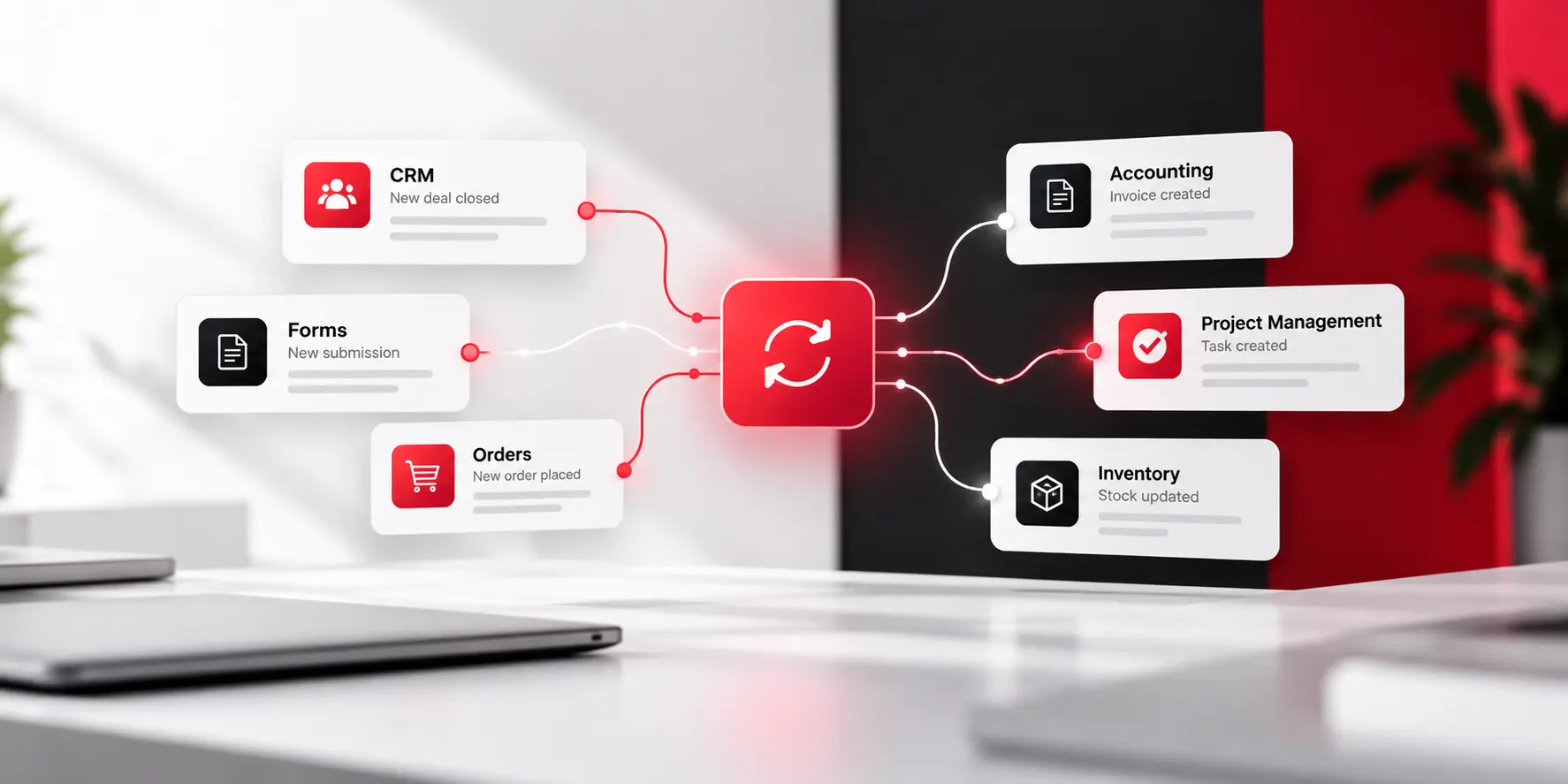
Picture the same Tuesday morning, a few months from now. Someone closes a deal in the CRM. The billing record updates itself in the background. Nobody opens a second tab. Nobody retypes a single detail. That is not a fantasy. It is what actually happens once this problem gets fixed, and it is a smaller […]