The Power of Experience-led E-commerce: Combining Content and Commerce with Drupal
 Manpreet Singh
·
04 Sep, 2025
Manpreet Singh
·
04 Sep, 2025

An E-commerce business must create a compelling and engaging shopping experience for attracting and retaining customers. To achieve this, E-commerce sites are increasingly turning to experience-led approaches, combining content and commerce to make shopping enjoyable for shoppers. When it comes to the experience-led approach, Drupal is an excellent choice for businesses.
Drupal’s flexibility, scalability, and powerful CMS are tailor-made to engage and delight your customers.
In this article, you will learn why Drupal is best for experience-led commerce and how Drupal Ecommerce Development Services can help your business stay ahead in the market.
Why use Drupal for Experience-led Commerce?
Drupal has gained significant attention in recent years for its ability to deliver exceptional user experience for E-commerce businesses worldwide. Discover why Drupal commerce is the best fit for building Experience-led commerce:
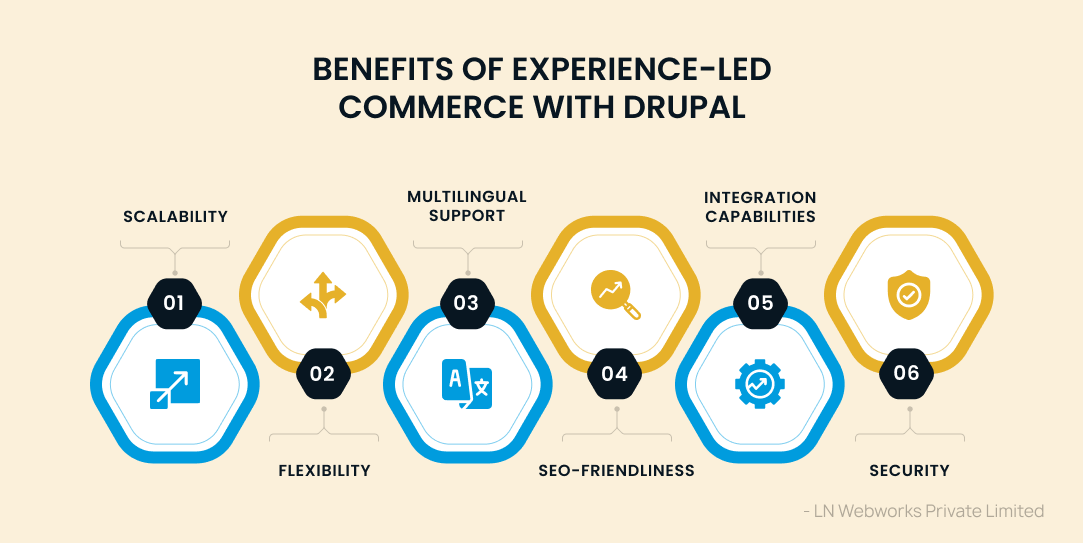
Scalability
E-commerce sites usually have to handle high traffic and a large volume of data. Drupal’s modular architecture makes it possible by providing new features and functionalities as per the needs without sacrificing performance.
The caching technology incorporated will allow frequently requested pages to be supplied rapidly without having to construct them from scratch each time. This will lead to improved website speed and makes it easy for scaling the business.
Flexibility
Drupal, a customized platform, is famous for its flexibility–adding new features, customizing web design, or integrating with third-party tools. Its robust API (Application programming interface) will help you to easily integrate with other business systems such as inventory management, shipping, and order fulfillment.
That too, you can add these new functionalities without having to build everything from scratch.
Multilingual support
Globalization has increased significantly in the previous several years. This allows e-commerce enterprises to sell items and services in many languages. Drupal also enables the building of multilingual websites, including right-to-left languages like Arabic and Hebrew. To add to that, Drupal’s translation tools will save time and reduce errors by managing and updating translations effectively.
SEO-friendliness
An SEO-optimized website will help e-commerce business to drive traffic and sales organically. Drupal builds and manages websites by keeping SEO in mind–Clear URLs, page titles, meta descriptions, and XML sitemaps built-in.
The modular architecture makes it simple to add SEO tools to the site, such as Google Analytics and Google Tag Manager, which increases search engine ranking.
Integration capabilities
E-commerce sites often need to integrate with payment gateways, shipping providers, and marketing automation platforms. Drupal offers a plethora of integration technologies, including Paypal, Stripe, Mailchimp, Salesforce, and others. You can even do custom integration based on the specific needs of your business process.
Security
E-commerce businesses must focus on building websites on platforms that value security the most. E-commerce sites generally involve or collect personal information like credit/debit card details.
Drupal’s dedicated team of developers regularly ensures the platform is secure and follows up with the latest security patches.
Community support
Drupal definitely stands out compared to other platforms in terms of community–active developers, users, and other contributors. The community involves individuals who come from diverse backgrounds and is equipped with a wealth of knowledge and experience to help you solve your specific E-commerce website issues. In addition to that, you can read documentation, and tutorials, and ask questions in support forums.
Best practices for creating content-rich E-commerce experiences using Drupal.
As the digital landscape continues to evolve, it’s becoming increasingly clear that delivering exceptional user experience is the key to success. Follow these top 7 best practices for creating E-commerce experiences using Drupal:
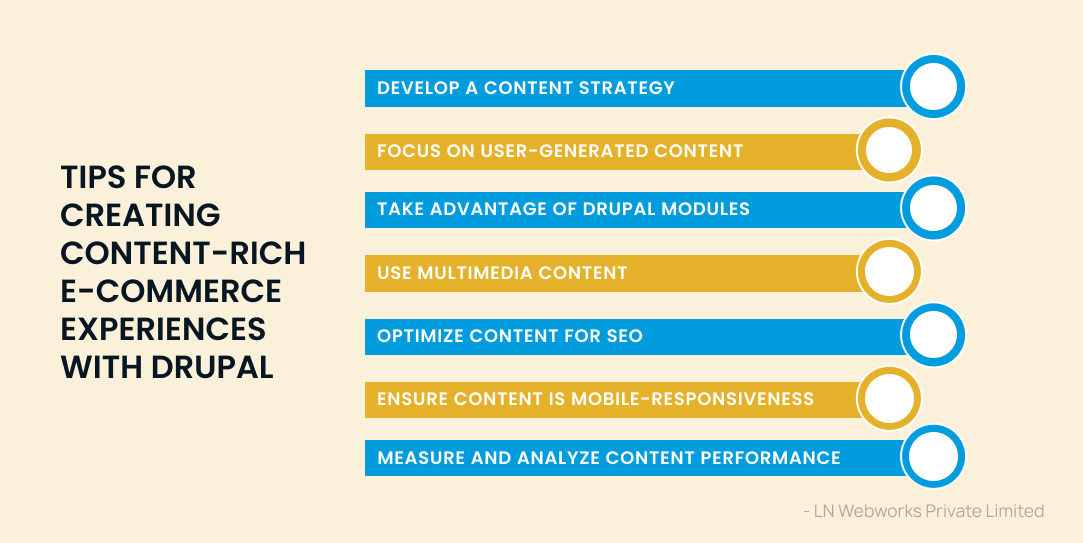
Develop a content strategy
Developing a content strategy involves conducting market research, creating a buyer persona, defining brand voice, and using an analytics tool to identify high-performing content. Once completed, it can be used to create content types, taxonomies, and views. Drupal’s workflow and publishing tools easily help you to ensure the content is reviewed and approved before publication. Doing this will ensure that the content is relevant and valuable, support the customer journey, and is aligned with overall business goals.
Focus on user-generated content
As the name implies, the user-generated content is created by the website users. Drupal’s modules such as ‘comment’ and ‘rate’ will help to achieve this purpose. Also, Drupal’s access control system will help to moderate user-generated content and prevent spam. The content can range from product reviews, ratings, comments, and social media posts. By following this approach, your E-commerce business can establish credibility and build trust with prospective customers.
Take advantage of Drupal modules
Drupal has an ocean of modules that will definitely enhance your E-commerce site’s functionalities. You can find modules for almost any feature you can imagine–from social media integration to payment gateways. With Drupal’s extensive module ecosystem, you can effortlessly enhance your website’s functionality without the hassle of coding from scratch.
Use multimedia content
Multimedia content can involve images, videos, and infographics to help your E-commerce business to enhance user experience and make content more engaging. Drupal offers several modules such as ‘video’ and ‘video embed field’ modules to create multimedia content for your website. The content will help you to showcase products, explain features and benefits, and provide tutorials or how-to guides within your E-commerce site.
Optimize content for SEO
E-commerce businesses can reach new users organically by optimizing their websites for SEO. You can include relevant keywords, create high-quality content, and optimize metadata–page titles and meta descriptions.
Drupal’s modules such as ‘Metatag’ and the ‘Pathauto’ module will help in optimizing your website for SEO. Also, Drupal’s taxonomy system can be used to create structured data that can help search engines understand the content better and increase rankings.
Ensure content is mobile-responsiveness
In 2023, the number of smartphone users who made online purchases using their mobile devices in the past 6 months reached at least 79%. Drupal offers several modules such as ‘Responsive Images’ and ‘Responsive Table’ modules to ensure your content is mobile-responsiveness. The content within the E-commerce website must be optimized for small screens and touch-based navigation. Following these principles will help your web pages load quickly on mobile devices and will be easy to read and interact with.
Measure and analyze content performance
Measuring and analyzing content performance is a neverending process. You can track metrics such as page views, time on site, bounce rate, conversion rate, and many others. Drupal even offers ‘Views’ and ‘Google Analytics modules to help you in this process. The content moderation system in Drupal will review and approve content changes before publishing. Effectively measuring and analyzing content performance will help you identify areas for improvement and optimize your content strategy to drive better results.
To Conclude
Drupal can be your choice for creating a great user experience and building high-quality e-Commerce stores that deliver real value to customers. If you’re ready to get started on your own experience-led E-commerce site, our expert Drupal team at LN Webworks is here to help. Contact us today to know how we can build converting E-commerce website that delivers a great user experience and build loyal customers.
Author