Cloud Outage Incident Response: Whose Incident is it?
Hem Kant
·
03 Nov, 2026
A cloud provider can fail without you doing anything wrong. Your customers, however, won’t distinguish between an infrastructure failure and a service failure on your end. They’ll see an unavailable product, a failed transaction, or a service they can no longer access. And they’ll expect you to have an answer.
That’s where incident response becomes more than a technical exercise. The cloud outages of 2026 offer a closer look at how quickly provider-level disruptions can affect businesses, where visibility gaps emerge, and why waiting for a status page to confirm a problem can cost valuable response time.
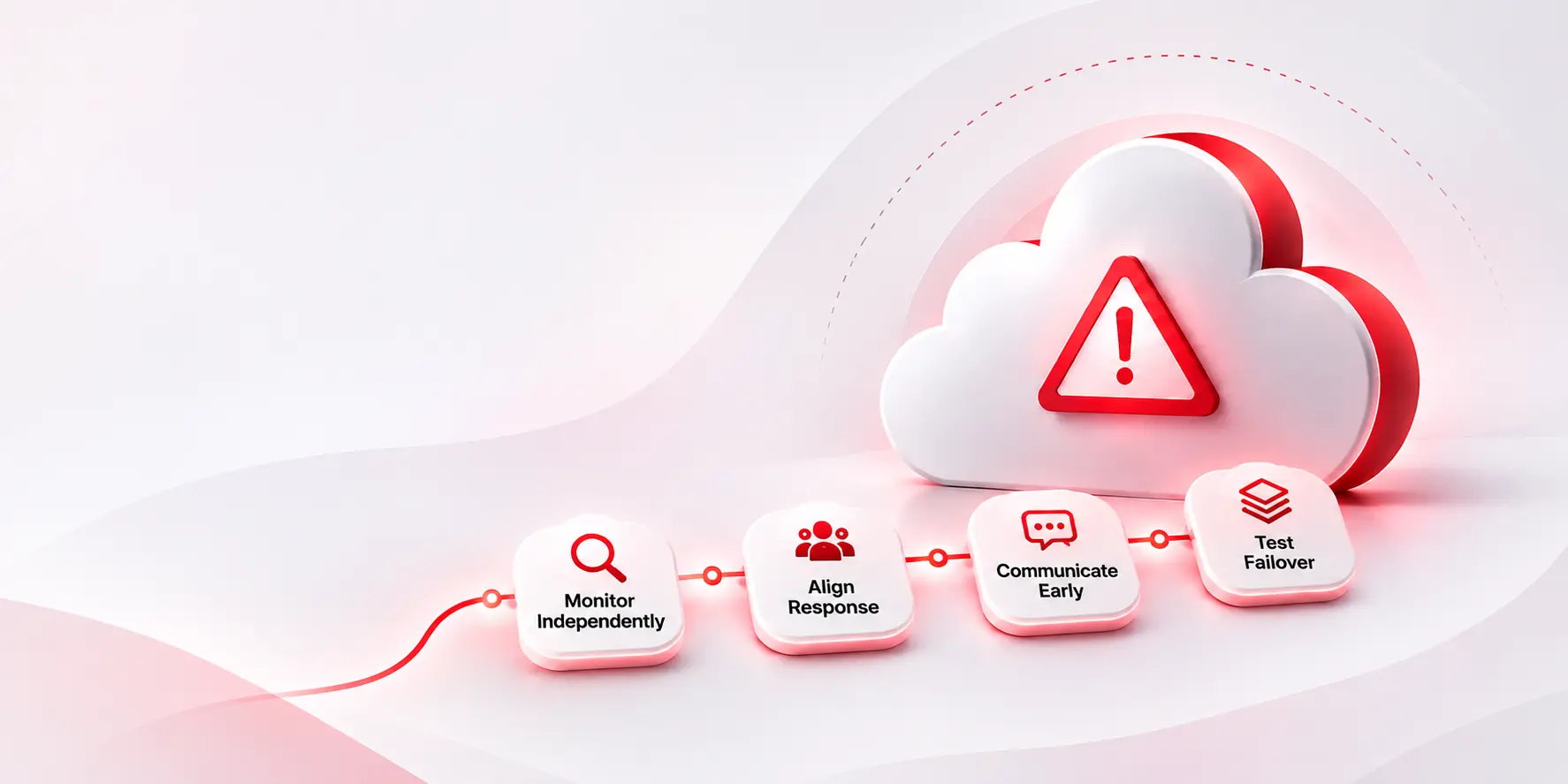
For organisations running critical applications, independent monitoring, agreed response responsibilities, and regularly tested failover arrangements are not optional safeguards. They’re part of keeping services accountable when the infrastructure behind them isn’t.
None of the three below came from an exotic attack. Two were physical, and one followed a maintenance change. Table 1 sets them side by side.
| Event | What Failed | How Long |
| AWS us-east-1, 7 May 2026 | Cooling failed in one availability zone and racks shut down from heat | Trading down for hours at one customer, with full recovery taking much of the next day |
| Azure, 30 September to 1 October 2026 | Gateway networking in 18 regions, linked by Microsoft to a maintenance change that was rolled back | About 7 hours |
| Google Cloud europe-west2, 20 October 2026 | A power-related failure in the London region, with total loss of availability seen from outside | About 8 hours, from 06:10 to 14:00 UTC |
The Google Cloud event is documented by ThousandEyes, the AWS case by the InfoQ summary of the Coinbase postmortem, and the Azure case by ITdaily. Two facts matter for planning.
First, the outages were measured in hours, not minutes. A plan that assumes the provider will be back soon is not a plan. Second, one failed zone or region was enough. In the AWS case the trigger was a single availability zone, and Coinbase customers could not trade, deposit, or withdraw for several hours.
Providers also publish incident reports afterward. Microsoft promised a full report within fourteen days for the Azure event, according to ITdaily. Read these reports, and ask which of the failure modes could happen to your own systems.
A provider status page describes what the provider has confirmed. Your monitor should describe what your users see. The two clocks start at different times, and the gap between them is where customers write the first angry message.
ThousandEyes caught the Google Cloud event from outside. Its monitoring saw traffic unable to reach the service from about 06:10 UTC. That is the view you want of your own site: a check from outside the provider network that fails when your users fail. Run it from at least two locations, and make one of the checks a full journey and not a simple ping.
Three things are worth watching:
Our managed support services monitor the same things: availability, performance, scheduled processes, critical user journeys, and the health of API connections to systems such as CRM and payment.
Knowing what depends on what comes first. Our piece on how a growing SaaS platform should govern its APIs starts with an inventory, and the same inventory tells you which provider and region each service relies on.
You cannot fix a provider cooling system. You can decide quickly, tell people early, and keep the business running in a reduced way. That takes decisions made before the incident. Figure 1 divides the first hour into four jobs.
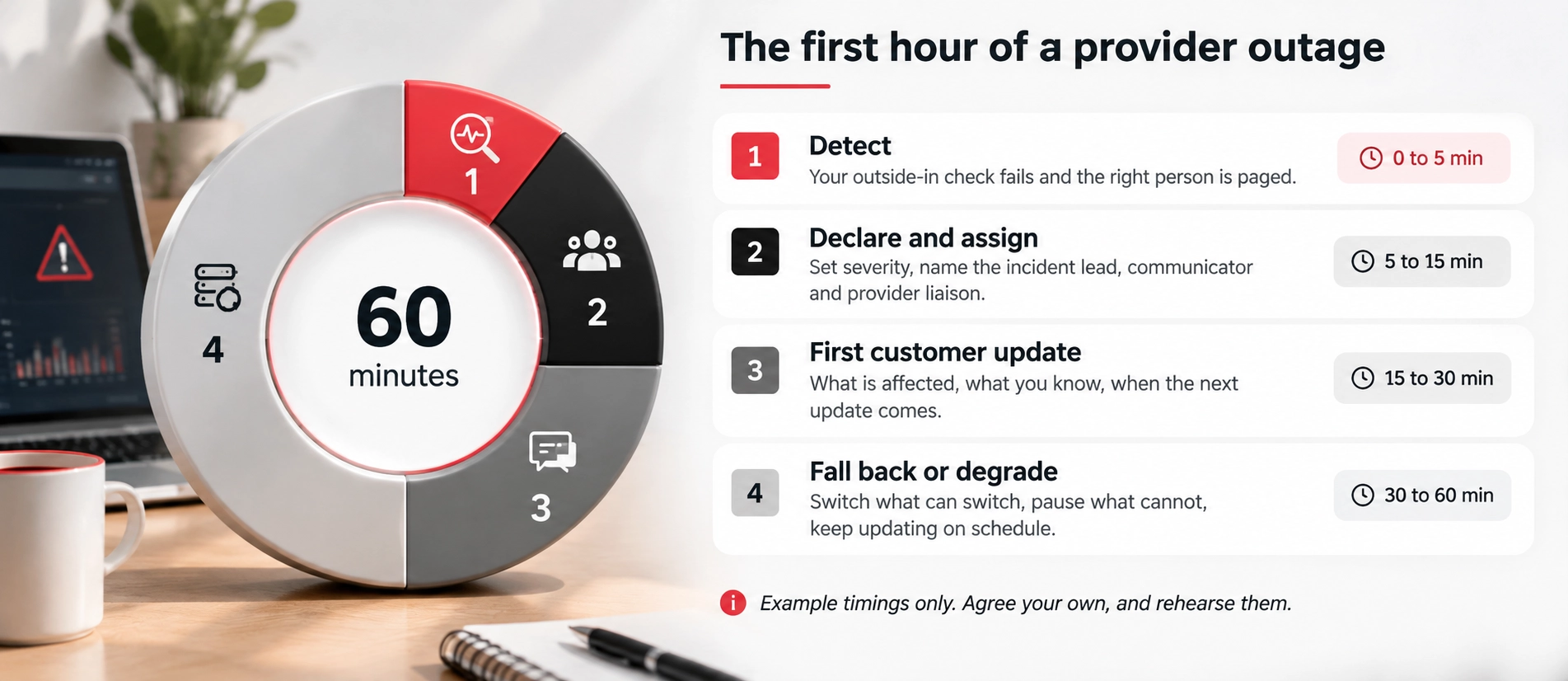
The timings are examples. What matters is that each job has an owner. Three roles cover most outages:
Write down what critical means in simple words, such as customers cannot pay or staff cannot work. Agree who may declare it. Also agree on a channel that does not depend on the failed provider, because a team that coordinates in a tool hosted in the broken region has a second problem.
The first update is the hardest to write. It should say what is affected, what you know, and when the next update will come. It should not guess at a cause or a repair time. Silence reads as neglect, and a wrong promise reads as worse.
Our own incident handling uses agreed severity levels, communication channels, and escalation procedures. We do not publish response times, so ask any provider, us included, for theirs in writing.
The Coinbase postmortem shows how a sound design can still fail. Its matching engine ran as a cluster inside one placement group, with the nodes close together on purpose for speed. When three of five nodes went down, the cluster lost quorum and could not process trades.
There was no automated failover to another zone. Recovery meant emergency code changes and manual rebuilding. According to InfoQ, Coinbase has committed to automated cross-zone recovery and wider disaster recovery testing.
Your system is probably smaller, but the lesson scales. A second zone on a diagram is not a failover. Failover is a restore you have done, a switch you have flipped, and a time you have measured. Three tests are worth scheduling:
Also keep a short list of what you will switch off to protect the rest. Pausing a report export or a bulk email job during an outage costs little, and it can keep the checkout alive.
Not every business needs multi-region. Many need a tested restore and a written decision on what downtime they will accept. A plan for a four-hour outage differs from a plan for a four-minute one, and so does the budget.
An incident review should do more than explain what went wrong. It should identify where the response slowed down, what information was missing, and which decisions could have been made sooner. Most importantly, it should lead to action: a documented incident timeline, at least one improvement put into practice, and a follow-up test with a defined date.
Cloud providers will continue to experience outages. That’s outside your control. What isn’t outside your control is how quickly your team detects a disruption, how clearly responsibilities are defined, how customers are informed, and whether your recovery plan works when it matters.
The real measure of incident readiness isn’t how detailed your response document looks. It’s how much of that plan your team can actually execute under pressure.
Not sure how prepared your infrastructure is for the next provider outage? Let’s look at where your busiest services run, which user journeys are most critical, and what your current monitoring would detect if a disruption occurred.
At LN Webworks, we can help assess those gaps and identify where your incident response and recovery approach needs attention.
What is cloud outage incident response?
It is the plan and practice for detecting, declaring, communicating, and recovering when a cloud provider fails. It covers monitoring, severity levels, named roles, customer updates, fallback steps, and a review afterward.
Who is responsible when my cloud provider goes down?
The provider is responsible for fixing its platform. You remain responsible to your own customers for your service. Provider service level agreements usually pay credits against the monthly fee, not your lost revenue, so read the terms you signed.
Should I rely on the provider status page?
Use it as one input, not as your monitoring. It shows what the provider has confirmed. Checks run from outside the provider network show what your users see, and they can start earlier.
Do I need a multi-region setup?
Not always. It depends on what an outage would cost you. Many teams are better served first by tested backups, a restore they have actually timed, and a written decision on how much downtime the business accepts.
What should the first customer update say?
Say what is affected, what you know, what you are doing, and when the next update will arrive. Send it early even if it says little, and keep to the time you promised.
How often should we test restores and failover?
Pick a schedule you will keep. For critical systems, a restore test every quarter is a common example, plus a test after any major architecture change. An untested backup is a hope, not a plan.

 SaaS Development
Key Takeaways Order matters more than speed. SaaS products are usually delayed by rework, not by slow typing. Three phases of five steps: decide, build, and launch. Each phase ends with a gate, a plain statement you can check before moving on. Four foundations are costly to retrofit: tenancy, access control, billing, and measurement. Launch […]
 Legacy Modernization
Key Takeaways Both paths fail, in different ways. Modernizing fails by never finishing. Rebuilding fails by losing rules nobody wrote down. A rebuild needs two keys: at least one real reason to rebuild, and all three conditions that make it safe. Old code holds knowledge. Years of fixes live in it, and a rebuild discards […]
 Digital Transformation
Key Takeaways Transformations fail early. The gaps that sink a project are usually visible before the build begins. Five groups of five checks. Purpose and ownership come first, then the four stages of our Digital Progression Framework. Two ticks or fewer in a group means stop. Fix that group before you spend on the stage […]