Key Takeaways
- Store rules are a product risk. They decide what you can ship, charge, and distribute, so they belong on the roadmap.
- Android now verifies developers. Enforcement began on 30 September in four countries and widened worldwide in 2027.
- Apple’s US link-out terms are unsettled. Purchases through approved external links carry no commission today, and the future rate is still open.
- Settled rules need action. Unsettled rules need flexibility. Build so that a rate change is a switch and not a rebuild.
- Name one owner. Someone should read store policy changes every month.
App store rules are now a product risk, and most roadmaps do not list them. In 2026, Google began verifying Android developers, and Apple’s fight over link-out fees moved toward the Supreme Court. Both change what an app can charge, how it is distributed, or who is able to install it.
In this we have covered where each rule stands, which parts are settled, and what to do in the next thirty days. We build mobile apps at LN Webworks, so these rules affect us too. This is practical guidance and not legal advice.
What Changed on Android
Google now asks developers to prove who they are and to register their apps. Registration opened to all developers in March 2026. On 30 September 2026, enforcement began in Brazil, Indonesia, Singapore, and Thailand, on certified devices running Android 7 or later. Verification then expands to certified Android devices worldwide in 2027.
The path depends on where you ship. Developers on Google Play register through Play Console, and Google Play registers about 99% of apps automatically. You register the rest by hand. Developers who distribute only outside Play use the Android Developer Console. Students and hobbyists can use a limited account that shares an app with up to 20 devices, with no ID and no fee.
Unverified apps are not banned. In enforcement countries, though, they no longer install the normal way. A user must follow an advanced flow that includes developer mode steps and a mandatory 24 hour wait. For an app that relies on direct downloads, a one day wait is a conversion problem.
Teams that ship internal tools or beta builds outside Play should check these too. A test link sent to a customer in Singapore is a distribution channel, and it needs a registered developer behind it. Agencies are a common gap, because many apps were first published under an agency account that nobody has opened in years. Find that account before the rule finds it for you.
What Changed on Apple
In the US, a 2025 court order stopped Apple from charging a commission on purchases made through approved external links in apps. A court found Apple in contempt over how it complied, and the Ninth Circuit upheld that finding in December 2025. It also said Apple may charge a fee limited to costs that are genuinely and reasonably necessary. No rate has been set.
The Supreme Court has agreed to hear Apple’s appeal on one narrow question: what standard governs civil contempt when an order does not name the conduct. It is not deciding whether the App Store is anticompetitive. Argument is not expected before January 2027, and a decision would come in mid-2027 or later. Until then, the commission on US link-outs stays at zero. The EU runs on separate terms under the Digital Markets Act.
For product teams, the zero rate is a gift with no end date attached. Web checkout can lift margins on subscriptions, but it also moves refunds, tax, and support onto you. Count those costs before you count the saved commission, and test whether users finish a purchase that leaves the app.
Where Each Rule Stands Today
|
Rule
|
Where it stands |
What an app owner does
|
| Android verification, four countries |
In force since 30 September 2026 |
Confirm every app and package is registered |
| Android verification, worldwide |
Planned for 2027 |
Finish registration and audit outside-Play channels this year |
| Advanced install flow |
Live in those four countries, with a 24 hour wait |
Move direct downloads to verified builds and tell users |
| Apple US link-outs |
No commission today, and the rate is not set |
Model web checkout at several rates and keep it switchable |
| Apple Supreme Court case |
Argument not before January 2027 |
Review each quarter and avoid a rebuild until the rule is clear |
Compliance work competes with feature work, and it usually loses until a deadline arrives. Our piece on the factors that affect a mobile app development timeline shows what tends to slip, so put the registration work on the schedule now.
Settled Rules Need Action and Unsettled Rules Need Flexibility
The useful question is not only what a rule says. Ask how settled it is and how soon it reaches your app. Figure 1 sorts the five items above on those two axes.
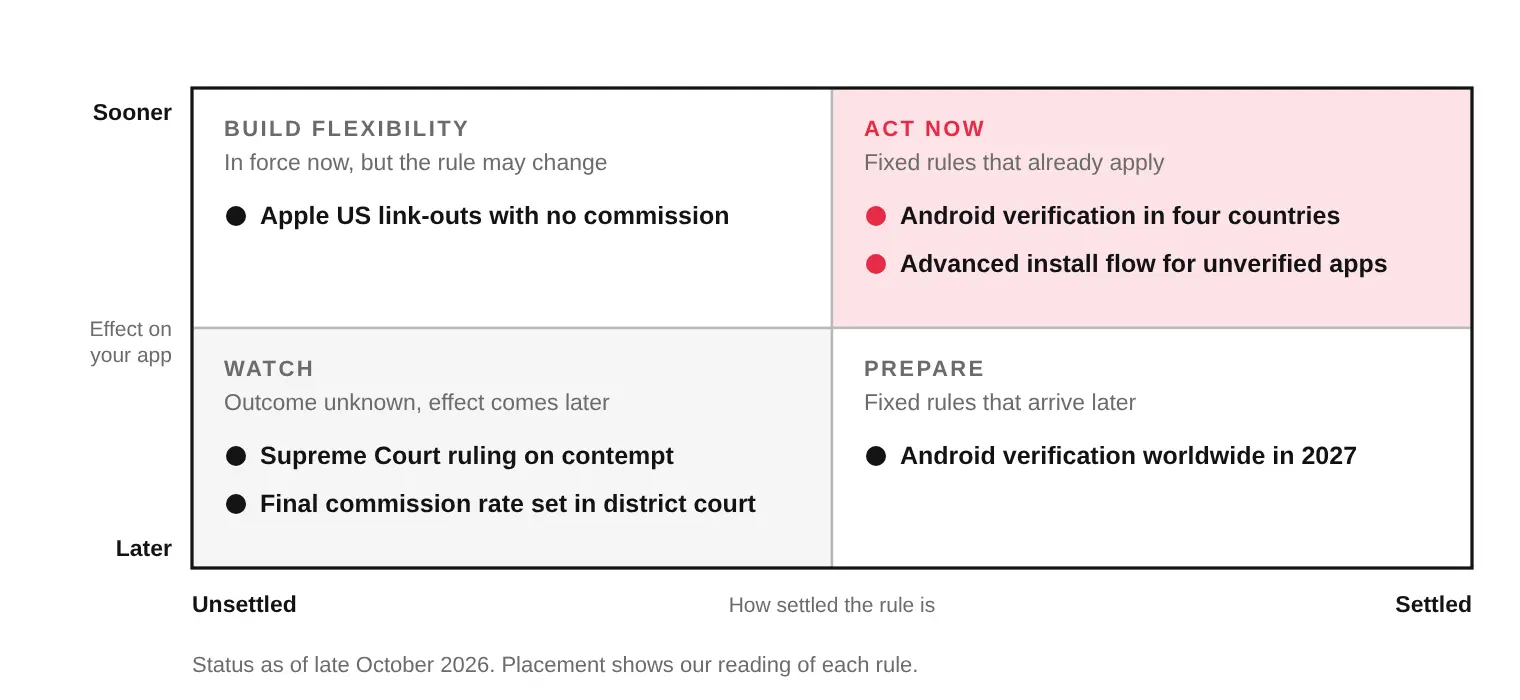
Android verification is settled, so the right response is action: register, audit, and fix account ownership. Apple’s link-out terms are in force but unsettled. A business plan that depends on a zero commission is a bet on a court calendar.
The answer is to build for flexibility. Moving purchases to the web means running a real checkout, with accounts, payments, and subscriptions that sync back to the app. Our digital commerce services cover that side of the work. Whatever you build, make the link-out a setting you can switch off, and keep in-app purchase working as a fallback.
A Thirty Day Plan for App Owners
- Inventory every app, package ID, and distribution channel: Include direct downloads, enterprise tools, and regional stores, and note who holds each developer account. Our mobile app development services include audits of existing apps.
- Confirm Android registration: Check that Play registered each app, and register the rest by hand, including anything shipped outside Play.
- Fix account ownership: If a former agency or employee holds the developer account, change that first.
- Model iOS web checkout at several rates: Test zero and two or three higher rates, to see whether the plan survives.
- Put the link-out behind a switch: One setting should turn it on, off, or change where it points.
- Name an owner and a monthly review: Fifteen minutes on store policy changes is enough to avoid a surprise.
Conclusion: Know What Would Change This Advice
This advice holds for now, and four events would change it:
- A rate set by the district court: Redo the web checkout model the same week.
- A Supreme Court decision on the contempt standard: Revisit how the link-out is designed.
- A date for your country from Google: Move registration to the top of the list.
- Final rules for managed enterprise devices: Check whether your internal apps are covered.
Until one of those happens, the plan above stands. Settled rules get action, and unsettled ones get a switch.
Put your apps in one table with the name, the package or bundle ID, the stores each ships through, and who holds each developer account. We will mark which apps face the Android rules and where your iOS purchases could use a web route. Book a Discovery Call →
Frequently Asked Questions
What is Android developer verification?
It is a Google requirement that developers confirm their identity and register their apps, so that installs on certified Android devices can be matched to a known developer. Registration opened to all developers in March 2026. Enforcement began on 30 September 2026 in four countries and widens worldwide in 2027.
Do I need to do anything if my app is only on Google Play?
Check it. Google Play registers about 99% of apps automatically, but you should confirm in Play Console that each app and your developer details are complete. Register any remaining apps by hand, and make sure the account is held by your organization and not a former agency or employee.
What happens to an unverified Android app?
In enforcement countries, an unverified app no longer installs the normal way on certified devices. Users must follow an advanced flow that includes developer mode steps and a mandatory 24 hour wait. Sideloading is not banned, but it becomes much harder, which hurts any app that relies on direct downloads.
Which countries are affected by Android verification now?
Brazil, Indonesia, Singapore, and Thailand, since 30 September 2026, for certified devices running Android 7 or later. Google plans to extend verification to certified Android devices worldwide in 2027.
Can I link to my website for payments from my iOS app?
In the US, a court order lets apps link to external purchases, and Apple cannot currently charge a commission on those purchases. The rate that Apple may charge in future is not set, and the EU has separate terms. Check Apple’s current guidelines and speak to counsel before you change your payment flow.
Will Apple’s link-out commission change?
It might. The district court still has to decide whether Apple may charge a fee limited to costs that are genuinely and reasonably necessary, and the Supreme Court will hear a narrow question about the contempt standard. Argument is not expected before January 2027, so plan for an answer in 2027 or later.