Discovery and Requirements
Define users, workflows, data needs, integrations, and project priorities.

Shopify provides the commerce foundation. The opportunity lies in shaping the storefront, customer journey, functionality, and operational connections around the business.
Build applications around structured data, user interactions, and business-specific workflows rather than relying on disconnected tools.
Create the application foundations for digital products with multiple users, permissions, and changing feature requirements.
Help teams manage internal operations, track information, and coordinate recurring tasks through a centralized system.
Enable frontend interfaces, external platforms, and backend data to communicate through structured application interfaces.
Extend application functionality through data processing, automated workflows, and integrations with AI-powered systems where appropriate.
Our Custom Django Development approach focuses on building dependable application functionality around your product requirements.

Build applications around your product's unique requirements, business rules, and user workflows. Tailor the functionality to your operations instead of forcing your processes into a generic solution.
Create data-driven web applications with organized backend logic and dynamic functionality. Support complex user interactions while keeping the application structured for future improvements.
Design data models, relationships, and database structures around how your application handles information. Establish a reliable foundation for retrieving, managing, and processing data as requirements evolve.
Build APIs that allow your Django application to communicate with frontend interfaces, mobile applications, and external platforms. Enable structured data exchange while keeping connected systems coordinated.
Implement authentication and access controls based on user roles, responsibilities, and application requirements. Help ensure users can access the information and functionality relevant to them.
Automate repetitive application tasks and data-processing activities to reduce manual effort. Build workflows that help teams manage routine operations more consistently.
Connect your application with payment gateways, CRM platforms, analytics tools, and external APIs. Bring essential systems together to support connected business processes.
Identify application bottlenecks and improve database queries, backend operations, and resource usage. Keep the application responsive and maintainable as its functionality and usage grow.
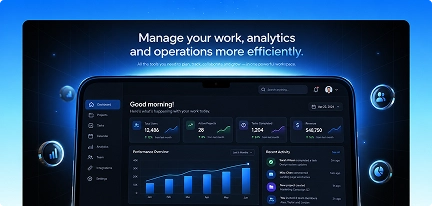
Build data-driven products with account management, permissions, dashboards, and connected workflows.
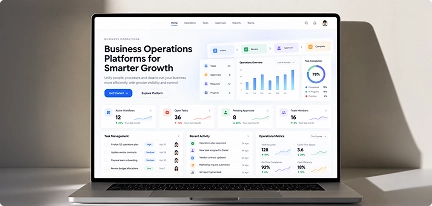
Bring approvals, reporting, and internal processes into a centralized application.
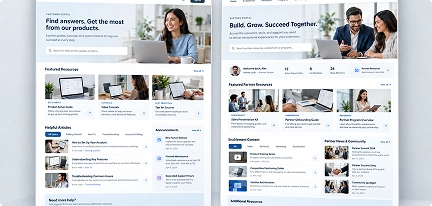
Provide secure access to information, resources, and account-specific functionality.
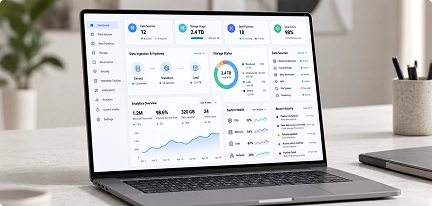
Organize complex datasets into searchable, manageable application experiences.
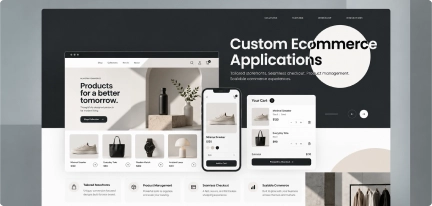
Support specialized catalog, customer, and transaction workflows when a custom commerce architecture fits the project.
 React
 JavaScript
 HTML/CSS
 PostgreSQL, MySQL
 REST APIs
third-party APIs
 Cloud Hosting, Containers
and CI/CD pipelines
 Authentication
 Payment Systems
and external services
We align product requirements, technical architecture, and integration needs before building and validating an application designed for long-term use.
Define users, workflows, data needs, integrations, and project priorities.
Establish the application structure, data models, APIs, and implementation roadmap.
Build the core application and connect the systems it depends on.
Validate functionality, access controls, performance, and key user journeys.
Prepare the release, monitor application behavior, and plan ongoing improvements.
We start with the product requirements.Architecture and framework decisions follow the application’s actual needs.
We plan for real-world usage. Data structures, permissions, integrations, and workflows are considered from the start.
We build for maintainability. Readable application structure helps teams manage and extend functionality.
We think beyond the backend. We consider APIs, user experiences, integrations, and deployment as part of the wider product.
“LN Webworks provided reliable and flexible web maintenance and Drupal support throughout our long-term engagement. Their team was always willing to adjust their approach when something wasn’t working, going above and beyond to meet expectations. They were open to feedback, quick to resolve concerns, and maintained strong communication through email and virtual meetings. Their adaptability and collaborative mindset truly set them apart.”

VP of Web, Hawke Media
“I’ve been extremely happy with my engagement with LN Webworks—so much so that we’ve continued the relationship to this day. They built our Drupal site from scratch with smooth Stripe integration, delivered consistently beyond expectations, and maintained clear communication throughout. Their specialists are reliable, personable, and manage work in a structured, professional way.”

CEO, Marengo
“LN Webworks delivered a Drupal platform that supports our growth and expansion initiatives. Their Drupal expertise was crucial to the project’s success, milestones were met consistently, and communication was clear throughout. We see them as a reliable long-term partner for our digital initiatives.”

CEO, Atollon
“LN Webworks is truly an expert team. They demonstrated deep knowledge of Drupal, were flexible and quick to respond, and maintained a high level of customer care throughout the project. The new SEO-friendly site and tailored e-commerce forms have directly contributed to improved visibility and a higher conversion rate.”

CEO, VisaGate
Yes. Django can support data-driven applications with custom business logic, user management, and integrations when the architecture fits the requirements.
Yes. It can support accounts, permissions, product workflows, and subscription integrations.he solution
Yes. Django can provide the backend and APIs while a separate frontend handles the user interface.
Yes. APIs and integrations can connect the application with suitable third-party platforms.
Yes. The work can include code improvements, integration updates, performance reviews, and architectural changes.
If the project’s requirements are better served by another framework or platform, the architecture should reflect that rather than forcing Django into the solution

Tell us what you’re building, connecting, or improving. We’ll help assess the right application architecture for your goals.
Discuss Your Project