Executive Summary
Most marketing teams don’t have an ideas problem. They have a research problem. Before a single ad concept can exist, someone has to read through customer reviews, work out who’s actually buying and why, and turn that into a brief, work that usually takes days and is the first thing skipped when a deadline gets tight.
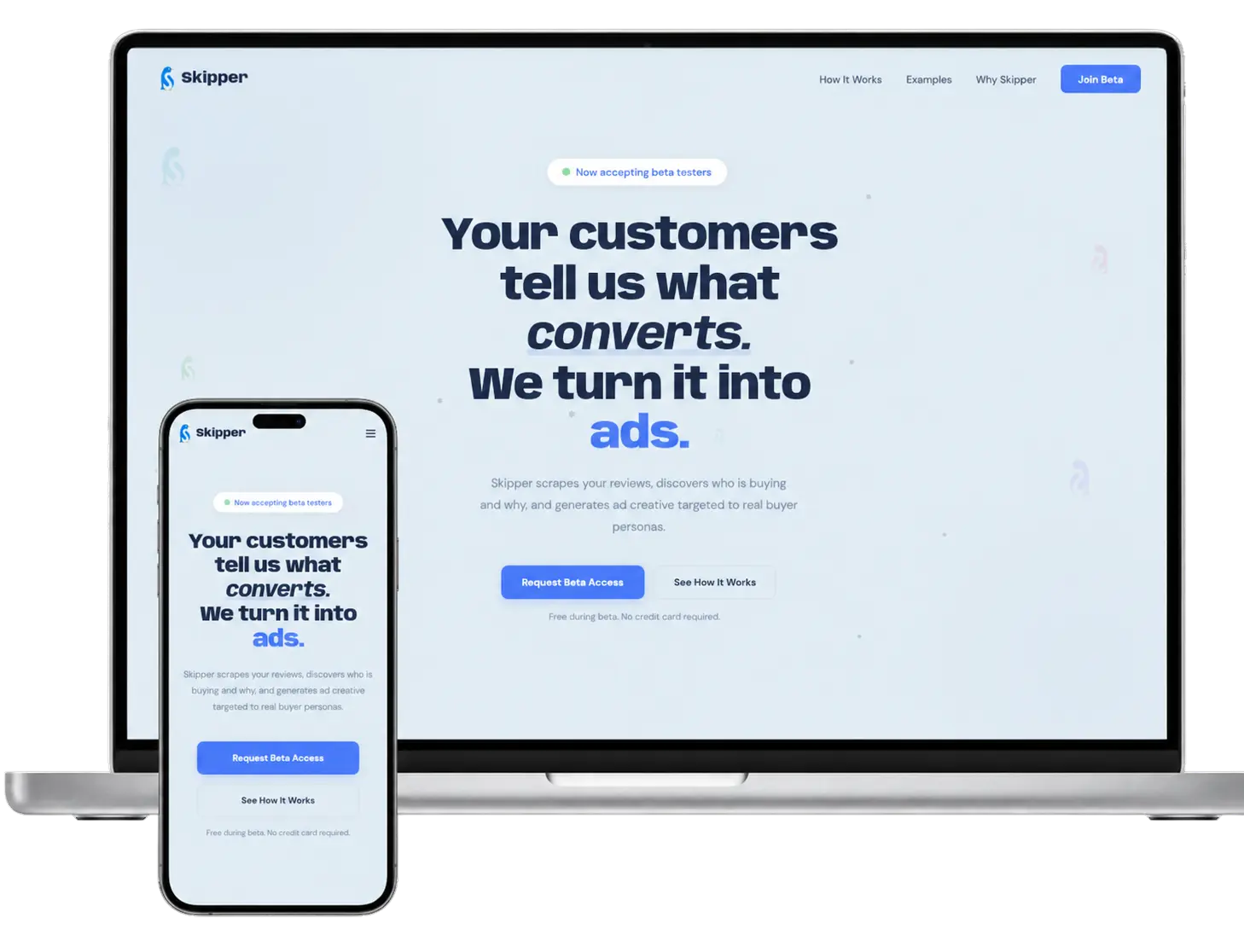
Skipper was built to make that research problem disappear. We designed and built Skipper’s core product from the ground up: a MERN-based platform backed by custom Python services that read a brand’s real customer reviews straight from a live product URL, no data upload required, and turn that raw feedback into persona insight, creative briefs, and finished ad images.
Eight months in, the platform has grown from a research-automation idea into a full creative production engine. The result: roughly 60 percent less research time behind a new ad concept, and about 20 percent lower cost to produce it.
Client Background
Industry: Gen AI SaaS, Marketing & Advertising Technology
Skipper operates in the Gen AI SaaS category, specifically AI-powered marketing and advertising tooling, built for marketing teams and agencies who need to move from a product page to a researched ad concept quickly, without the research overhead that normally stands in the way.
The Challenge
Here’s what producing a research-backed ad concept used to require: reading customer reviews to find personas, angles, and motivators. Writing a brief from that research by hand. Then, briefing a designer separately, or manually prompting image tools to get something usable.
Every one of those steps lived in a different tool, or in someone’s head. There was no single path from “here’s our product page” to “here’s a researched, on-brand ad concept.” Which meant the research that makes an ad good was usually the first thing skipped under time pressure.
Solution Delivered
We built Skipper as a connected, end-to-end platform on MERN, with custom Python services handling the research and AI-orchestration layer. The platform integrates GPT and Claude APIs for language and reasoning tasks, and an image-generation pipeline that started on the Nano Banana model before we migrated it to GPT Image as the product matured.
TECHNOLOGY MERN Stack · Python · GPT API · Claude API · GPT Image · Nano Banana (early iteration)
01. Automated Research From a Live URL
We built Skipper to scrape and analyze a brand’s real customer reviews straight from its live product URL, no manual data upload required. From that raw review data, it automatically generates PAMs, personas, angles, and motivators, the research foundation that used to take days, now in minutes.
02. Brief and Concept Generation
From the PAMs output, Skipper generates ad briefs and creative concepts automatically, turning raw customer insight directly into a usable creative direction, not a pile of notes someone still has to interpret.
03. Ad Image Generation and Editing
The platform generates finished ad images across multiple categories and styles, and supports AI-assisted editing after generation, so teams can refine creative without briefing a designer for small changes.
04. Brand Guidelines, Detected Automatically
Skipper reads a brand’s visual guidelines, colors, fonts, and style, straight from its product URL, so generated creative stays on-brand without a manual handoff.
05. Ongoing Concept Recommendations
Beyond a single request, the platform keeps recommending new concepts, giving marketing teams a running pipeline of ideas instead of a one-time output.
What Changed:
|
~60% less research time before creative work can start |
~20% lower cost to produce ad creatives |
Beyond the numbers, the bigger shift was structural: research, persona insight, briefing, creative generation, and editing now run as one connected workflow instead of several disconnected tools and manual handoffs.
Why This Matters
Most marketing teams don’t lack ideas; they lack the time to do the research that makes an idea worth testing.
Skipper bets that automating the unglamorous part, reading reviews, identifying who’s actually buying and why, drafting the brief, doesn’t just make research faster. It makes research get used, because it’s no longer the bottleneck standing between a product and its next ad.
This build also reflects how we approach AI product engineering generally: rather than adding a single AI feature to an existing workflow, the goal was a connected pipeline where each AI-assisted step feeds directly into the next, from raw customer language to finished creative.
Exploring a Similar AI-Native Product?
From custom research automation to generative creative pipelines, we’re happy to talk through what a build like this could look like for your platform.