
Stage 2 is the connectivity and operational flow stage. Once the platform foundation is stable, organizations need reliable system integration before governance, automation, and AI can scale effectively.
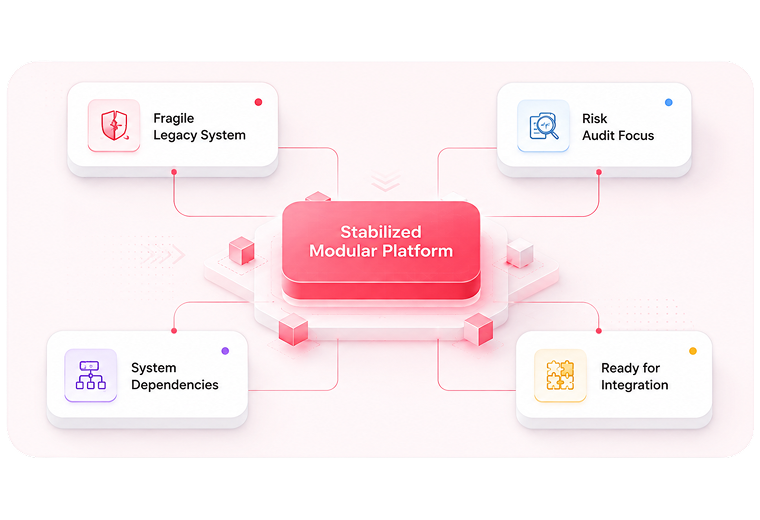
Stabilize the platform, reduce technical risk, and create a reliable foundation for integration.
Connect critical business systems, standardize data flow, and eliminate manual coordination across teams.
Create governance, operational visibility, and consistent workflows across connected systems and teams.
Automate business processes and intelligent workflows once systems, data, and operations are integration-ready.
Your systems work individually, but the connections between them create friction. If two or more of these signals feel familiar, Systems Integration is likely your next step.
Systems Integration is not about connecting tools for the sake of it. It’s about removing structural gaps that slow data flow, create manual work, and limit operational scale.
CRM, billing, support, product, and operational tools work independently, forcing teams to manually move information between systems.
Critical business data exists in multiple systems with different formats, ownership rules, and records—creating unreliable reporting and decisions.
Point-to-point integrations, plugins, and custom APIs are difficult to maintain, making system changes risky and integration failures harder to diagnose.
Teams rely on spreadsheets, exports, emails, and repetitive data entry to move workflows forward, increasing delays and operational overhead.
Disconnected data, inconsistent triggers, and unreliable integrations prevent workflows, automation, and AI from operating across the business.
We follow a deliberate integration sequence to map system relationships, establish reliable data flows, and reduce manual coordination before introducing broader automation.
Identify the systems, APIs, data sources, dependencies, and manual handoffs behind critical business processes. Establish where information originates, where it moves, and where it breaks down.
Prioritize integrations creating the greatest operational friction. Standardize data exchange, strengthen APIs, remove duplicate handoffs, and establish reliable system-to-system communication.
Avoid adding disconnected point-to-point integrations. Create reusable integration patterns, clear ownership, monitoring, and architecture that can support future workflows, automation, and AI.
We solve the integration bottlenecks that matter most first—creating reliable connections, cleaner data flows, and measurable operational improvements without unnecessary platform disruption.
Recommended Starting Point
Map how your systems, APIs, data, and workflows connect today. We identify integration gaps, fragile dependencies, duplicate data flows, and the highest-impact opportunities for creating a connected operating environment.
System dependency map, integration risk assessment, prioritized connection roadmap, and recommended architecture patterns.
Connect the business-critical systems creating the most operational friction—from CRM and billing to support, product, ERP, or internal platforms.
Production-ready integrations, standardized data mappings, API workflows, error handling, and integration monitoring.
Strengthen fragile APIs and standardize how data moves between systems so integrations remain reliable as your business and technology stack evolve.
Modernized API architecture, standardized data contracts, synchronization rules, integration documentation, and monitoring framework.
Disconnected systems create different bottlenecks across industries. See where integration gaps are slowing operations, fragmenting data, and limiting your ability to scale.
As SaaS businesses grow, CRM, product, billing, support, and analytics systems often evolve separately. Stage 2 connects these systems so customer and operational data can move reliably across the business.
Student, admissions, academic, CMS, CRM, and departmental systems often operate in silos. Stage 2 creates reliable connections that reduce administrative effort and improve access to consistent information.
Healthcare operations depend on information moving securely between clinical, patient, administrative, and operational systems. Stage 2 focuses on creating controlled, reliable integrations without compromising
Commerce operations depend on continuous data flow between storefronts, inventory, payments, fulfillment, CRM, and support. Fragmented integrations create delays that directly affect the customer experience.
Publishing operations often span CMS, DAM, analytics, subscriptions, advertising, and distribution platforms. Stage 2 connects these systems so content, audience, and revenue data can move more efficiently.
We connect systems with purpose. Stage 2 creates reliable data flows and scalable integration patterns while avoiding fragile connections that create more operational complexity.
Everything you need to know about connecting systems, improving data flow, and preparing your operations to scale.
You are likely in Stage 2 if your core platforms work, but teams still rely on spreadsheets, manual data entry, exports, or disconnected tools to keep operations moving. An Integration Architecture Assessment can identify where connectivity gaps are creating the most friction.
Not necessarily. Stage 2 is designed to make better use of the systems you already have. We first assess APIs, data structures, dependencies, and integration limitations before recommending replacement or modernization.
Start with the connections that create the greatest operational impact. We prioritize systems based on workflow dependencies, data criticality, manual effort, business risk, and their importance to future automation.
Yes, when the legacy platform provides a safe and reliable integration path. Depending on its architecture, this may involve APIs, middleware, integration layers, or controlled data synchronization rather than replacing the entire system.
We avoid unnecessary point-to-point connections and establish clear data contracts, reusable integration patterns, monitoring, error handling, and ownership. The goal is an integration architecture that remains maintainable as your technology stack grows.
The goal is to minimize disruption. Integrations are mapped and prioritized before implementation, then introduced in controlled phases with testing, validation, monitoring, and fallback planning around business-critical workflows.
Yes. Reliable automation and AI depend on connected systems, consistent data, predictable triggers, and clear ownership. Stage 2 establishes this integration foundation before more advanced workflows are introduced.