
Legacy Modernization

Modernize your legacy platform with confidence, not disruption.
Legacy systems shouldn’t slow growth, delay innovation, or increase operational risk. We help organizations identify what is fragile, stabilize critical systems, and build a modernization roadmap that protects business continuity while preparing the platform for future scalability, integration, and AI readiness.
13+
Years of transformation expertise

Deep experience modernizing legacy platforms, enterprise applications, and complex digital ecosystems across industries.

1,000+
Digital projects delivered

Successfully delivered modernization, migration, integration, and digital transformation initiatives for organizations worldwide.

4.9
Clutch rating

Consistently recognized by clients for strategic guidance, technical excellence, communication, and reliable project delivery.

95%
Client retention

Long-term partnerships built on trust, measurable business value, and continuous digital evolution.

Operational Pipeline

Where legacy modernization fits in your digital progression

Stage 1 creates the operational foundation for every transformation initiative that follows. Before organizations invest in integration, automation, governance, or AI, they need platform stability, architectural clarity, and a modernization strategy that reduces risk and protects business continuity.

01
Legacy modernization

Identify fragile systems, reduce technical risk, and establish the modernization roadmap that creates decision confidence.

02
Systems integration

Connect business-critical platforms, eliminate fragmented workflows, and create a reliable foundation for data and operations.

03
Digital operations

Standardize governance, platform management, and operational visibility so teams can scale with consistency and control.

04
Workflow automation

Automate repeatable business processes and intelligent workflows once the platform foundation is stable and integration-ready.

You may be in stage 1 if…

These are the operational signals that indicate legacy modernization should be your first priority. If several of these challenges sound familiar, your platform is likely limiting execution, increasing risk, and making future transformation initiatives harder than they need to be.

01
Getting harder to change

Routine updates, new features, and platform improvements take longer, cost more, and create greater operational risk with every release cycle.

Getting harder to change
02
Technical debt is slowing teams

Product, IT, marketing, and operations teams are spending more time managing platform limitations than delivering strategic initiatives.

Technical debt is slowing teams
03
Governance pressure is rising

Security, accessibility, compliance, permissions, and operational oversight are becoming increasingly difficult to manage across the platform.

Governance pressure is rising
04
Workarounds are everywhere

Manual processes, disconnected tools, duplicate data, and operational workarounds have become part of everyday execution.

Workarounds are everywhere
05
Modernization path is unclear

Leadership knows the platform must evolve, but lacks clarity on priorities, dependencies, sequencing, and the safest modernization approach.

Modernization path is unclear
06
AI and integration initiatives keep stalling

Automation, integration, personalization, and AI opportunities continue to emerge, but the underlying platform is not yet ready to support them effectively.

AI and integration initiatives keep stalling
Identified Vulnerabilities

The core problems we target

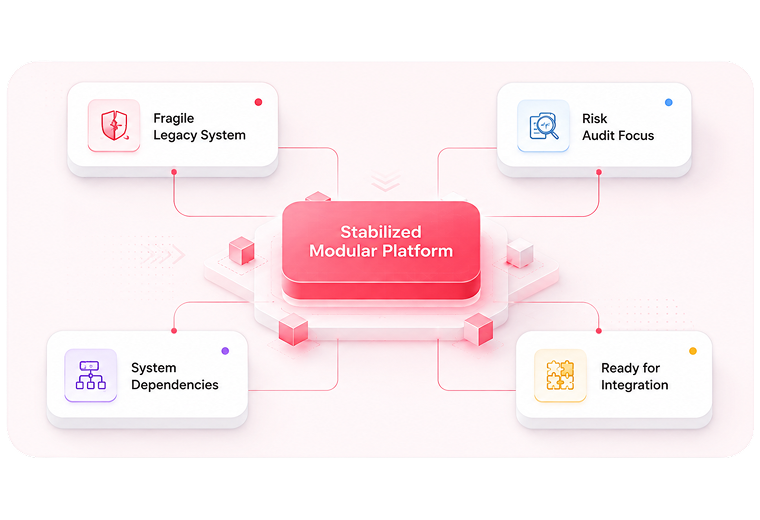
Legacy modernization is not about replacing technology for its own sake. It is about removing the structural constraints that slow execution, increase operational risk, and prevent future transformation. These are the five vulnerabilities we assess and resolve during Stage 1.

Platform risk
Aging CMS or application stack

Outdated platforms become harder to maintain, secure, and extend. Every update introduces more risk, while new capabilities become increasingly difficult to implement.

Velocity loss
Accumulated technical debt

Development slows as fragile code, outdated architecture, and repeated workarounds reduce team productivity, increase costs, and delay strategic initiatives.

Governance gap
Weak permissions and governance

Inconsistent ownership, access control, publishing workflows, and compliance processes create operational risk and reduce confidence in the platform.

Dependency risk
Unclear system dependencies

Critical integrations, data flows, and platform relationships are not fully understood, making modernization, migration, and operational changes significantly more disruptive.

Readiness gap
Low AI and automation readiness

The platform lacks the architectural foundation, standardized data, and integration readiness required to support automation, intelligent workflows, and AI initiatives at scale.

How to move through stage 1

Stage 1 is designed to reduce uncertainty before major modernization decisions are made. We follow a structured three-step approach that helps leadership identify the real constraints, stabilize critical risks, and choose the modernization path that creates the strongest long-term foundation.

01
Clarify what should trigger action first

Separate visible symptoms from structural platform issues. Assess technical debt, platform risk, governance gaps, integration dependencies, security exposure, and AI readiness before deciding what to modernize.

02
Stabilize what cannot wait

Address the issues that create immediate operational risk, including performance bottlenecks, security and compliance gaps, governance inconsistencies, accessibility concerns, and critical workflow disruptions.

03
Avoid rebuilding too early

Modernization should follow evidence, not urgency. Map dependencies, validate architecture, and establish governance before committing to a replatforming, automation, or AI initiative.

Match your situation
01
Leadership needs strategic clarity before making modernization decisions
02
A rebuild, upgrade, or platform migration is being considered
03
Risk is driven by complex integrations and system dependencies
04
Immediate platform performance, governance, or security improvements are required
05
AI, automation, or intelligent workflows are being planned
Start with the right modernization move, not the biggest one.

Focused engagement offerings

We don’t begin with large transformation programs. We begin with focused engagements that reduce uncertainty, stabilize critical risks, and produce measurable outcomes before broader modernization investments are made.

01
Modernization readiness audit

Our recommended starting point for organizations that need clarity before committing to a rebuild, migration, or platform transformation.
Identify platform vulnerabilities, quantify technical debt, map system dependencies, and create a structured modernization roadmap that leadership can act on with confidence.

Use this when
  • Platform updates feel increasingly risky.
  • Release velocity is declining.
  • Technical debt is affecting delivery.
  • Leadership needs objective modernization priorities.

Deliverable highlight

A modernization blueprint with dependency mapping, technical debt assessment, governance findings, risk prioritization, and a phased action roadmap.

02
Phased replatforming plan

When modernization requires a platform transition, we create a structured migration strategy that minimizes operational disruption and protects business continuity.

Best for

Organizations planning a CMS migration, application replatforming, or enterprise platform modernization.

Deliverable highlight

Migration sequencing plan, dependency map, data transition strategy, rollout phases, and risk mitigation roadmap.

03
Integration architecture roadmap

Build the integration foundation required for scalable operations, automation, and future AI initiatives.

Best for

Organizations with fragmented systems, custom integrations, inconsistent data flows, or API architecture challenges.

Deliverable highlight

System integration blueprint, API architecture recommendations, data flow mapping, dependency analysis, and implementation priorities.

Who feels this stage most

Legacy modernization challenges look different across industries, but the pattern is the same: platform complexity begins to slow operations, increase risk, and limit future growth. Select the scenario that best matches your business environment.

Your product is working. Your operations are falling behind.

Growth creates hidden operational friction. Customer onboarding, billing changes, integrations, and feature delivery become increasingly difficult as technical debt and platform complexity accumulate.

Common signals
  • Customer onboarding depends on manual processes.
  • API integrations are slowing product delivery.
  • Technical debt is reducing release velocity.
  • Platform changes require excessive testing and coordination.
Recommended next step
Modernization Readiness Audit
Identify technical debt, platform dependencies, integration risks, and the modernization priorities that will improve delivery speed and scalability.

The platform supports the institution, but governance is becoming unmanageable.

Universities and educational institutions often operate with multiple departments, decentralized publishing, accessibility requirements, and aging CMS environments that create governance and operational complexity.

Common signals
  • Accessibility compliance is difficult to maintain.
  • Content ownership and publishing workflows are inconsistent.
  • Departmental sites operate in disconnected systems.
  • Platform upgrades are repeatedly delayed.
Recommended next step
Performance & Governance Sprint
Improve governance, accessibility, permissions, publishing workflows, and platform stability before broader modernization efforts.

The platform cannot evolve at the pace healthcare operations require.

Healthcare organizations face growing pressure from security, compliance, patient experience, and system integration requirements. Legacy platforms often become barriers to operational improvement.

Common signals
  • Security and compliance updates are difficult to implement.
  • Patient or provider systems are poorly integrated.
  • Manual coordination exists between critical systems.
  • Platform changes create operational risk.
Recommended next step
Integration Architecture Roadmap
Map system relationships, data flows, integration risks, and the architecture needed for secure, scalable modernization.

Revenue growth is outpacing platform flexibility.

As product catalogs, fulfillment operations, marketing systems, and customer experience become more complex, legacy commerce platforms can limit growth and operational efficiency.

Common signals
  • Checkout or performance issues affect conversion.
  • Inventory and order systems are fragmented.
  • Marketing and commerce platforms are poorly connected.
  • Seasonal releases create operational instability.
Recommended next step
Phased Replatforming Plan
Create a staged migration strategy that protects revenue, minimizes disruption, and modernizes the commerce platform safely.

Content velocity is increasing, but the publishing platform is slowing down.

Publishing organizations often struggle with editorial workflows, permissions, performance, and content distribution across multiple channels.

Common signals
  • Editorial publishing workflows are inconsistent.
  • Performance issues affect audience experience.
  • Content distribution relies on manual coordination.
  • Platform governance is limiting editorial efficiency.
Recommended next step
Performance & Governance Sprint
Optimize publishing workflows, permissions, platform performance, governance, and operational consistency.

Our pragmatic approach to stage 1

Stage 1 is designed to create operational clarity before major technology decisions are made. We focus on stabilizing critical systems, reducing structural risk, and building a modernization foundation that supports long-term scalability, integration, and AI readiness without unnecessary disruption.

What stage 1 delivers

Platform stabilization and structural risk reduction
Faster release cycles and improved development confidence
Better performance, reliability, and operational visibility
Clear dependency mapping across systems and data flows
Stronger governance, permissions, and security controls
A modernization roadmap aligned with business priorities

What stage 1 is not

A cosmetic website redesign
A rushed platform migration or rebuild
A generic technical audit without business interpretation
Feature development presented as modernization strategy
AI planning on an unstable or fragmented platform
A transformation approach that puts business continuity at risk

Frequently asked questions

Everything you need to know before starting a legacy modernization initiative.

1. How do we know if we are in stage 1?

If platform updates feel increasingly risky, technical debt is slowing delivery, governance issues are growing, or leadership is discussing modernization without a clear roadmap, Stage 1 is likely the right starting point. A Modernization Readiness Audit confirms the risks, dependencies, and priorities.

Most organizations should not make that decision before understanding platform dependencies, technical debt, governance gaps, and operational risk. Stage 1 helps determine whether phased modernization, targeted stabilization, or a full replatforming strategy is the safest and most cost-effective path.

The audit produces a structured modernization roadmap, dependency mapping, technical debt assessment, governance findings, integration risk analysis, and prioritized recommendations. The goal is to give leadership decision confidence before significant investment begins.

Most Stage 1 engagements are completed within 2–6 weeks, depending on platform complexity and the number of systems involved. The objective is rapid clarity and actionable priorities, not a lengthy consulting exercise.

Yes. Our approach prioritizes business continuity by identifying critical dependencies, sequencing changes carefully, and stabilizing high-risk areas before broader modernization work begins. We avoid unnecessary disruption and rushed migrations.

AI and automation depend on stable architecture, clean data, reliable integrations, and clear governance. Stage 1 evaluates whether the platform can realistically support AI initiatives or whether foundational modernization is required first.

Once the platform foundation is understood and stabilized, organizations typically move into Systems Integration, Digital Operations, Workflow Automation, or AI implementation. The next step depends on the roadmap created during Stage 1.

Not necessarily. Many organizations can extend the life of their existing platform through targeted modernization, governance improvements, performance optimization, and integration restructuring. We recommend replacement only when the platform can no longer support business requirements safely or economically.

Ready to Build or Modernize?
Get in touch

Ready to Build or Modernize?

Whether you're starting something new or upgrading an existing platform, we're here to help you take the next step.

Start the Conversation

What best describes where you're starting from?
Privacy Overview

This website uses cookies so that we can provide you with the best user experience possible. Cookie information is stored in your browser and performs functions such as recognising you when you return to our website and helping our team to understand which sections of the website you find most interesting and useful.