Quick Commerce vs E-commerce: What’s the Difference?
 LN Webworks
·
18 Sep, 2025
LN Webworks
·
18 Sep, 2025
We have all heard about e-commerce; it is impossible not to come across one. After all, it is everywhere. Customers will browse through a company’s website, add items to the virtual cart and purchase the product as per their wish.
However, there is something new that comes in the market- quick commerce. But what exactly is it?
Quick Commerce: Unlike traditional methods of websites and shopping carts, quick commerce or q-commerce is all about using quantum computers to streamline the online shopping experience.
Get near instance results with no waiting whatsoever, all thanks to quick commerce. On top of that, it also offers high security as compared to traditional e-commerce platforms because its fulfillment centres are equipped with advanced security features, making it the top candidate for online shoppers.
Quick commerce is not only increasing the on-demand delivery service but also changing the way we shop for food, groceries, or other household essentials. Imagine getting all the groceries and having them delivered within a few minutes. Very rarely will people go to stores and wait in line.
To make it possible, q-commerce relies heavily on delivery vehicles to deliver products, making the operation more efficient with less amount of time.
Let’s learn the differences between quick commerce and e-commerce!
What Is E-commerce?
E-commerce is all about buying and selling goods and services over the internet. Amazon is one of the most prominent examples of an e-commerce platform. All in all, e-commerce is all about online banking and bill pay. It is also often known as electronic commerce or internet commerce.
Some of the most common traditional e-commerce platforms include:
- Flipkart
- Amazon
- Myntra
- Aliexpress
- Ebay
Related Article : Custom eCommerce Solutions: Key Features and Challenges
How Does E-commerce Work?
Following the customer’s selection of a product, the web server managing the website receives a communication from the customer’s web browser, processes the order, and forwards it to the order manager. After that the manager goes through the item’s stock level in the database and if it is available the system verifies the order and gives the expected date of delivery.
In case it is not, then it places orders with manufacturers or for new supplies. After processing the customer’s payment information, the merchant system verifies that there are enough funds in the customer’s account.
Top Features Of E-commerce
- With features like descriptions, photos, prices, ratings, and availability data, a comprehensive catalog of goods or services is crucial for online sales.
- High-quality, responsive, and easy-to-use website with a search bar and well-organized sections in the navigation bar.
- Offers customized discounts and deals. Also provide other useful features to make it feel special
- 24/7 customer service for questions, refunds, and issues, as well as a secure payment gateway for handling online transactions and safeguarding client information.
What Is Quick Commerce?
Quick commerce, on the other hand, is a new type of e-business that is growing with mobile commerce and voice-activated devices such as Google Home and Amazon Echo. Quick commerce uses a quantum computing system to power e-commerce transactions.
With the help of quantum computers, businesses are able to process large amounts of data more efficiently and fastly, which ultimately leads to faster and more accurate decision-making. With more people turning towards the digital economy, it is evident that the quick commerce business model is growing significantly.
Related Article : What Is Quick Commerce : A Complete Guide
How Does Quick Commerce Work?
The concept is straightforward: providing a consumer with an urgently needed component for a meal that is already underway. In other words, the sooner the buyer receives their purchase—between two hours and six minutes—the better. The larger, less obvious magic is taking place in the backend, but the magic isn’t taking place in front of you.
The majority of these Q-commerce owners use “dark stores,” which are strategically placed warehouses, to guarantee a speedy turnaround from order to doorstep, even though they are not in the same line of work. A small number of them also use crowdsourcing, which gives them access to a large pool of people who are always prepared to act.
Top Features Of Quick Commerce
- It mainly focuses on a limited range of items including groceries, essential goods, and household items.
- Have the capacity to deliver products within a short period of time, usually within minutes or hours.
- Fast delivery is made possible by a dense network of tiny warehouses or dark stores situated near customers.
- Provides customers with a high degree of convenience, enabling them to order goods and have them delivered promptly without ever leaving their homes.
Quick Commerce vs. E-Commerce: Core Differences
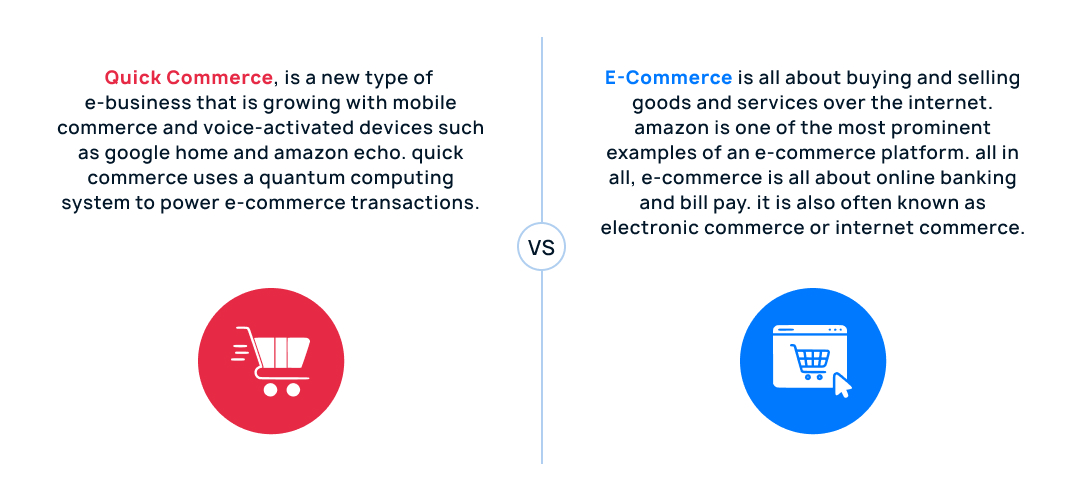
As online shopping continues to evolve, two significant models have emerged: E-commerce and Quick Commerce (Q-Commerce). While both serve the purpose of connecting consumers to products online, they operate in distinct ways, offering unique benefits. Here’s a breakdown of the core differences:

Which Model Should You Choose?
The choice depends on your business goals and target audience.
Quick Commerce
- Your focus is on fast-moving goods like groceries or pharmaceuticals.
- You’re targeting urban areas with high demand for instant delivery.
E-Commerce
- You want to provide a diverse range of products.
- Your audience values detailed comparisons and variety.
How LN Webworks Helped Mali-achats Succeed In ECommerce
We successfully partnered with Mali-achats to launch a scalable E-Commerce Store. By leveraging our expertise in e-commerce and quick commerce development, we helped [ streamline operations and enhance customer satisfaction with rapid delivery solutions. Our tailored approach ensured the platform was both efficient and user-friendly, resulting in improved performance and customer retention
Why Partner With LN Webworks?
At LN Webworks, we specialize in creating customized platforms for both e-commerce and quick commerce businesses. As a leading eCommerce development company, we offer solutions that ensure scalability, efficiency, and superior user experiences.
Whether you’re building a traditional online store or launching a lightning-fast delivery service, we help you develop platforms that cater to the needs of your customers and drive business growth.
Final Thoughts
At LN Webworks, we provide cutting-edge e-commerce solutions that are customized to meet the needs of both quick commerce and traditional e-commerce models. Whether you’re looking to build a robust e-commerce platform or streamline your quick commerce operations, our expert team is here to help you create efficient, scalable, and customer-centric solution.
Contact Us today to discuss how our solutions can help you succeed in both e-commerce and quick commerce.Let us guide you through creating a seamless, efficient, and scalable platform that meets your business needs
Author