Top Web Accessibility Lawsuits That Make the Case for Accessible Design
Khushboo Arora
·
19 Sep, 2025
The concept of web accessibility has become crucial for various businesses in the increasingly digital world. By building an accessible website, you can make it more likely to be found on SERPs by improving its search engine optimization and enhancing its usability, reach, and inclusivity.
You might not know that if businesses fail to comply with the Americans with Disabilities Act (ADA), they not only sideline people with disabilities but also expose themselves to legal risk.
In fact, the number of web accessibility lawsuits has increased tremendously over the last couple of years, rising from about 2,300 in 2018 to more than 4,000 in 2021. Therefore, web designers and business owners need to be aware of the importance of web accessibility.
In this blog, we will discuss the Americans with Disabilities Act, some of the top accessibility lawsuits, and how it can be avoided.
The ADA, enacted in 1990, is a civil rights law that provides the disability community with equal access to employment, transportation, communications, state and local government programs and services, and public accommodations.
Similarly, a web accessibility lawsuit is a lawsuit against a business that runs an eCommerce website that does not comply with the ADA.
It is organized majorly into three key areas:
It focuses on employment equality, which means that workplaces should be equally accessible and equitable.
This section states that be it schools or transportation, all government services should be accessed equally, even for the differently abled.
This part deals with businesses and non-profit organizations that serve people, such as cinemas, hotels, restaurants, grocery stores, etc. It states that everyone can participate equally in public life.
Being a web designer, you should understand that no product is truly usable until everyone can use it. Remember, denying access to people with disabilities is discrimination.
It is the sole reason why every organization should embrace an accessible approach while building a website.
Here are some of the top web accessibility lawsuits against organizations that did not follow the accessibility checklist while building their website:
This case is from 2016, when Gil sued Winn Dixie, the store owner, because their website was not accessible to blind people. He violated the ADA because Gil was unable to enjoy the facilities, privileges, advantages, or accommodations that Winn-Dixie offers to its sighted customers equally.
Therefore, he sued him on July 12, 2016, and a two-day bench trial was held June 5-6. This was the first trial regarding website accessibility under the ADA.
Outcome
The result of the case was that Dixie’s website was integrated with physical store locations, yet it should also meet accessibility requirements. Therefore, Gil did not get any damages, but Dixie provided him with the lawyer fee.
Furthermore, Dixie was asked to keep $250,000 to make their website accessible to disabled people.
This is another case from 2017, in which Access Now filed a case against Blue Apron on behalf of four plaintiffs, claiming that their website was not compatible with visually disabled people. They claimed that Blue Apron’s website was incompatible with screen readers because its meal service’s content was “largely unusable due to various accessibility barriers.”
The case was highlighted because the company lacks a brick-and-mortar store.
Outcome
Blue Apron was able to dismiss the case because it said that Title III of the ADA was not applicable to them and that its company’s website was not associated with a brick-and-mortar store.
The case was settled in 2018, with Blue Apron agreeing to improve the accessibility of its website. This case clarifies that even companies with no physical premises can be sued for violating the ADA if their website, their primary ‘place’ of business, is not accessible.
This case was filed in 2022 by Crystal Redrick against Gendarme Cologne for Men, Inc. in California. The formers claimed that their website is not fully digitally accessible. Crystal Redrick was right in claiming this; therefore, the company responded to him, stating that they would create an adequate website, keeping in mind the ADA guidelines.
Thus, they partnered with a software company to create a sufficiently digitally accessible website.
Outcome
Crystal Redick asked for $15,000 as a settlement. Gendarme, working with a third-party company, comprehended that their claim was a false positive for inaccessibility, and the case was dismissed.
In 2016, Guillermo Robles sued Domino’s Pizza over violations of ADA Title III, which prohibits discrimination in public places. Robles, a blind man, sued them because he could not order pizza from their website or app using screen-reading software.
In his case, he mentioned that the ADA requires businesses with physical locations to ensure that their websites and other online platforms are accessible to people with disabilities.
The district court initially dismissed the case, but Robles was not satisfied with the decision, so he filed an appeal, and the 9th Circuit Court of Appeals in San Francisco ruled in his favor.
Outcome
Domino’s appealed to the US Supreme Court. The case took six years to complete, and finally, in June 2022, Domino’s Pizza settled with Guillermo Robles. The terms of this settlement have not been released to the public at the time of writing.
This case was filed in 2012 in Massachusetts by the National Association of the Deaf against Netflix, stating that they do not provide closed captioning for most of its “Watch Instantly” movies and television, violating the ADA.
Before the settlement, Netflix stated that it could not be forced to provide closed captions as they do not own copyrights to most of its programming.
Outcome
The judge ruled in favor of NAD, stating that existing online services were not exempt from ADA requirements as public places are not only actual physical structures. Therefore, the judge ordered that Netflix caption its streaming video library by 2014. Furthermore, Netflix also had to pay $755,000 to the NDA in legal fees and damages.
Judge’s words- “In a society in which business is increasingly conducted online, excluding businesses that sell services through the internet from the ADA .. would severely frustrate Congress’s intent that individuals with disabilities fully enjoy the goods, services, privileges, and advantages available indiscriminately to other members of the general public.”
The four principles to keep your website away from ADA trouble are-
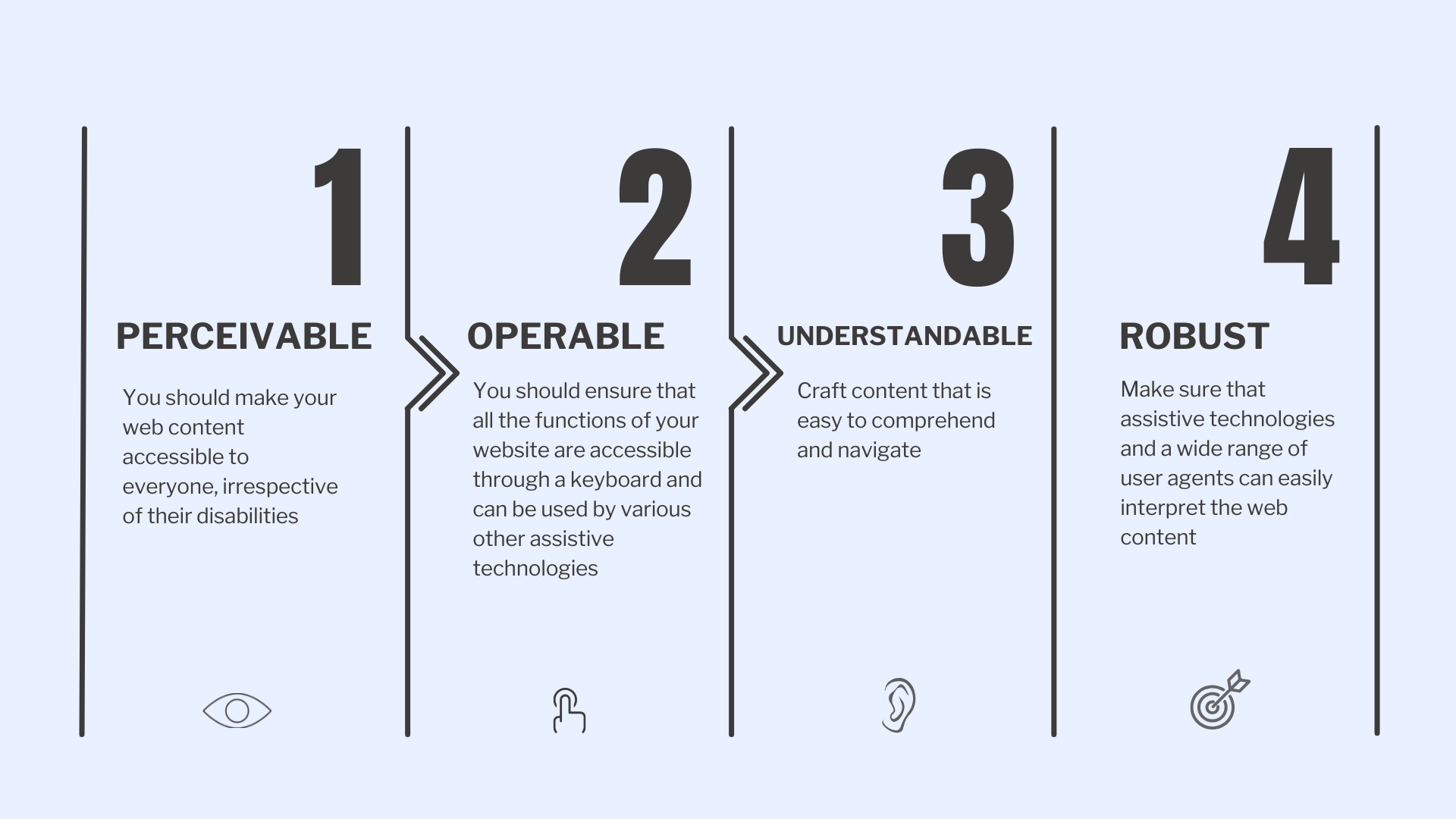
Let’s look at some of the primary requirements for building an ADA-compliant website-
Alt-text is a description of the image in a digital format; it is essential for accommodating screen readers. It is used to make visual content accessible for the visually impaired or people with low vision
You should try and keep the contrast ratio as low-color contrast; otherwise, it will be difficult for visually impaired or color blind people to access your web content
A lot of people find it challenging to navigate with a mouse. Therefore, you should ensure keyword accessibility to meet ADA compliance
Every form entry must allow screen readers to convey related content
If your website shows video or audio-based content, ensure that you provide captions, audio descriptions, or transcripts. This is an important feature for visually impaired or deaf people
Make sure that your website is mobile-responsive, as mobile traffic accounts for 62.5% of the global internet web traffic. To make it accessible, you should include large buttons, accessible menus, and a touch-friendly interface to help users with motor disabilities
The path of ADA compliance and web accessibility might seem daunting, but following it safeguards you from web accessibility lawsuits. It is not only a legal or business requirement but a lucrative opportunity to expand your customer base by allowing every user on this planet to access your website.
An estimated 1.3 billion people experience significant disability, representing 16% of the world’s population or one in six of us. Thus, making your website or online platform accessible to everyone will help increase visitors or sales, which will, in turn, help increase your revenue.
Aligning your website with ADA compliance lawsuits starts with knowing which laws apply in your specific state, city, or county. Therefore, if you also plan to comply with the ADA guidelines, one of the most important steps is to have an inclusive website design.
To ensure your website remains accessible and ADA compliant, LN Webworks offers an automated accessibility audit and reports so you can swiftly and sustainably meet your compliance goals.

 Other, SaaS Development
SaaS CRMs win on speed. Custom wins on fit and ownership. This isn’t a pitch for either one. Every early-stage SaaS company hits this decision within the first year, usually right after the founder realizes a spreadsheet isn’t a CRM. The default answer is almost always a SaaS CRM: HubSpot, Salesforce, Zoho, sign up in […]
 Other
Other
Most “audits” and “assessments” promise clarity but deliver a sales deck with language that lacks clarity. You book the call expecting evidence about your specific platform, and what shows up is a generic pitch for whichever package is easiest for the firm to sell. That’s the actual reason process transparency matters here, not because a […]
 Other
Other
In late June and early July, videos started circulating on Instagram of people walking up to moving e-rickshaws, tapping a phone, and watching the vehicle lose power mid-ride. It spread as a prank trend before anyone fully understood the mechanism. Drivers in Patna (India) reported it first, assuming mechanical failure, until investigators traced it to […]