Common Security Mistakes in App Development APIs: A Cautionary Tale
 Team LN Webworks
·
17 Jul, 2026
Team LN Webworks
·
17 Jul, 2026
Team LN Webworks
·
17 Jul, 2026
Team LN Webworks
·
17 Jul, 2026
Common security mistakes in app development APIs LN Webworks remain one of the most overlooked risks in modern application engineering. At LN Webworks, this pattern appears consistently across engagements: development teams focus on what users can see in the interface and underestimate what malicious actors can access beneath it. An API defines the rules and protocols that allow different software systems to communicate. It is the connective tissue of your application controlling how data moves between services, systems, and users. When that data movement is not carefully controlled, sensitive information such as phone numbers, email addresses, or internal identifiers can be exposed through API responses even when it never appears on screen. The assumption that hidden means protected is a dangerous one, and it has contributed to significant data exposure incidents across industries. This article walks through a practical example of how that mistake happens, why it matters, and what your engineering team can do to address it with maintainable execution and clear next steps.
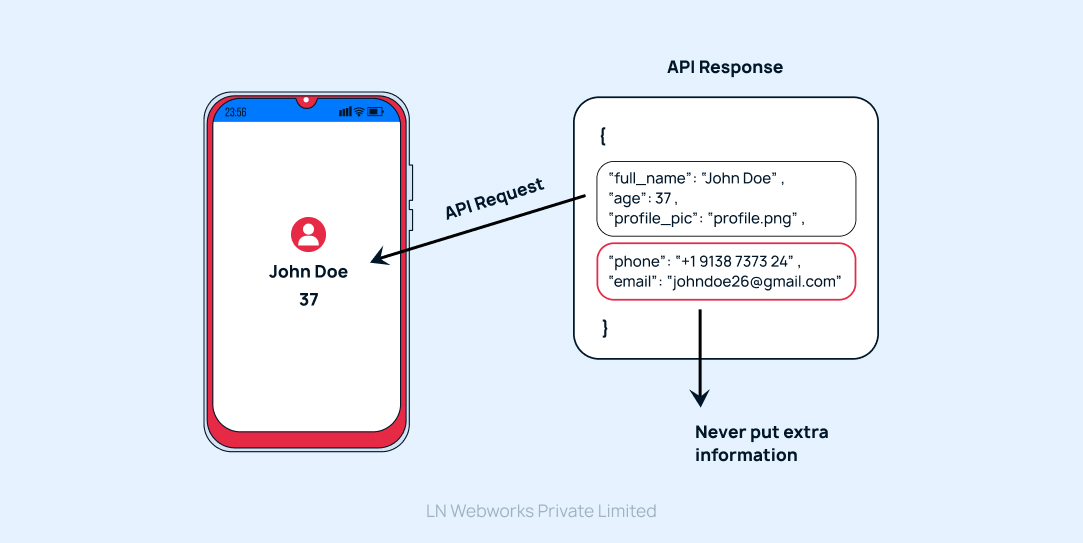
Consider a common scenario that illustrates one of the common security mistakes in app development APIs that LN Webworks encounters across application engineering engagements. An application displays a list of users, showing only their full names on the interface. On the surface, this appears to respect user privacy phone numbers, email addresses, and internal identifiers are omitted from the visible display, reserved for administrative access only. The development team operates under a reasonable-sounding assumption: because the API data feeding this list is not directly visible within the application interface, there is no harm in including all user details in the API response. That assumption is incorrect, and it is precisely where the exposure begins.
One of the common security mistakes in app development APIs that LN Webworks encounters regularly is the assumption that data not displayed in the interface is data that cannot be reached. That assumption is incorrect. While the application UI may show only a user’s name, the underlying API call frequently returns a full payload: phone numbers, email addresses, internal identifiers, and other sensitive fields that the development team simply chose not to render on screen. The data is present in the response. It is transmitted. It is accessible. The fact that it does not appear in the interface does not make it protected. This is a door left unlocked not through malicious intent, but through a gap between what the team built and what they considered possible.
Fiddler, a popular web debugging tool, allows individuals to inspect the traffic entering and leaving their computer. This tool transforms into a powerful asset for hackers, akin to finding an unlocked door in what was assumed to be a secure building. With tools like Fiddler, intercepting API calls to reveal hidden data becomes trivial. Suddenly, millions of users’ private information is at risk, all because the data was there for the taking.
This scenario underscores a fundamental principle in cybersecurity: Never transmit sensitive information that is not necessary for the task at hand. If an app’s UI doesn’t require certain data, that data shouldn’t be included in the API response. Period.
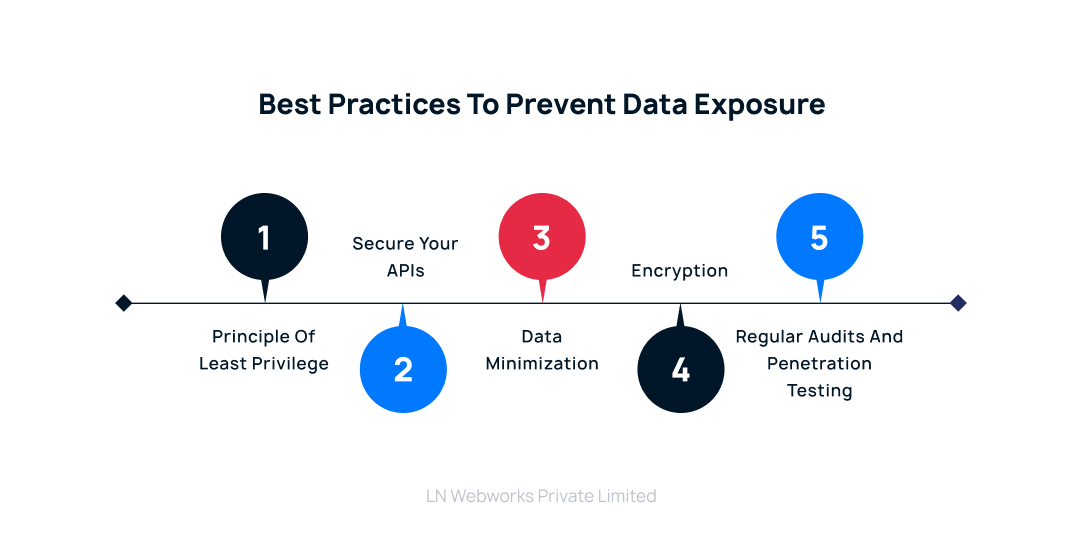
One of the common security mistakes in app development APIs that LN Webworks documents consistently is granting broader data access than any given function actually requires. The principle of least privilege addresses this directly: every API endpoint should request and expose only the data that is strictly necessary to perform its intended function nothing more. If a user list display requires only a name, the API response should return only a name. Internal identifiers, contact details, and administrative fields have no place in that payload. Applying this principle at the design stage, rather than as a correction after the fact, reduces your exposure surface and supports maintainable execution across the full application lifecycle.
Implement robust authentication and authorization measures to ensure that only intended users can access your APIs. Robust API security protocols protect sensitive data from unauthorized access.
Regularly review the data your APIs are transmitting and receiving, cutting down on any non-essential information. Data minimization is the process of limiting data collection to only what is necessary for a specific function.
One of the common security mistakes in app development APIs that LN Webworks documents is the assumption that internal network traffic does not require the same protection as external-facing data. It does. Use HTTPS for all data in transit without exception, and apply field-level encryption to sensitive data such as personal identifiers, contact details, and authentication tokens even within your internal network. Encryption ensures that data remains confidential during transmission and at rest, reducing exposure if a network boundary is compromised. This is not an advanced measure reserved for large organizations. It is a foundational practice that belongs in every API design decision from the start.
Addressing common security mistakes in app development APIs requires more than reactive fixes. LN Webworks recommends that engineering teams conduct scheduled security reviews and penetration tests as a standard part of their delivery process not as a one time response to an incident. Regular reviews are systematic examinations of your API architecture, authentication controls, and data transmission practices, designed to surface vulnerabilities before they are exploited. Penetration testing goes further, simulating the methods a malicious actor would use to access data that should not be reachable. Together, these practices provide proof-first credibility that your API security posture reflects actual risk, not assumptions. If your team has not conducted a formal review of what your APIs transmit versus what your interface displays, that gap is a clear next step worth addressing now.
The common security mistakes in app development APIs that LN Webworks documents across application engineering engagements point to a consistent and preventable problem: development teams treat interface visibility as a proxy for data protection, and that assumption creates real exposure.
Security in application engineering is not a feature added at the end of a development cycle. It is a delivery reality that must be built into every API design decision from the start. Sensitive fields transmitted in an API response, even when they never appear on screen, remain accessible to anyone with basic technical knowledge and intent. That is not a theoretical risk. It is a documented pattern with measurable consequences.
The practices outlined in this article least privilege access, data minimization, robust authentication, HTTPS encryption, and regular penetration testing are not optional additions. They are foundational to maintainable execution and responsible application engineering.
If your team is uncertain whether your current API architecture exposes more than it should, that uncertainty is itself a clear next step worth acting on. LN Webworks brings over a decade of experience in product engineering and Platform modernization to help teams identify where the gaps are and address them with owner-led accountability and scope control. Reach out to LN Webworks to speak with a certified engineer about your current API security posture.
The common security mistakes in app development APIs that LN Webworks documents across application engineering engagements share a consistent root cause: teams treat interface visibility as a proxy for data protection. It is not.
The core lessons from this article are worth stating plainly:
API responses frequently contain far more data than the interface displays. Sensitive fields such as phone numbers, email addresses, and internal identifiers are transmitted even when they never appear on screen and that transmission creates real exposure.
Tools like Fiddler make intercepting API traffic straightforward. Any data included in an API response can be accessed by someone with basic technical knowledge and intent, regardless of what the UI renders.
The principle of least privilege applies directly to API design. If a field is not required for the function the API serves, it should not be included in the response.
Practical security measures including robust authentication, data minimization, HTTPS encryption, and regular penetration testing are not optional additions. They are foundational to maintainable execution and responsible application engineering.
Security is not a feature added at the end of a development cycle. It is a delivery reality that must be built into every API design decision from the start. If your team is unsure whether your current API architecture exposes more than it should, that is a clear next step worth taking seriously. LN Webworks can help you assess where the gaps are and address them with owner-led accountability and scope control.
 Other, SaaS Development
SaaS CRMs win on speed. Custom wins on fit and ownership. This isn’t a pitch for either one. Every early-stage SaaS company hits this decision within the first year, usually right after the founder realizes a spreadsheet isn’t a CRM. The default answer is almost always a SaaS CRM: HubSpot, Salesforce, Zoho, sign up in […]
 Other
Other
Most “audits” and “assessments” promise clarity but deliver a sales deck with language that lacks clarity. You book the call expecting evidence about your specific platform, and what shows up is a generic pitch for whichever package is easiest for the firm to sell. That’s the actual reason process transparency matters here, not because a […]
 Other
Other
In late June and early July, videos started circulating on Instagram of people walking up to moving e-rickshaws, tapping a phone, and watching the vehicle lose power mid-ride. It spread as a prank trend before anyone fully understood the mechanism. Drivers in Patna (India) reported it first, assuming mechanical failure, until investigators traced it to […]