How Top Brands Boost Repeat Purchases with Personalization
 Anirudh
·
24 Jun, 2026
Anirudh
·
24 Jun, 2026
Most eCommerce brands chase new customers, yet repeat buyers are the real profit center. According to Bain & Company, even a 5% boost in retention can lift profits by 25–95%. Repeat customers account for the majority of revenue, yet many brands still rely on discounts and promotions. These short-term tactics erode margins and fail to build true loyalty.
Top brands are proving there’s a better way: personalization. If done right, it transforms customer journeys from transactions into relationships. Customers come back not only for a coupon, but because they feel understood, valued, and supported.
The Hidden Forces Driving Repeat Purchases
Personalization isn’t just about showing the right product. The brands winning loyalty understand three often-overlooked forces:
- Memory: Customers stick with brands that “remember” them. Saved carts, past orders, and tailored recommendations reduce friction.
- Relevance: When offers align with a customer’s context (location, timing, preferences), they feel intuitive, not pushy.
- Inclusion: Experiences that are accessible to every shopper build trust and widen the repeat base.
McKinsey confirms the stakes: 71% of consumers expect personalization, and companies that deliver see a 40% revenue uplift. Forrester adds that leaders in personalization see higher customer lifetime value and stronger advocacy rates.
Franchise Apps Driving Repeat Orders
Personalization has helped franchise and multi-site brands unlock loyalty at scale. Two examples highlight the impact:
Golden Roast (Australia) – Catering Franchise
- Challenge: Outdated ordering slowed campaigns and created inconsistent experiences.
- Solution: A Drupal CMS with location-based personalization, showing localized menus, tailored offers, and quick reorders.
- Impact: Campaign rollouts dropped from weeks to days. Franchisees reported more repeat catering orders. Customers described the platform as if it “remembered their preferences.”
This project revealed an important lesson: in multi-location businesses, personalization must strike a balance between central control and local flexibility. Head offices can standardize promotions, while franchisees can fine-tune offers for their local audience.
Octave Clothing (India) – Fashion Retailer
- Challenge: A mobile-first customer base needed speed and tailored browsing.
- Solution: A personalized, mobile-optimized platform with dynamic product suggestions and fast checkout.
- Impact: 28% increase in mobile orders and stronger repeat purchase trends.
The Octave project underscores the importance of mobile-first personalization. Younger audiences expect frictionless mobile experiences, and any additional clicks can kill conversion. By optimizing for speed and tailoring recommendations, Octave transformed its app from a simple storefront into a loyalty hub.
These outcomes prove that personalization isn’t a “nice to have.” It’s an engine of repeat revenue.
Accessible Personalization: The Loyalty Multiplier
But even flawless personalization fails if not every customer can use it. That’s where accessibility comes in by integrating WCAG 2.1 AA standards to ensure every customer can engage.
- Catholic Distance University (US): Platform rebuild improved accessibility scores by 40%, attracting more students.
- ACG World (Global): After design revisions and platform updates, performance improved by 62%, while multilingual engagement rose 48%.
- TeleHealth (Ireland/Canada): Developed a scalable video consultation platform that enhanced patient adherence through accessible video experiences.
Accessibility isn’t compliance alone; it’s loyalty expansion. It is often observed that brands that design inclusively broaden their repeat buyer pool. As accessibility laws tighten worldwide, proactive investment not only prevents compliance risks but also unlocks new revenue streams.
Practical Takeaways: 5 Areas to Audit for Loyalty Wins
Every retailer can uncover loyalty gains by auditing five areas:
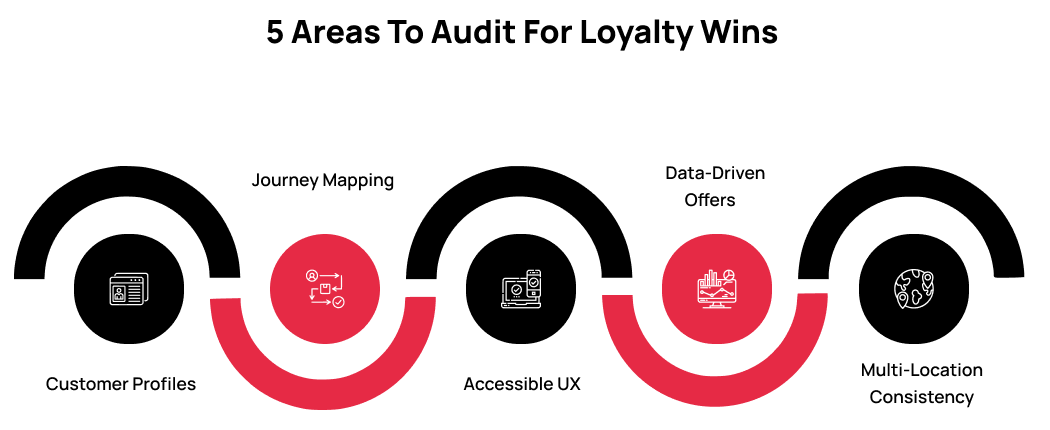
Customer Profiles
- Unify purchase history, preferences, and location across channels.
- Example: Golden Roast reduced friction by localizing menus tailored to each location.
- Deeper Insight: Many retailers collect this data but fail to leverage it effectively. The key is connecting systems (POS, eCommerce, CRM) so insights become actions.
Journey Mapping
- Build reorder triggers, loyalty nudges, and upsell flows into journeys.
- Example: Octave Brand Clothing’s quick reorder buttons lifted repeat sales.
- Deeper Insight: Post-purchase touchpoints, such as thank-you emails, replenishment reminders, and loyalty milestones, are often overlooked. Mapping them ensures consistent loyalty cues. TeleHealth’s video follow-up reminders are a strong example of this principle in action.
Accessible UX
- Ensure checkout works seamlessly across mobile devices, keyboards, and screen readers.
- Example: Catholic Distance University saw 40% higher engagement after WCAG-first design.
- Deeper Insight: Accessibility isn’t only about compliance. Simple improvements, like larger tap targets on mobile, improve usability for all customers, not just those with disabilities.
Data-Driven Offers
- Align promotions with behavior, not generic blasts.
- Example: Apparel brands using browsing history for bundles saw a higher average order value.
- Deeper Insight: Segmentation by recency, frequency, and monetary value (RFM) can multiply repeat purchases. High-value customers need different offers than first-time buyers. Nu Mobile utilized behavioral segmentation to create smarter bundles, thereby boosting engagement without resorting to discounts.
Multi-Location Consistency
- Roll out localized campaigns in days, not weeks.
- Example: Golden Roast cut rollout times dramatically with a centralized CMS.
- Deeper Insight: Consistency doesn’t mean uniformity. Top brands use central systems to manage brand-wide promotions while still empowering local managers to personalize them for cultural, seasonal, or local events.
From Transactions to Trust
Repeat purchases are not a matter of luck; they are the result of intelligent systems and purposeful design. Connect your data, map your touchpoints, and build personalized experiences that work for real people.
But personalization is also becoming the new competitive moat. As acquisition costs rise and customer expectations sharpen, brands that fail to personalize risk being left behind. Meanwhile, those who build loyalty through memory, relevance, and inclusion are future-proofing their growth.
Ready to audit your repeat purchase potential? Schedule a call with LN Webworks experts, and let’s identify where you’re losing customers and work together to fix it.
Start building your next-level personalization strategy today.
FAQs: Personalization and Repeat Purchases
Why is personalization more effective than discounts for repeat purchases?
Personalization fosters trust and long-term loyalty, whereas discounts can erode margins and often result in one-time returns rather than sustained engagement.
What technologies help enable personalization at scale?
Platforms like Drupal, Shopify, and WooCommerce, when integrated with CDPs, recommendation engines, and automation tools, enable real-time personalization across customer journeys.
How does accessibility tie into personalization?
If a platform isn’t accessible, personalization efforts fail for part of the customer base. Accessibility expands reach and ensures that every shopper can complete key actions, such as checkout.
What quick wins can a retailer achieve with personalization?
Examples include enabling one-click reorders, tailoring product bundles based on browsing history, and quickly rolling out localized offers across multiple sites..
How does LN Webworks approach personalization projects?
LN Webworks combine owner-led accountability, agile delivery, and deep expertise in Drupal, Shopify, and WooCommerce to design solutions that are both scalable and accessible. From cutting downtime by 80% (An Eventful Life) to enabling faster rollouts (Golden Roast), our approach ensures measurable gains in loyalty.