If your team is manually stitching together campaigns, spreadsheets, and ad hoc dashboards, you’re already paying an automation tax: slower launches, inconsistent data, and preventable leakage at checkout.
AI doesn’t replace your team: it removes monotonous work, reveals patterns you can’t see, and lets you ship with confidence.
At LN Webworks, we see that growth inflection points rarely come from bigger ads: they come from better systems, faster iteration, and experiences that feel personal at scale. That’s the real promise of AI and automation in e-commerce.
Why Now: The E-commerce Stack Is Getting Modular, Smarter, and More Accountable
Three forces are converging:
- Composable architectures: faster experimentation and less vendor lock-in.
- AI-driven merchandising and operations: predictive insights across the journey.
- Board-level expectations for compliance, security, and accessibility.
Together, they reward brands that invest in strong foundations: clean data, integrated systems, and UX that respects users’ time and needs.
The 10 Defining Trends (and How to Use Them)
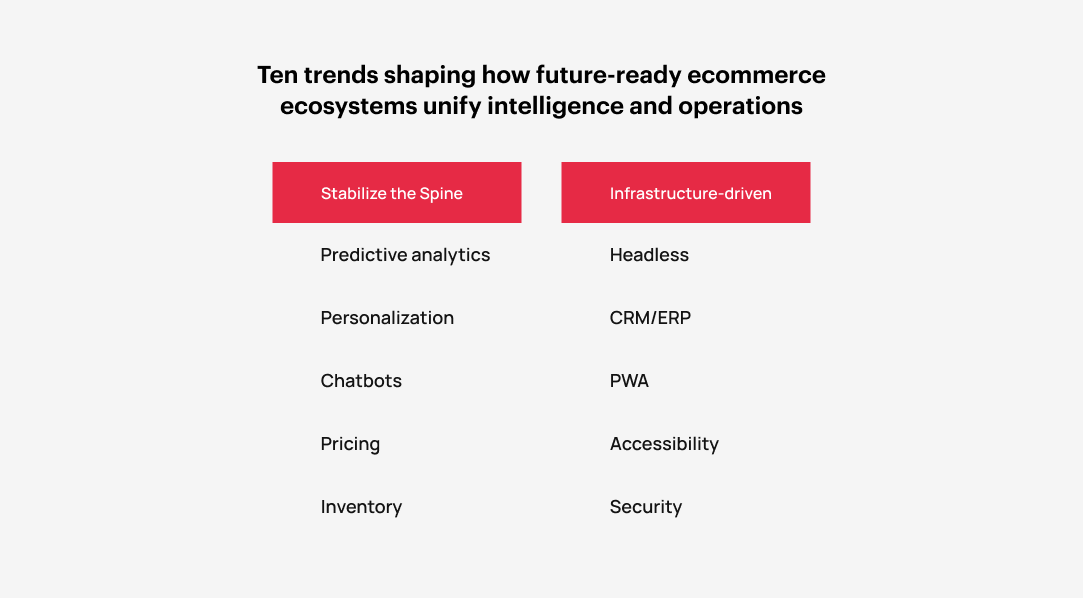
1. Composable & Headless Becomes Default, Not Edge Case
What’s changing: The frontend and backend are decoupled, allowing UX updates without disrupting the backend.
Why it matters: Faster experiments, better performance, and freedom to evolve.
Start here: Pilot a headless storefront (e.g., Next.js) on a high-impact category page while keeping your backend stable.
Read more: Best Headless Ecommerce Platforms in 2025
2. Predictive Analytics Moves From Nice-to-Have to Flow Controller
What’s changing: Models now anticipate demand, churn, and next best actions.
Why it matters: Smarter inventory buys and fewer out-of-stocks.
Start here: Use order and session data to score purchase intent; feed insights into automated campaigns and recommendations.
3. Real-Time Product Recommendations That Respect Context
What’s changing: Collaborative and content-based algorithms personalize discovery.
Why it matters: Higher average order value and more meaningful interactions.
Start here: Begin with PDP and cart cross-sells; measure lift before expanding to home or email.
Related: How Top Brands Boost Repeat Purchases with Personalization
4. Chatbots & Virtual Assistants as First-Response CX
What’s changing: AI-powered assistants now resolve common inquiries: order status, returns, sizing, and more, 24/7.
Why it matters: Faster resolution, lower support cost, higher satisfaction.
Start here: Deploy guided bots for post-purchase queries; add multilingual support next.
5. Dynamic Pricing With Safeguards
What’s changing: Algorithms adjust pricing by demand, stock, and geography, within brand rules.
Why it matters: Protects margins while staying competitive.
Start here: Test dynamic markdowns for long-tail products aligned with inventory forecasts.
6. Inventory Optimization Becomes a Shared, Automated Truth
What’s changing: Predictive forecasting links demand, purchasing, and fulfillment.
Why it matters: Fewer stockouts and reduced holding costs.
Start here: Integrate order data with the ERP, set safety stock thresholds, and share dashboards across teams.
7. CRM & ERP Integration as the Backbone of Personalization
What’s changing: Customer, catalog, and finance data finally sync seamlessly.
Why it matters: Accurate personalization and cleaner attribution.
Start here: define data ownership, choose a master system, and monitor sync health.
8. Performance, Core Web Vitals, and PWAs Drive Mobile Revenue
What’s changing: Users expect app-like speed on mobile. PWAs deliver fast, resilient experiences.
Why it matters: Faster sites convert better; every second matters.
Start here: Audit Core Web Vitals (LCP, CLS); implement lazy-loading; test a PWA rollout.
9. Accessibility & Inclusive Design as a Competitive Advantage
What’s changing: WCAG 2.2 and inclusive design principles are becoming standard.
Why it matters: Accessible sites reach more users and strengthen brand trust.
Start here: Ensure keyboard navigation, color contrast, focus states, and alt text compliance.
10. Security and Compliance Shift Left
What’s changing: PCI compliance, WAF, and encryption are embedded into sprints.
Why it matters: Prevents data breaches and downtime.
Start here: Enforce TLS, 2FA, dependency scans, and scheduled penetration tests.
What This Looks Like in Practice
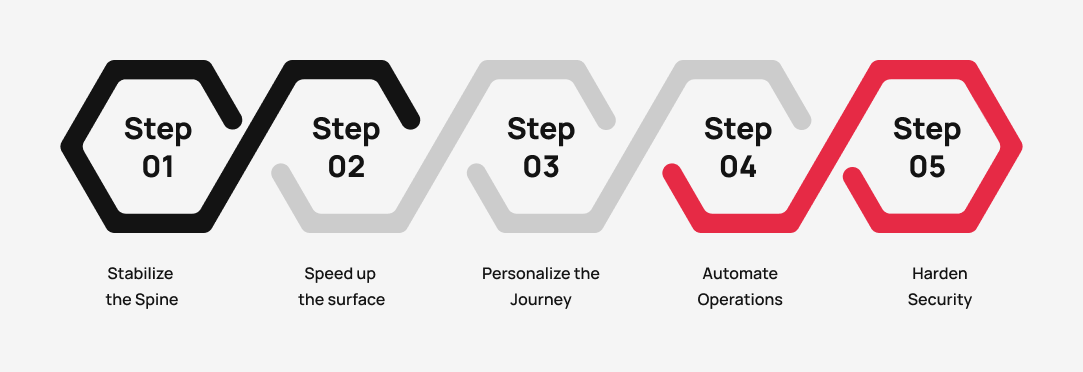
High-performing ecommerce teams don’t chase every new trend. The sequence transformation:
- Stabilize the spine: Integrate CRM/ERP for data reliability.
- Speed up the surface: Improve Core Web Vitals and deploy PWAs.
- Personalize the journey: Add intent-driven recommendations and dynamic content.
- Automate operations: Forecast inventory and enable smart pricing.
- Harden security: Embed DevSecOps in every sprint.
Every improvement compounds: better data drives better models, which power better UX, which builds loyalty.
A Simple Framework: From Fragmented to Future-Ready
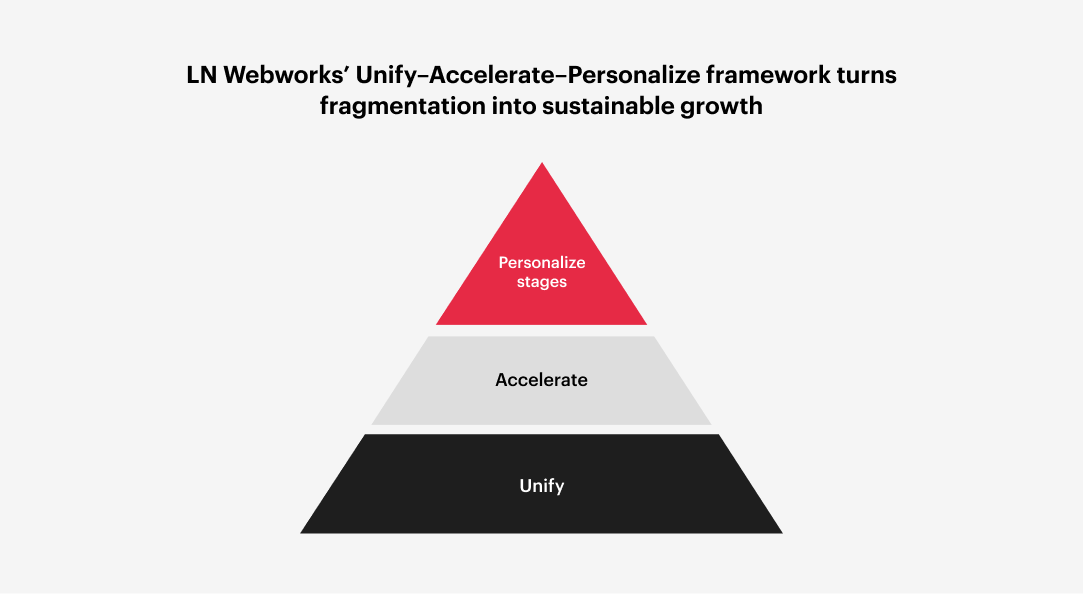
Think in three stages:
- Unify: Connect systems and standardize data.
- Accelerate: Upgrade speed and agility through composable architecture.
- Personalize: Layer intelligence for adaptive, compliant experiences.
This progression transforms your e-commerce ecosystem from reactive to predictive, positioning your team to scale sustainably.
Your Next Step: One Sprint That Proves the Potential
Pick a high-friction user journey, like product page to cart on mobile, and run a 30-day “Performance & Personalization Sprint”:
- Instrument: Baseline Core Web Vitals and conversion.
- Improve: Optimize media, lazy-load assets, and prefetch navigation.
- Personalize: Add context-aware recommendations.
- Measure: Track speed, click-throughs, and AOV.
- Repeat: Expand to other high-impact flows.
You’ll uncover what works for your audience and where automation delivers real value.
Ready to Turn Trends into Outcomes?
LN Webworks partners with growth-focused ecommerce brands to build secure, scalable, and future-ready platforms, combining:
- Drupal for robust content-commerce ecosystems
- Laravel for high-velocity product builds
- Python for automation and predictive insights
- React for engaging, high-performing frontends
Our engagements are transparent, sprint-based, and led by people who care as much about your outcomes as you do.
Book your site assessment: https://www.lnwebworks.com/contact
We’ll review your ecommerce stack through the Unify–Accelerate–Personalize lens, highlight quick wins, and map a 90-day roadmap tailored to your growth goals.
The Author
Hem Kant
Content Strategy and Integrity Lead (Social+ Services)
Curious by nature, Hem Kant is a strategist and writer who grounds his work in quiet reflection. He draws inspiration from the stillness of winter, clean cityscapes, good books, and honest talk (Networking). He writes with a commitment to integrity and a sharp focus on essential detail, delivering work defined by substance and insight.