The Hidden Costs of Outdated eCommerce Platforms
 Anirudh
·
18 Dec, 2025
Anirudh
·
18 Dec, 2025
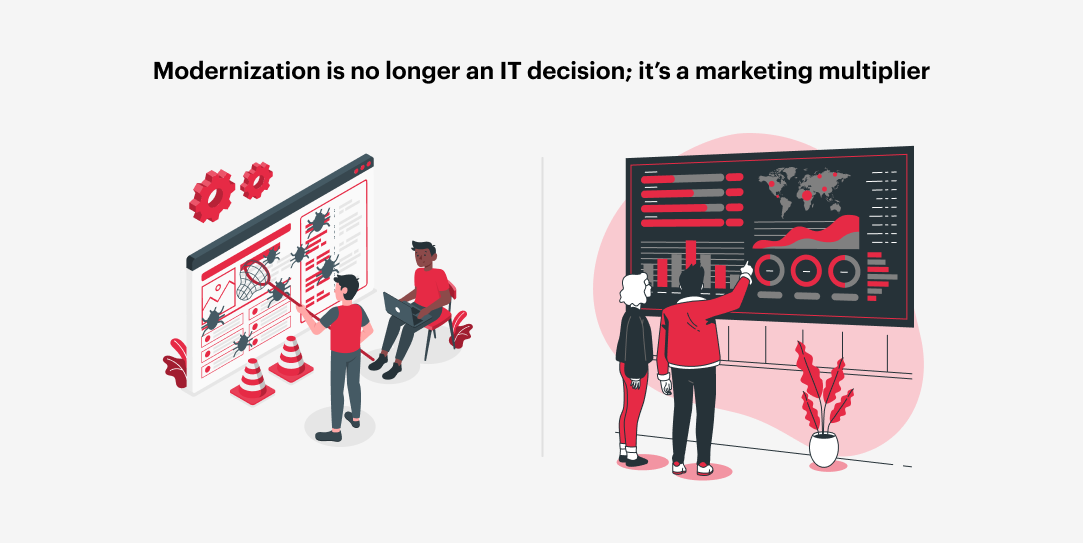
Every CMO feels it before they see it: campaign fatigue without campaign failure. ROI flattens, reporting cycles stretch, and “simple” site changes take weeks instead of days.
That’s the invisible tax of outdated eCommerce platforms: not just lost performance, but lost adaptability. The ability to shift, launch, and learn at market speed is replaced by incremental, reactive updates that quietly drain budgets and morale.
The U.S. Government Accountability Office (2023) reports that 80% of IT budgets go to maintaining existing systems. The same imbalance exists across private eCommerce: most companies spend more on “run” than “grow.”
When infrastructure can’t evolve, neither can the strategy it supports. The opportunity cost compounds across departments, markets, and fiscal years, making the hidden costs of outdated eCommerce platforms one of the biggest unspoken drains on profitability.
Where Legacy Systems Quietly Undermine Growth
Technical Debt Isn’t Just a Technology Problem: It’s a Margin Problem
Every quick fix, a plugin patch, a manual workflow, a delayed update, adds interest to the debt column. Over time, those costs compound into a structural drag on marketing speed and profit margin; a challenge at the heart of every legacy system cost analysis.
| Hidden Cost | Typical Annual Range (USD) | Impact |
| Maintenance & patching | $15K-$50K+ | Reactive updates, fragile uptime |
| Vendor licensing | $5K-$30K | Locked-in proprietary modules or SaaS fees |
| Integration gaps | $20K-$60K | Manual API workarounds, lost data fidelity |
| Downtime & recovery | $10K-$80K | Average $5K/hour loss (Uptime Institute, 2024) |
| Scaling bottlenecks | 5-15% gross margin erosion | Peak-season slowdowns, abandoned carts |
Forrester’s 2024 Digital Operations Index found that teams operating on modern, composable architectures execute cross-channel campaigns 48% faster than those on legacy monoliths.
Technical debt doesn’t just slow down delivery; it quietly eats away at profit.
Experience Performance = Revenue Performance
Speed is not a UX bonus; it’s a revenue multiplier. Google’s 2024 mobile study found that the bounce probability jumps 32% when load time increases from 1 to 3 seconds, and 123% at 10 seconds.
For mid-market retailers, each second of delay can reduce conversion probability by 2-3%, resulting in $200K-$600K in annualized revenue loss. Walmart’s data reinforces it: a 1-second improvement = 2% more conversions.
This is the new ROI math of eCommerce modernization: speed protects margin and accelerates growth.

Integration Gaps Create Insight Gaps
Modern marketing relies on synchronized systems, including CRM, analytics, automation, and fulfillment. When APIs break, the entire data loop collapses.
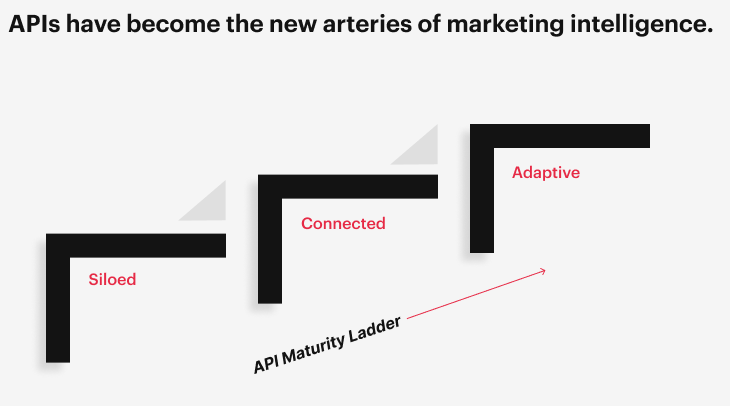
The Postman 2024 API Report found that 74% of companies are API-first, and 63% deploy new APIs within a week. Legacy stacks, by contrast, can take 4-6 weeks for the same change, a 5x agility gap that translates into 10-20 hours of lost work per marketer, per week.
These gaps often make platform migration ROI difficult to achieve until modernization bridges the divide between systems.
API maturity is now a marketing metric.
The Security–Trust Equation
In commerce, trust is currency. IBM’s 2025 Cost of a Data Breach Report pegs the global average breach at $4.45 million, with retail among the hardest hit. Over 60% of incidents can be traced back to outdated or unpatched systems.
Beyond direct costs, breaches damage SEO, brand equity, and conversion confidence, incurring costs far higher than those of prevention. In short, outdated eCommerce platforms increase both financial and reputational exposure.
When eCommerce Modernization Becomes Marketing Leverage
A lifestyle retailer faced stagnation, characterized by 4-second load times, 70% cart abandonment, and 6-week campaign rollouts. After migrating from a monolithic CMS to a headless, composable commerce 2025 stack:
- Checkout time ↓ 38%
- Mobile conversions ↑ 22%
- Campaign velocity ↑ 45%
Modernization delivered not just technical agility but creative freedom. Their team now launches micro-campaigns on a weekly basis instead of quarterly.
Quantifying the Real Hidden Cost
Drawing from LN Webworks’ modernization benchmarks and 2025 eCommerce cost data, this legacy system cost analysis reveals how modernization rapidly pays back its investment:
| Business Type | Legacy Annual Cost | Modern Equivalent | ROI Timeline |
| Multi-site retail (5-10K SKUs) | $120K-$180K | $60K-$90K | 9-12 months |
| SaaS with subscription flow | $90K-$140K | $45K-$80K | 6-9 months |
| Franchise network with legacy integrations | $200K+ | ~$110K | 12-15 months |
Each modernization project recovers its investment within the first year through higher conversions, reduced downtime, and automation gains; clear evidence of platform migration ROI.
Discover what your ROI could be.
How Modern CMOs Are Reframing the Narrative
Today’s CMOs are redefining eCommerce modernization as a strategic marketing decision, not a technical one. The shift is subtle but powerful: from “keeping up” to “compounding value.”
From Cost Center to Growth Engine
Modern CMOs now speak the CFO’s language: revenue per second, not just engagement per session.
A modernized stack reduces campaign launch cycles by 40-60%, freeing budget for innovation rather than upkeep. In leadership meetings, these metrics frame modernization as a means to protect margins, not as an IT expenditure.
From “Projects” to “Pipelines”
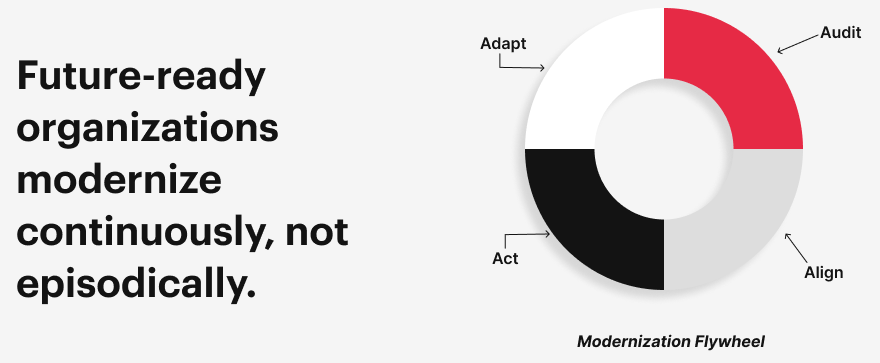
Gone is the one-off rebuild. Forward-thinking teams adopt continuous modernization pipelines: audit, iterate, scale.
This creates a rhythm of quarterly optimization, integrating new APIs, UX updates, and AI automation as normal business functions. It keeps systems and teams perpetually future-ready.
From Compliance to Inclusion
Accessibility and inclusivity have evolved from compliance checkboxes to key performance levers for brands. According to WCAG 2.2 benchmarks, accessible sites convert 10-20% better due to clearer navigation and mobile usability.
Modern CMOs tie this to audience reach, equity, and customer lifetime value, proving empathy and profitability can scale together.
From Awareness to Action: A Modernization Roadmap
Transformation without direction leads to rework. CMOs and CTOs who achieve measurable platform migration ROI follow a disciplined, data-led roadmap for eCommerce modernization:
Step 1: Audit & Quantify
Document every recurring cost: maintenance, plugins, downtime, and staff hours lost. A 30-day audit often reveals 2-3x the perceived spend.
Step 2: Align KPIs Across Leadership
Define modernization success metrics:
- Marketing: campaign velocity, conversion lift
- Technology: uptime, integration speed
- Finance: cost of delay, ROI timeline
Alignment transforms modernization from a departmental initiative into an enterprise investment.
Step 3: Pilot, Then Scale
Start small by migrating one product line or campaign microsite. Measure gains in speed, uptime, and conversion. Use that data to justify full rollout. LN Webworks’ own pilots show payback within 6-9 months when executed iteratively.
Step 4: Institutionalize the Continuum
Build modernization into quarterly planning. Treat it as a living framework that compounds value with each sprint, new integrations, automations, and design enhancements added continuously.
The Real Risk Is Standing Still
Legacy systems don’t collapse, they corrode.
Each quarter spent patching instead of progressing reduces your competitive edge, employee morale, and marketing elasticity. The most successful digital leaders of 2025 aren’t the ones with the biggest budgets; they’re the ones who replaced inertia with intentional iteration.
Modernization is leadership maturity in action.
It signals that your brand values agility, inclusivity, and data-driven decision-making over technical nostalgia.
In today’s economy, the real cost isn’t the migration itself, but rather the months of opportunity lost by waiting.
The hidden costs of outdated eCommerce platforms are no longer invisible: they’re itemized in every unlaunched campaign, every unclaimed customer, and every deferred idea.
Talk to LN Webworks Experts
Let’s audit your hidden costs, uncover unrealized ROI, and build a modernization roadmap that compounds value, not technical debt.
FAQ
Q1: What are the real risks of using an outdated eCommerce platform?
Hidden costs include rising maintenance fees, slow load times that negatively impact SEO, compliance gaps, and increased security exposure.
Q2: How does modernization impact revenue?
Modern, API-first builds increase conversions 15-30% and reduce maintenance spend by up to 50%, paying back migration costs within a year.
Q3: How can modernization improve marketing agility?
Headless or composable systems enable marketing teams to launch, test, and iterate campaigns five times faster with no developer bottleneck.
Q4: When should we consider migrating?
If site changes take weeks, integrations fail regularly, or your maintenance budget exceeds 30% of total platform spend, it’s time.