Going Global Without Growing Pains: Building Multilingual, Multi-Currency, and Compliance-Ready eCommerce
 Anirudh
·
01 Jul, 2026
Anirudh
·
01 Jul, 2026

Global eCommerce is expected to exceed $6.3 trillion in 2025, accounting for nearly one-fifth of all retail transactions worldwide (eMarketer). Yet, many technology leaders describe global growth as a stress test, not a milestone. Every new market adds complexity: more languages, more regulations, more ways to fail.
Scaling internationally reveals whether your platform was built for adaptability or just expansion. What appears as growth on a roadmap can translate into fragmentation in production: disconnected APIs, delayed translations, mismatched currencies, and uneven load times.
The truth is that global readiness is not a feature; it’s a foundation. Teams that invest in readiness early experience smoother launches, stable performance, and far fewer post-release corrections. For CTOs and IT heads, readiness is now the definition of scalability.
Why Global Expansion Breaks More Than It Builds
Global commerce rarely fails because of market conditions. It fails because internal systems: language management, payments, compliance, and performance, scale at different speeds. These aren’t technical bugs but systemic fractures that appear when readiness isn’t built into the architecture.
Language and Localization Gaps
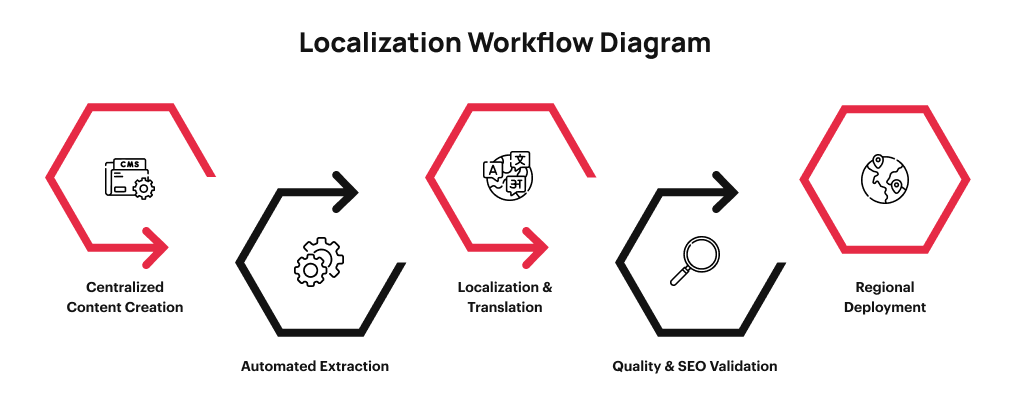
Localization is often mistaken for translation. For CTOs, it’s a synchronization challenge. When product data, metadata, and interface strings are stored in separate systems, inconsistencies multiply. Over time, translations become outdated, content mismatches appear, and SEO rankings decline.
Search algorithms penalize inconsistency, and customers lose trust when language feels “off.” Scalable localization requires orchestration: automated translation workflows, regional SEO governance, and continuous synchronization between content and code. When automation governs delivery, global messaging stays accurate and brand voice remains consistent across every language.
Currency and Payment Fragmentation
Payment systems are the most visible point of friction for global shoppers. Each region expects its own familiar payment methods: installments in Europe, wallets in Asia, UPI in India, Pix in Brazil. When local preferences are ignored, checkout abandonment spikes.
Behind that customer moment lies the deeper operational burden: reconciliation. Currency fluctuations, regional tax logic, and varied refund workflows can overwhelm finance teams. Mature systems address this through automation, including real-time exchange rates, tax mapping by region, and integrated reporting. As financial operations scale with transactions, global expansion shifts from being reactive to being sustainable.
Compliance and Accessibility Overlaps
Crossing borders introduces new rules: from privacy regulations to accessibility mandates. GDPR in Europe, CCPA in California, VAT frameworks in the UK, and WCAG 2.2 accessibility standards all operate independently of one another. The challenge is timing: most teams address compliance after launch instead of designing it in from the start.
Embedding compliance into the development process changes everything. Privacy-by-design ensures data is encrypted, cookie consent is managed automatically, and data deletion is traceable. Similarly, accessibility testing during sprints ensures that compliance isn’t just a legal requirement, but also a user-centered approach. The payoff is both reputational and operational: compliant platforms go live faster and require fewer post-launch adjustments.
This principle holds even more true in highly regulated sectors like healthcare ; see how compliance shapes telemedicine app development, from cost to core features.
For a practical checklist on accessibility implementation, see our article on building an accessible ecommerce site
Performance and Scalability Gaps
Performance defines trust before any sale occurs. A site that loads in two seconds in London might take five in São Paulo or Tokyo. Centralized infrastructure creates invisible barriers to conversion.
Distributed performance engineering solves this problem. By utilizing CDNs, edge caching, and multi-region load balancing, modern platforms can deliver a consistent user experience globally. The goal isn’t to achieve maximum speed in one market but predictable performance everywhere, typically between 2 and 3 seconds globally. That reliability signals operational maturity before a buyer even clicks “Add to Cart.”
From Patchwork Fixes to Platform Readiness
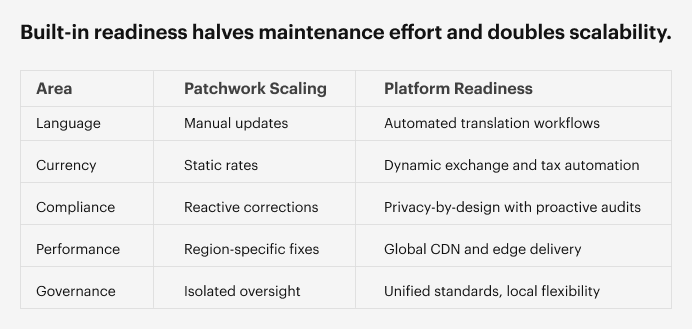
Many global rollouts fail because “internationalization” was an afterthought. Teams add translation plugins, duplicate product catalogs, and script compliance fixes just before launch. The short-term win hides a long-term cost: fragmented data and spiraling maintenance effort.
True readiness starts with integrated design. It addresses every global requirement, including language, payment, compliance, and performance, as part of a single system. By centralizing governance and decentralizing delivery, organizations can maintain standards while empowering regional agility.
The CTO’s Global Readiness Framework
Every CTO eventually faces the same test: Is our technology expanding faster than our processes? The five pillars of global readiness provide a roadmap for scaling both in tandem.
1. Build for Scale, Not Retrofits
Global readiness begins with architectural choice. Platforms like Drupal 10 and other enterprise frameworks include multilingual and compliance modules natively. Leveraging these early prevents later re-engineering.
A global-ready architecture centralizes data, content, and logic, serving one source for multiple markets, one payment layer for various currencies, and a single compliance model that covers all. Every new region becomes a configuration, not a custom build. See how headless ecommerce platforms support this architecture natively.
2. Centralize Governance, Localize Experience
Governance provides consistency; localization creates connection. Global customers expect familiar UX patterns, but cultural nuances drive adoption. A two-tier model of centralized governance with localized expression maintains brand integrity while ensuring relevance and adaptability.
Regional teams can adapt promotions, pricing, or tone, while global teams control security, performance, and compliance. This balance keeps innovation safe, structured, and scalable.
3. Treat Compliance as a Market Enabler
Compliance isn’t bureaucracy, it’s market access. Hardcoding GDPR logic, automating accessibility checks, and maintaining regional audit logs streamline entry into regulated territories.
Mature teams view compliance as an integral part of deployment readiness. This discipline shortens release cycles and strengthens trust with customers and regulators alike.
4. Design for Global Performance
Performance is a measure of respect for the user’s time. Distributed CDNs, cached APIs, and continuous monitoring ensure equitable experience across geographies.
Regular synthetic testing across continents ensures metrics transparency and consistent load times. Predictability, not perfection, drives global retention.
5. Prepare People as Much as Platforms
Readiness is human as much as technical. Global expansion requires shared ownership: who approves translations, who handles privacy tickets, who tests refunds? Well-defined workflows eliminate guesswork and reinforce accountability.
At LN Webworks, for example, these principles are built into Agile sprint rituals and QA-first processes. Each deployment undergoes multi-level validation, including technical, ethical, and accessibility checks, before reaching production. That consistency protects both the brand and the customer.
Assessing Readiness: A Practical Framework
Readiness isn’t a checkbox; it’s a continuum. Most organizations fall somewhere between “reactive” and “ready.”
Reactive teams address issues as they arise, often after disruption. Evolving teams automate some processes but still rely on manual interventions. Ready teams unify automation, governance, and reporting into one scalable ecosystem.
Companies achieving readiness in at least three dimensions: language, currency, compliance, and performance, typically reduce time-to-market by 40-60%. That efficiency compounds with every region added.
The Road Ahead: Adaptive Globalization
The next wave of eCommerce will favor adaptability over reach. Artificial intelligence will power real-time localization and cultural nuance. Payment ecosystems will diversify beyond credit cards to instant networks and digital wallets. Accessibility will shift from compliance to expectation, becoming a central component of brand equity.
CTOs who view readiness as a continuous capability, rather than a milestone, will navigate these changes more smoothly. Global expansion will always be complex, but adaptability ensures it stays within control.
Global Ambition, Local Precision
Going global isn’t the problem. Precision is.
Delivering consistent experiences, compliance, and trust across markets demands readiness by design.
Readiness turns expansion from a gamble into a governed system. It replaces reactivity with rhythm, patchwork with process, and uncertainty with clarity.
Scaling well is not about doing more, it’s about doing it right; once, for everywhere.
Benchmark your platform’s readiness with LN Webworks’ global frameworks for multilingual, multi-currency, and compliance-first commerce.
Scaling globally shouldn’t mean starting over in every market. LN Webworks helps CTOs build platforms that perform, comply, and adapt anywhere.
to benchmark your global readiness.