Drupal Community Module Evaluation: A Go-to Guide
 LN Webworks
·
04 Sep, 2025
LN Webworks
·
04 Sep, 2025

It’s not only about what a module from the Drupal community can achieve when you consider using it. Along with how long you want your website to remain, you need also to consider who will maintain it after it goes up. These factors influence the level of danger you are willing to accept.
For instance, you might desire modules with an excellent track record and robust community support if you’re not too familiar with Drupal.
Every module available on Drupal.org is licensed under the GPLv2 and is open source. This means that while they are free to use, any dangers are your responsibility but every module has a community of users who assist with problems and updates, as well as a team of maintainers for each module. Additionally, partnering with a reputable Drupal web development company can provide further assurance in terms of module selection, ongoing support, and maintenance.
Let’s discuss some factors to consider when evaluating a community module.
Alternatives When Community Modules Fall Short
You have a couple of choices if the community doesn’t have the functionality you require or if using it would be too dangerous:
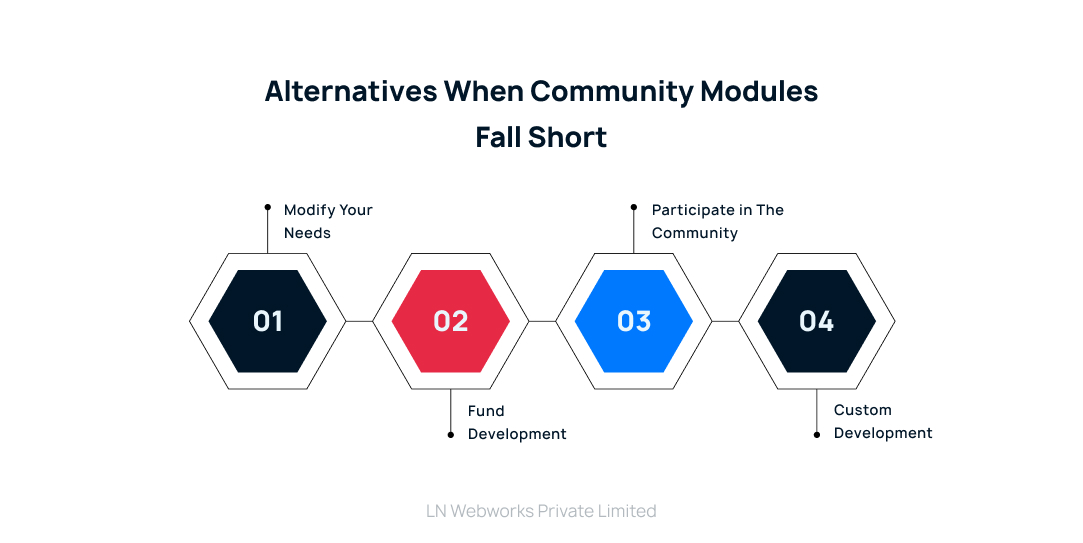
Modify Your Needs
You might reduce the scope of what you hope to accomplish or seek for an existing project that offers the required capability, then recommend incorporating it as a feature. This lowers the danger and the cost.
Fund Development
To better suit your demands, you might spend money developing an already-existing module. While there is some danger involved, it may be easier to handle than starting from scratch.
Participate in the Community
You might create a new module on your own and release it to the group. Although it takes work up front, over time others might help maintain and develop it.
Custom Development
You could create bespoke functionality just for your organization without sharing it with the community. This option typically has the highest cost, effort, and risk because you’re solely responsible for maintenance and improvements.
Criteria for Module Selection in Drupal Community
Consider the following criteria when evaluating a project within the Drupal community. You’ll need to determine suitable thresholds for your organization, depending on the level of risk you’re willing to accept for the additional functional value a module offers.
1. Number of Commits by Maintainers
Checking a module’s commit history on Drupal.org can tell you a lot about its development and stability.
Frequent Commits
Many commits indicate active maintainers who consistently improve the module, potentially leading to more features and better stability.
Less Frequent Commits
Fewer commits could suggest a newer module or one that’s not actively maintained. This might mean limited features.
Look for the “Source code” link on the project page’s sidebar to find a module’s commit history. The Feeds module, for example, has been around for 13 years with an average of 135 commits annually. This high commit rate suggests a project with a lot of community involvement. Simpler modules might see fewer updates.
2. Assessing Time Since Last Commit
In community projects, maintainer activity can vary over time. Here’s what to consider:
Recent Commits
If there have been commits in the last month, it indicates an actively engaged maintainer and community.
Less Recent Commits
Commits made in the last 3 months or more suggest less active maintenance and community involvement.
Using a module with a less active community may mean slower release cycles and potentially having to provide your own support and bug fixes.
For complex modules, low community activity poses a greater risk.
3. The number of sites using the module
Community maintainers have significant control over the stability of their projects’ releases, making versioning unreliable as an indicator of stability. Instead, we can look at the number of sites using the module as a gauge of its exposure to various use cases. Coupled with the number of open issues in the project’s issue queue, this provides a more accurate assessment of its real stability.
Drupal.org offers usage data through its Update module, which reports module usage back to Drupal.org when enabled. You can access this information on the project page.
For example, looking at the Feeds module, it shows usage on over 98,000 websites. This widespread adoption indicates its suitability for diverse applications and suggests a high level of stability.
4. Assessing Project Stability through Issue Metrics
Open issues, closed issues, and open bugs are crucial metrics that offer insight into two important aspects:
Project Development
The number of logged issues reflects how well-developed the project is. A higher volume of logged issues may indicate areas that need improvement or unresolved problems within the module.
Maintainer Activity
The quantity of issues that have been closed or addressed reveals how actively the maintainers are resolving issues and enhancing the module. An increased quantity of closed issues indicates that the maintainers are actively maintaining and providing support.
Let’s Wrap It Up!
Beyond their functionality, community modules for Drupal must be evaluated on a number of other grounds. Maintainer activity, project maturity, community support, and stability indicators like the number of commits, time since the last commit, number of sites utilizing the module, and issue metrics are just a few of the things you need to evaluate.
If you need assistance navigating Drupal module selection or require expert guidance in optimizing your website, LN Webworks, a Drupal company, is here to help! Reach out to us today for personalized support and solutions.
Author