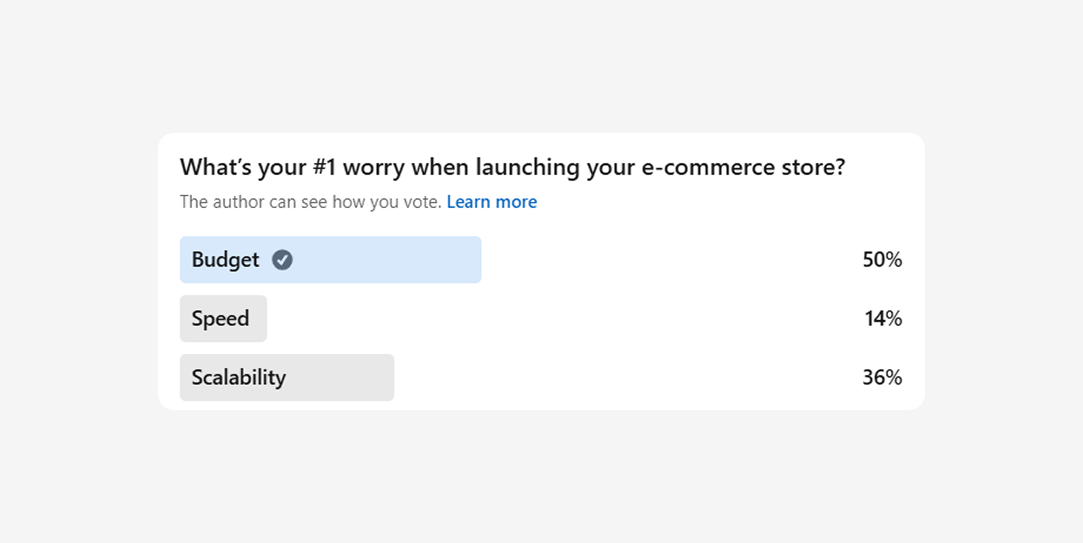
Last week, we ran a quick poll on LinkedIn asking founders, CTOs, and e-commerce experts what worries them the most when launching an e-commerce store.
The responses were crystal clear: Budget.
Nearly half of the respondents said that managing costs was their number one concern, higher than scalability, technology, or marketing.
And they’re absolutely right to feel that way.
After working with dozens of founders and brands over the past decade, we have learned that budget isn’t just a financial question; it’s a growth question. It defines how fast you can move, what technology stack you can adopt, and how long your brand can sustain before the business begins paying for itself.
Let’s break down why budget becomes such a central worry and how smart founders use it as a strategic weapon instead of a constraint.
Why Budget Tops Every Founder’s List
Every founder dreams of building a store that looks beautiful, performs flawlessly, and converts visitors into loyal buyers. But the reality is: every choice costs money, and every decision competes for limited capital.
When you’re at the starting line, there’s always a trade-off between:
- Launching fast or building to last
- Designing big or validating lean
- Hiring experts or experimenting in-house
Budget tension often comes from this uncertainty. Founders don’t just worry about spending too much; they worry about spending wrong.
We have seen founders burn through funds chasing perfection before the first sale, and others underinvest so much that their store can’t scale beyond the pilot stage. Both make the same mistake: treating the budget as a wall instead of a steering wheel.
The Psychology Behind “Budget Fear”
When we talk to founders, early age startups, the money question is rarely about affordability. It’s about risk perception.
Here’s what usually drives that anxiety:
- Lack of clarity: They don’t know what realistic costs look like across design, platform, and maintenance.
- Lack of visibility: They can’t tell which investments will create long-term value versus what’s just a shiny add-on.
- Lack of control: They’ve heard stories of delayed projects, hidden costs, and misaligned agencies.
These worries are valid. In fact, they’ve created an entire ecosystem of “budget-first decision making”, where founders start conversations with “What’s the cost?” instead of “What’s the return?”
But here’s what separates successful founders from the rest: they stop trying to minimize cost and start optimizing value.
The Real Cost Factors Most Founders Miss
In over ten years of helping businesses launch and scale online, we have noticed and have the right data that founders often misjudge three critical cost areas:
1. Platform Fit
Your platform is your growth foundation. A low-cost setup might seem smart today, but if it limits performance or scalability later, you’ll end up paying 2x for rework. The platform decision (Shopify, Magento, or Drupal Commerce) should always align with your business model and growth horizon, not your current catalog size.
2. Customization vs. Templates
Templates are great for validating ideas quickly, but once your business scales, they become rigid. Custom builds cost more upfront but pay off through flexibility, faster performance, and fewer conflicts later. In short, your website should grow with you, not against you.
3. Post-Launch Reality
Most founders plan for “go-live,” not “stay-alive.” Maintenance, hosting, marketing automation, and periodic performance audits are part of your total cost of ownership. Budgeting only for development and ignoring operational costs is like buying a car and forgetting to budget for fuel.
How Budget Shapes Strategic Decisions
Here’s what we tell every founder: your budget is your first business model.
How you allocate it reflects what you value: speed, quality, scalability, or marketing reach.
- If you invest heavily in design and branding but skip performance optimization, you’ll have a beautiful store that loads slowly and loses conversions.
- If you spend most of your funds on paid ads without building a solid SEO foundation, you’ll end up renting traffic instead of earning it.
- And if you focus entirely on cost-cutting, you risk building something that can’t handle growth when it finally comes.
Budget isn’t about “how much can we afford?”
It’s about “what future are we funding right now?”
A Smarter Way to Think About Budget
Here’s a simplified allocation model we often use with first-time founders:

This is not a fixed formula but just a rough overview. Your goal isn’t to spend less, but to spend intentionally. Each phase should create momentum for the next.
Five Budget Lessons Every Founder Learns (Sometimes the Hard Way)
- Clarity beats creativity at the start.
Define success metrics before design. Know what your store must achieve in the first 90 days.
- Short-term savings often cost long-term growth.
Cheap hosting, poor architecture, and outdated plugins can quietly drain performance.
- Don’t outsource blindly.
A good tech partner educates, not just executes. Demand transparency in what you’re paying for.
- Budget is a living document.
Revisit it every quarter. Reallocate funds toward what’s performing, and cut what’s not.
- ROI is the only real metric that matters.
Traffic, clicks, and likes mean little without conversions or repeat customers.
Wrapup
If you’re a founder planning to launch your first eCommerce store, remember this:
Budget doesn’t define what’s possible; strategy does.
The smartest founders don’t eliminate risk; they distribute it. They use their budget to build clarity, not constraints. At LN Webworks, we’ve worked with founders across industries who started with modest budgets but clear intent.
They didn’t try to do everything at once. They prioritized scalability, invested in foundational tech, and treated marketing as a continuous engine, not a post-launch sprint.
And that’s why their stores didn’t just launch; they lasted, and we are still associated with them. Because in e-commerce, success isn’t about spending the most. It’s about spending with purpose.
If you want to plan your first store with the right budget and mindset, just talk with our e-commerce experts (we won’t charge anything for the discovery call).
Here is something we have built and scaled: Octave.
The Author
Hem Kant
Content Strategy and Integrity Lead (Social+ Services)
Curious by nature, Hem Kant is a strategist and writer who grounds his work in quiet reflection. He draws inspiration from the stillness of winter, clean cityscapes, good books, and honest talk (Networking). He writes with a commitment to integrity and a sharp focus on essential detail, delivering work defined by substance and insight.