A Beginner’s Guide To Hreflang and Multilingual SEO
 Manpreet Singh
·
04 Sep, 2025
Manpreet Singh
·
04 Sep, 2025
Strengthening your SEO game is essential! But are you taking all the proper measures to accomplish that? If not, then this blog is here to help you. With the help of a multilingual SEO, switching to your preferred language in a global website with just a prompt has become easy.
But that’s not all, there is more to it than what appears. In order to make your website content accessible to everyone, it is essential to be clear about what kind of SEO technicalities to use. And if ignored it might adversely affect your website’s ranking.
What Is Multilingual SEO?
Multilingual SEO is a technique that improves the accessibility of your website by getting rid of the language barrier. This process is based on the language to localize your website content into different languages by preference. In short, allowing you to reach more and more audiences beyond your region or country.
Why Multilingual SEO Is Important?
Well, multilingual SEO is vital for making your website content accessible to all. And today businesses have the full scope of expanding themselves worldwide. And the best proven way is social media to reach global customers. And to meet this global demand Multilingual SEO is the perfect tool.
Let us go more in-depth to understand the need for professional multilingual SEO services:
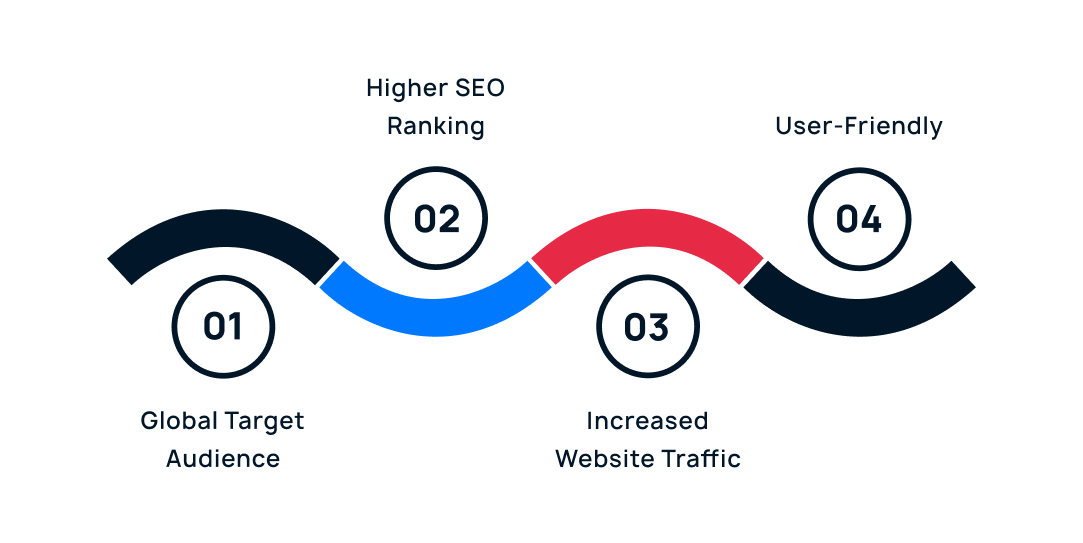
1. Global Target Audience
With a broader audience and multiple languages to communicate, a multilingual website can capture the attention of users globally.
2. Higher SEO Ranking
Search engines like Google prioritize translated versions of your website as part of one and drive traffic to the main website. Thus, it helps the SEO ranking effect and puts your website higher in search results.
3. Increased Website Traffic
As the main target is a global audience, it is necessary to optimize global multilingual SEO through multilingual websites. It is a platform that would attract more traffic as compared to a monolingual site.
4. User-friendly
When language hurdles are addressed, users may browse your website more effectively. With a smooth user experience, they may read your website in their native tongue, comprehend your services, and make an informed choice.
How Drupal Simplifies Multilingual SEO Efforts?
Drupal is a CMS that simplifies the creation of multilingual sites for the developers. It not only provides an open-source platform, but with its automated language translation, you will be able to reach a broader audience with Localization of your site content.
On top of that, Drupal’s latest offering with AI allows content editors to make, translate, and manage large amounts of content quickly. With AI, the translation is done with ease while ensuring seamless multilingual support for a website.
Related Article : Drupal SEO: Everything You Need to Know
Top Drupal Modules For Translation
There are four vital translation modules in Drupal 10 to help make multilingual websites.
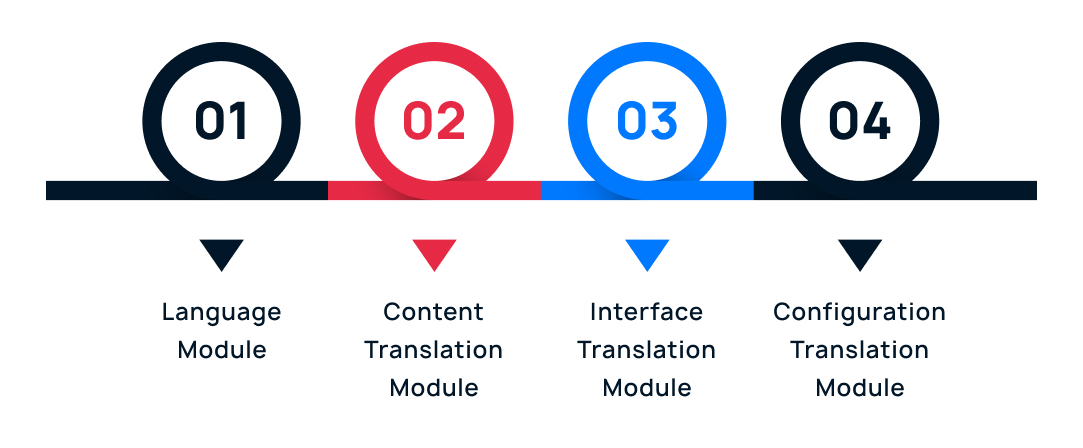
Language Module
It enables you to add and manage many languages on your Drupal website. Apart from that, it also allows the users to configure language options, assign languages to content, and select how languages are applied to different pages
Content Translation Module
With this, you will be able to translate the content entities such as custom blocks, comments, taxonomy terms, and users. All site content, including pages and blocks, can be localized into multiple languages with its help.
Interface translation Module
Together with any additional modules and themes, this module manages the translation of the Drupal core interface.
Configuration translation Module
It offers a translation tool for configurations and settings, letting you translate labels, site names, view names, and text used within views.
What Sets Multilingual SEO Apart from Regular SEO?
Let’s start with when we think about SEO, what comes to mind? Keywords! It’s a basic concept- use appropriate keywords and rank your content higher on search results. It is a regular SEO practice that focuses on targeting relevant keywords in a single language, leading your website to rank higher in the search results.
Conversely, multilingual SEO prioritizes language when optimizing your website’s content for several search engines. By translating your website’s content and user experience into many languages, multilingual SEO ups your SEO game.
Regular and multilingual SEO are two essential components you cannot overlook if you want to improve your website’s search engine results and increase traffic.
Translation vs. Localization: Key Differences for SEO Success
Based on the language of your target audience, language targeting targets ads or related content. Given the close relationship between localizing and translating your material, it could be challenging to distinguish between the two. For SEO, both of them are essential.
Translation and Localization are two different procedures, even though both entail modifying content to fit a specific language and cultural environment.
Translation
Translation involves converting content directly from the source language to the target language, reaching a wider audience. Translating your website’s pages means converting your current material into a different language while also modifying its tone and style according to the original language. The precise meaning of the original information is retained; translation merely changes the language of your content.
Localization
Localization helps in adapting your content to particular sets of audiences. Let us take an example for better understanding: there are different dialects within Mexico, Spain, and Argentina, where Spanish is the primary language. With the help of Localization, you can quickly adapt the content to the dialect as per different regions, making it accessible to each group of audience.
What Are Hreflang Tags?
To meet the perfect requirements, multilingual SEO needs tools and techniques. Hreflang tags are one such; let us understand why they matter and how you can implement them.
It is an HTML attribute meant to specify a specific language and geographical targeting of a site page. When a single main page is available in many languages, the hreflang tag aids Google in identifying these variants and providing users with the relevant version.
Importance Of Hreflang Tags
In a nutshell, hreflang tags enable search engines to provide relevant material to various user groups speaking various languages. This is why they are essential:
Enhances International SEO ranking
Optimizing your website’s content for several languages and geographical areas is known as international SEO. This improves your website’s exposure and traffic, which improves your performance in international search engine optimization.
Every page of your website should use hreflang tags to help develop regionally specialized content that will rank higher in search results for users who are looking for it.
The User Experience Gets Better
Using hreflang tags helps you cover a broader range of audiences, hence increasing the traffic to the website. For instance, Users can be sent to pages in their local languages from a business website catering to clients from across the world. The user experience is smooth as a result.
Your audience is more inclined to browse the remainder of your website and become potential buyers if they have a positive experience.
No Duplicate Content Problem
Most of the time, search engines get confused with duplicate content on the internet. With the help of the hreflang tag, you can easily avoid such issues. In case your website has the same content but in a different language, Hreflang tags inform search engines that, despite their similarities, the information is intended for two distinct audiences.
When used appropriately, hreflang tags aid in preventing duplicate content problems.
How To Use Hreflang Tags?
<head>

    <link rel="alternate" hreflang="en-us" href="https://www.yoursite.com/en-us/" />

    <link rel="alternate" hreflang="es-es" href="https://www.yoursite.com/es-es/" />

    <link rel="alternate" hreflang="x-default" href="https://www.yoursite.com/" />

</head>
Common Mistakes And How You Should Avoid It
Not focusing on local context
If you are prioritizing only translation without thinking about the local context, then the chances of your content being irrelevant are high. Hence, invest in localized content creation to offer engaging, valuable information that caters to the local audience’s requirements.
Misusing Hreflang Tags
Search engines can better determine which language version of your material to display in various locations with the use of hreflang tags. Ranking problems may arise if these tags are misapplied. To avoid giving users the incorrect language version, make sure your hreflang configuration is correct.
Overlooking Regional Competitors
Ignoring your regional competitors can also create some issues in your ranking. So, go through the competitors in each region to understand their strategies and find opportunities for improvement.
Using Automated Translations
Despite their allure, computer translations frequently overlook cultural quirks, which results in subpar user experiences. Delivering high-quality material that appeals to the local audience requires human translation and Localization.
Final Thoughts
LN Webworks is here to help you create multilingual websites that are optimized for SEO, making sure that your business reaches its global potential. Our team offers professional drupal development services Localization, and translation to help you effectively engage with a diverse audience worldwide.
Want to take your business global? Get in touch with us today, and let’s build your multilingual SEO strategy.
Author